Question: How would you summarize the given case? TIA! Case Application 11-B TOO MUCH INFORMATION FOR GOOGLE? discussing salaries. These are not uncommon, although When a
How would you summarize the given case? TIA!
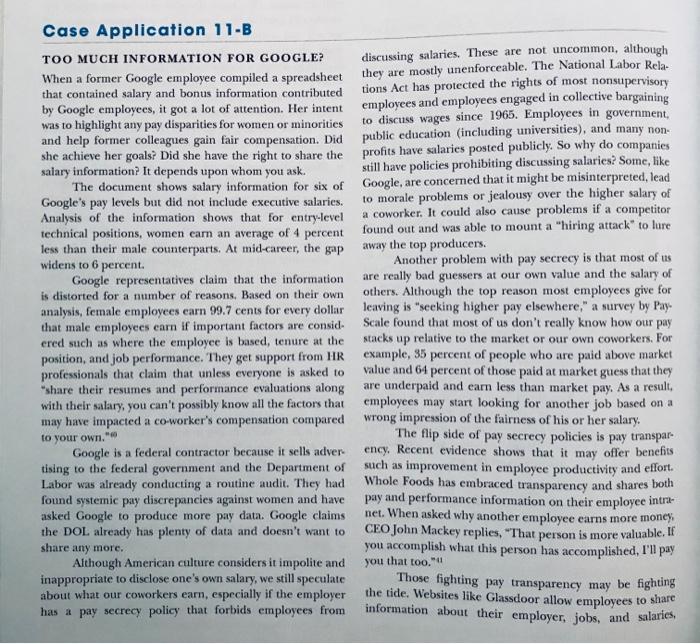
Case Application 11-B TOO MUCH INFORMATION FOR GOOGLE? discussing salaries. These are not uncommon, although When a former Google employee compiled a spreadsheet they are mostly unenforceable. The National Labor Rela that contained salary and bonus information contributed tions Act has protected the rights of most nonsupervisory by Google employees, it got a lot of attention. Her intent employees and employees engaged in collective bargaining was to highlight any pay disparities for women or minorities to discuss wages since 1965. Employees in government, and help former colleagues gain fair compensation. Did public education (including universities), and many non- she achieve her goals? Did she have the right to share the profits have salaries posted publicly. So why do companies salary information? It depends upon whom you ask. still have policies prohibiting discussing salaries? Some, like The document shows salary information for six of Google, are concerned that it might be misinterpreted, lead Google's pay levels but did not include executive salaries. to morale problems or jealousy over the higher salary of Analysis of the information shows that for entry-level a coworker. It could also cause problems if a competitor technical positions, women carn an average of 4 percent found out and was able to mount a "hiring attack" to lure less than their male counterparts. At mid-career, the gap away the top producers. widens to 6 percent. Another problem with pay secrecy is that most of us Google representatives claim that the information are really bad guessers at our own value and the salary of is distorted for a number of reasons. Based on their own others. Although the top reason most employees give for analysis, female employees earn 99.7 cents for every dollar leaving is seeking higher pay elsewhere," a survey by Pay- that male employees carn if important factors are consid Scale found that most of us don't really know how our pay ered such as where the employee is based, tenure at the stacks up relative to the market or our own coworkers. For position, and job performance. They get support from HR example, 35 percent of people who are paid above market professionals that claim that unless everyone is asked to value and 64 percent of those paid at market guess that they "share their resumes and performance evaluations along are underpaid and earn less than market pay. As a result, with their salary, you can't possibly know all the factors that employees may start looking for another job based on a may have impacted a co-worker's compensation compared wrong impression of the fairness of his or her salary. to your own The flip side of pay secrecy policies is pay transpar Google is a federal contractor because it sells adver ency. Recent evidence shows that it may offer benefits tising to the federal government and the Department of such as improvement in employee productivity and effort. Labor was already conducting a routine audit. They had Whole Foods has embraced transparency and shares both found systemic pay discrepancies against women and have pay and performance information on their employee intra- asked Google to produce more pay data. Google claims net. When asked why another employee earns more money, the DOL already has plenty of data and doesn't want to CEO John Mackey replies, "That person is more valuable. If share any more. you accomplish what this person has accomplished, I'll pay Although American culture considers it impolite and you that too." inappropriate to disclose one's own salary, we still speculate Those fighting pay transparency may be fighting about what our coworkers earn, especially if the employer the tide. Websites like Glassdoor allow employees to share has a pay secrecy policy that forbids employees from information about their employer, jobs, and salaries anonymously skirting the pay secrecy policies for coworkers and job seekers.12










 Study Help