







Question: https://en.wikipedia.org/wiki/Helmholtz_equation https://en.wikipedia.org/wiki/Lorenz_gauge_condition https://en.wikipedia.org/wiki/Stokes%27_theorem https://en.wikipedia.org/wiki/Solenoidal_vector_field For the next problems, consider the vector field F = 2y 2(a + 2) 2y (ac2 + 32 + 2 2)
https://en.wikipedia.org/wiki/Helmholtz_equation
https://en.wikipedia.org/wiki/Lorenz_gauge_condition
https://en.wikipedia.org/wiki/Stokes%27_theorem
https://en.wikipedia.org/wiki/Solenoidal_vector_field
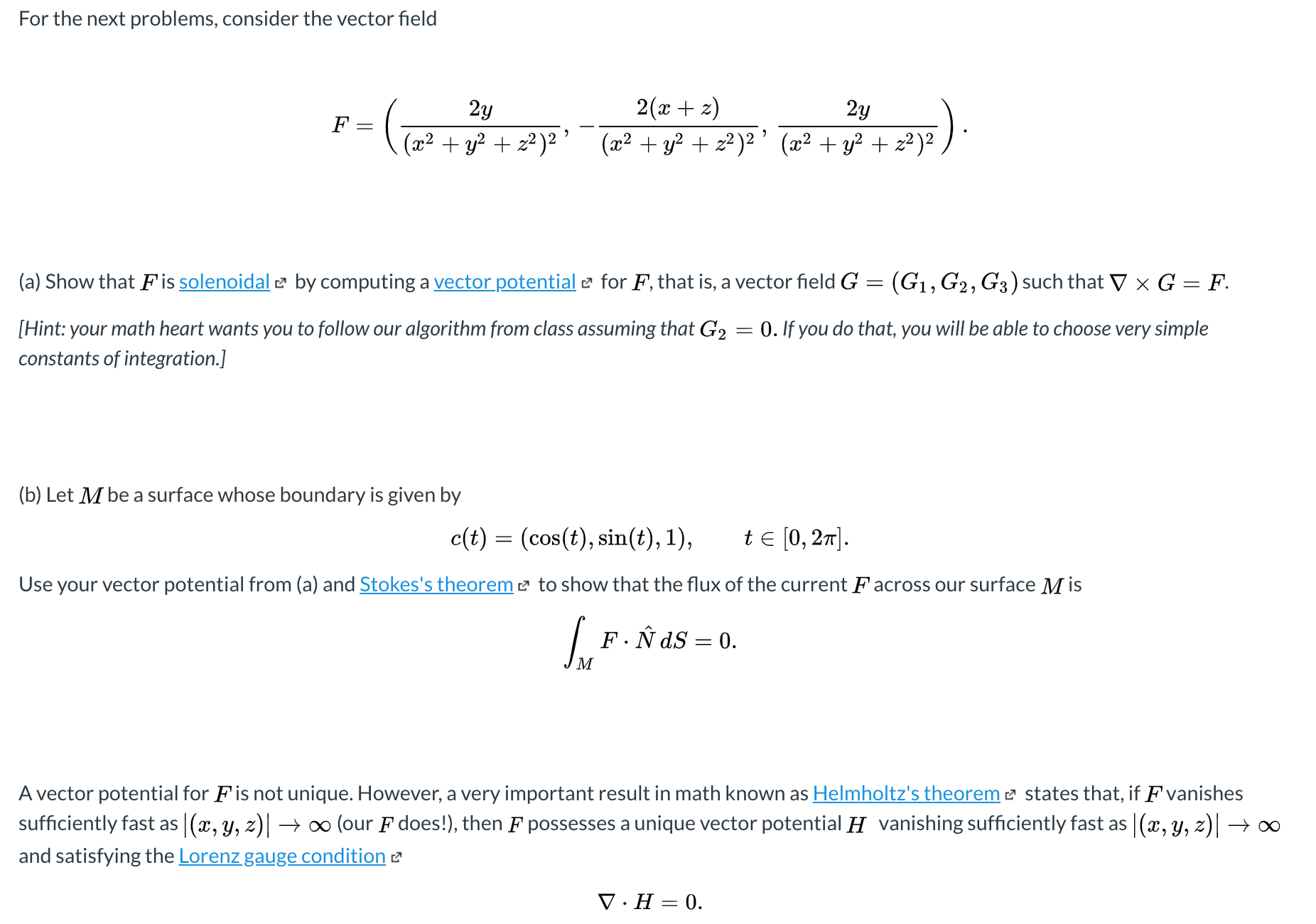
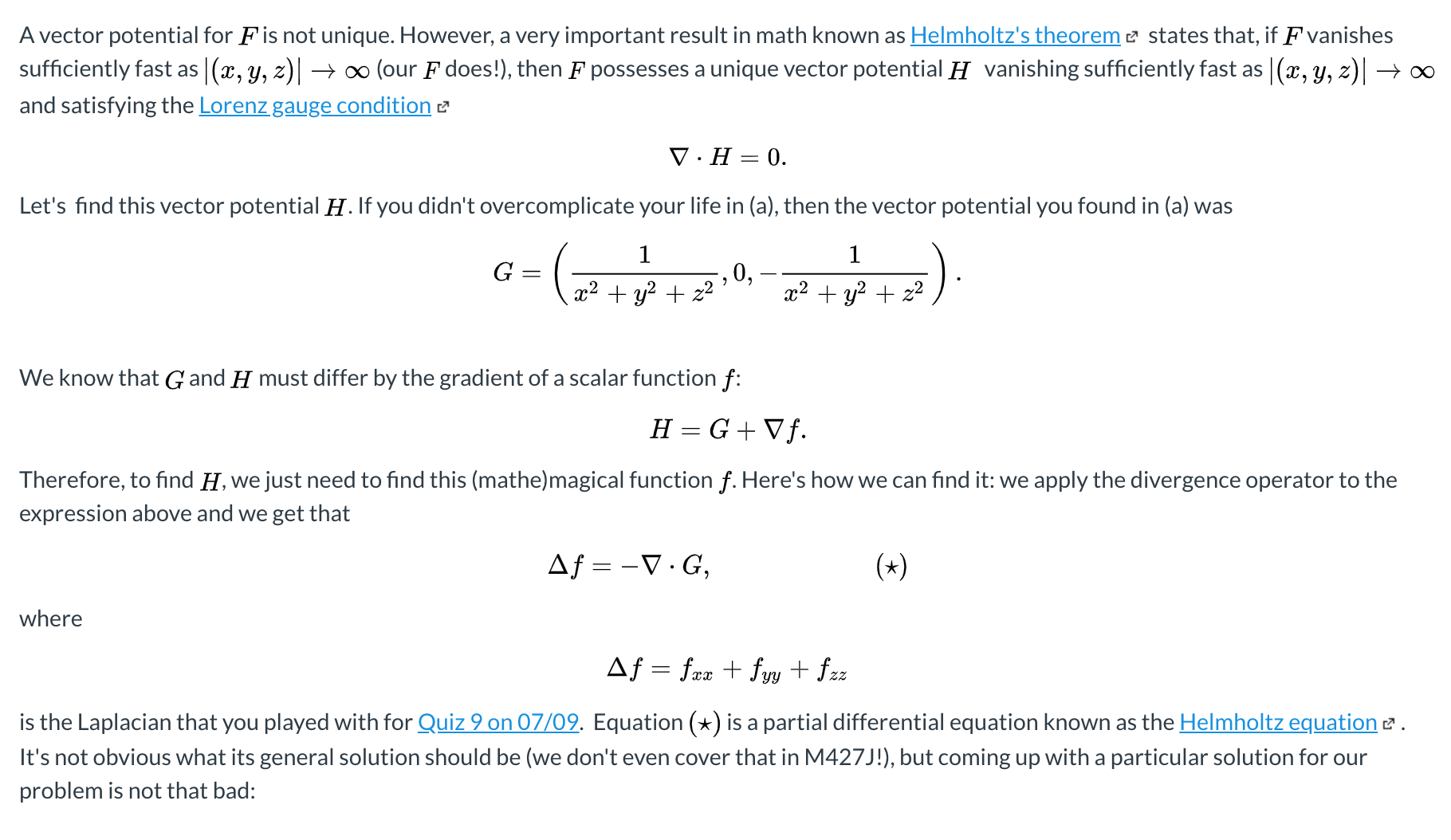
For the next problems, consider the vector field F = 2y 2(a + 2) 2y (ac2 + 32 + 2 2) 2 ' (202 + 32 + 2 2)2' (202 + 32 + 2 2 ) 2 (a) Show that F is solenoidal z by computing a vector potential & for F, that is, a vector field G = (G1, G2, G3 ) such that V x G = F. [Hint: your math heart wants you to follow our algorithm from class assuming that G2 = 0. If you do that, you will be able to choose very simple constants of integration.] (b) Let M be a surface whose boundary is given by c(t) = (cos(t), sin(t), 1), te [0, 27]. Use your vector potential from (a) and Stokes's theorem & to show that the flux of the current F across our surface M is F. NaS = 0. A vector potential for F is not unique. However, a very important result in math known as Helmholtz's theorem & states that, if Fvanishes sufficiently fast as | (a, y, z) | - co (our F does!), then F possesses a unique vector potential H vanishing sufficiently fast as | (x, y, z) | - co and satisfying the Lorenz gauge condition V . H = 0.A vector potential for F is not unique. However, a very important result in math known as Helmholtz's theorem & states that, if Fvanishes sufficiently fast as | (x, y, z) | - co (our F does!), then F possesses a unique vector potential H vanishing sufficiently fast as | (x, y, z) | - co and satisfying the Lorenz gauge condition V . H = 0. Let's find this vector potential H. If you didn't overcomplicate your life in (a), then the vector potential you found in (a) was G = 1 x2 + 92+ 22 ' 0, 1 202 + 92 + 22 We know that G and H must differ by the gradient of a scalar function f: H = G+Vf. Therefore, to find H, we just need to find this (mathe)magical function f. Here's how we can find it: we apply the divergence operator to the expression above and we get that Af = -V .G, ( * ) where Af = fxx + fyy + fzz is the Laplacian that you played with for Quiz 9 on 07/09. Equation () is a partial differential equation known as the Helmholtz equation . It's not obvious what its general solution should be (we don't even cover that in M427J!), but coming up with a particular solution for our problem is not that bad
Step by Step Solution
There are 3 Steps involved in it

Get step-by-step solutions from verified subject matter experts
 Study Help