







Question: https://phet.colorado.edu/sims/html/bending-light/latest/bending-light_en.html Part A: Refraction 1. Navigate to https://phet.colorado.edu/sims/html/bending-light/latest/bending-light_en.html. Select Intro. Play with the simulation a bit to get a feel of the controls. 2. Set
https://phet.colorado.edu/sims/html/bending-light/latest/bending-light_en.html
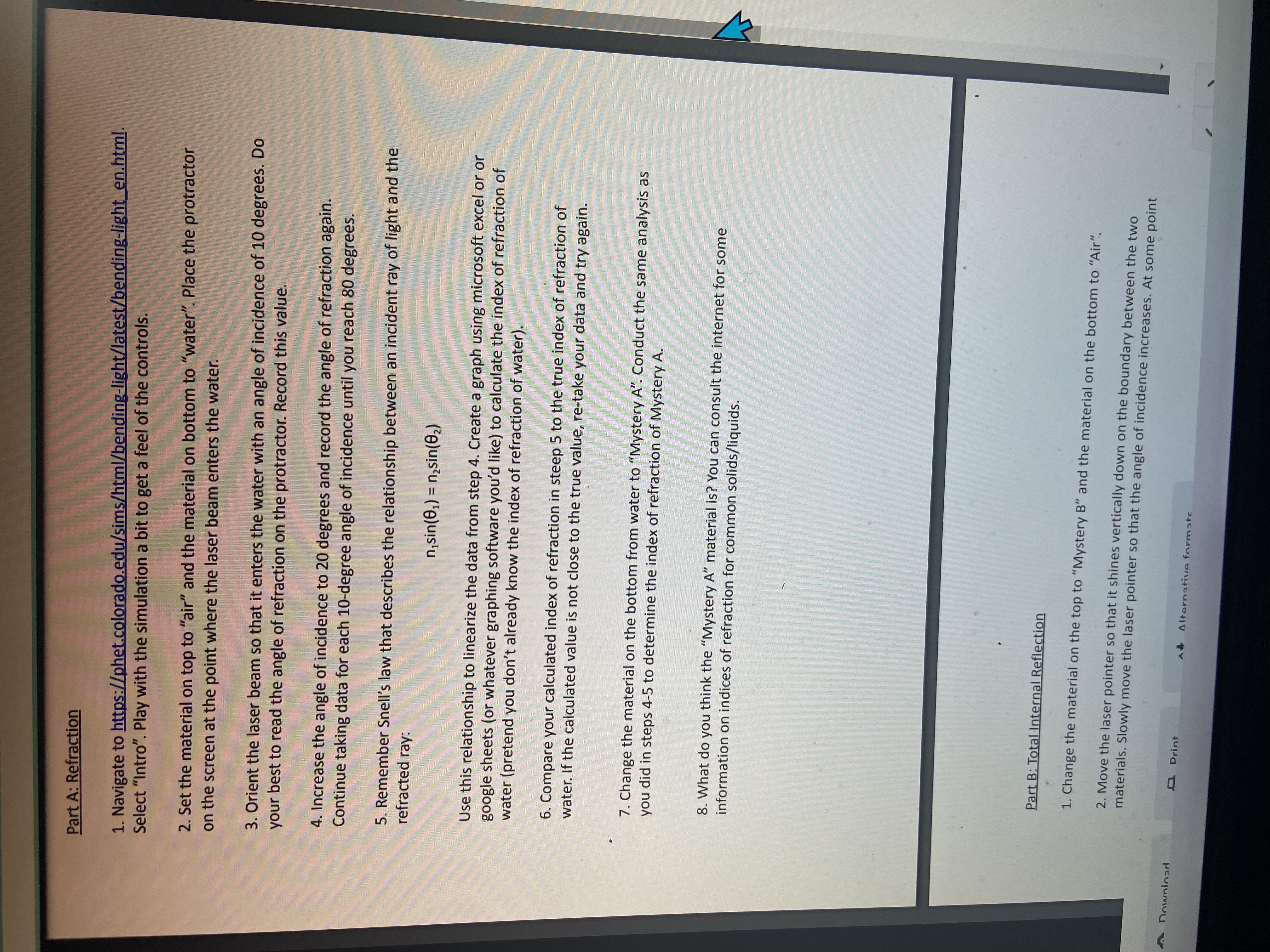
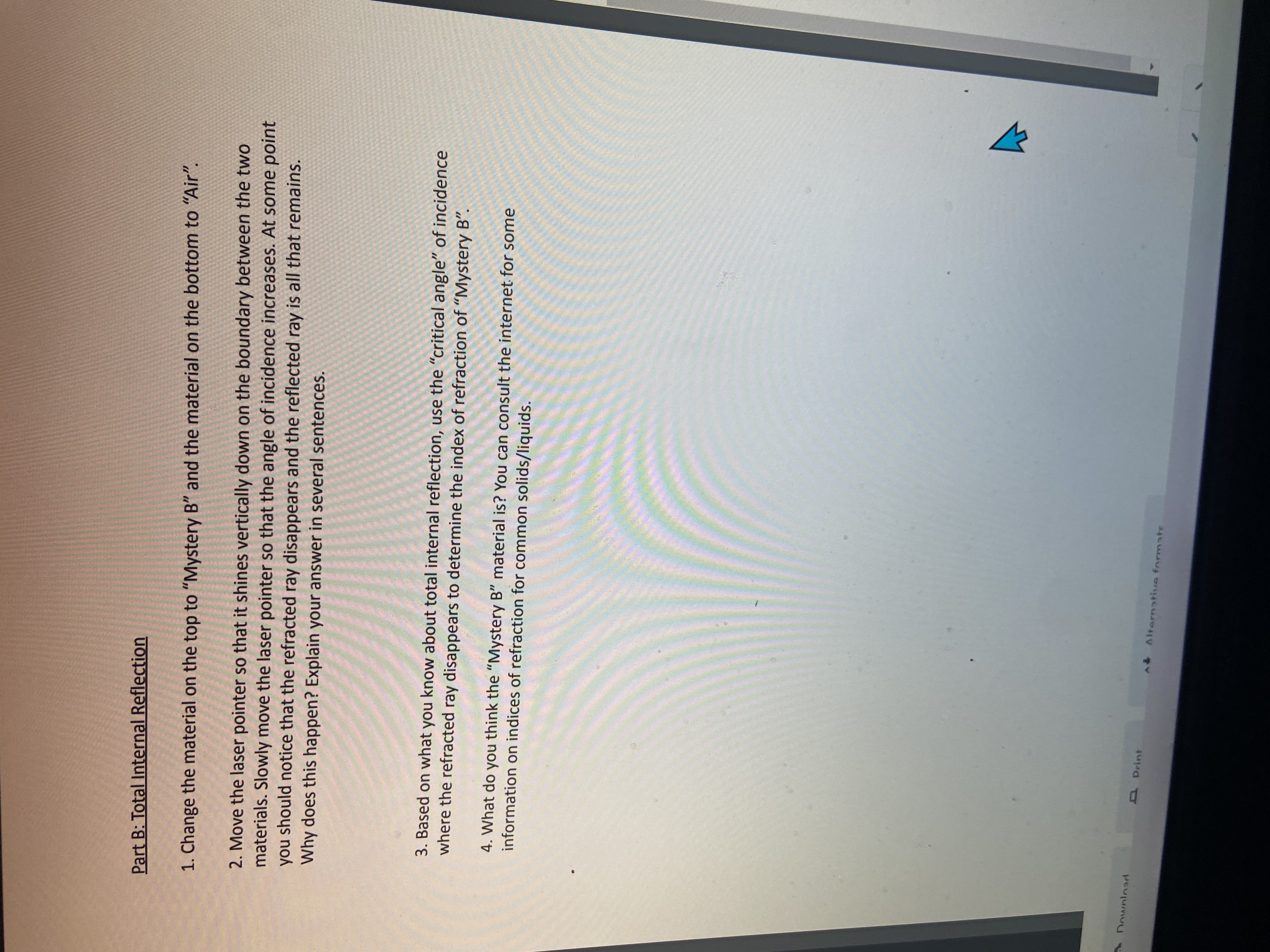
Part A: Refraction 1. Navigate to https://phet.colorado.edu/sims/html/bending-light/latest/bending-light_en.html. Select "Intro". Play with the simulation a bit to get a feel of the controls. 2. Set the material on top to "air" and the material on bottom to "water". Place the protractor on the screen at the point where the laser beam enters the water. 3. Orient the laser beam so that it enters the water with an angle of incidence of 10 degrees. Do your best to read the angle of refraction on the protractor. Record this value. 4. Increase the angle of incidence to 20 degrees and record the angle of refraction again. Continue taking data for each 10-degree angle of incidence until you reach 80 degrees. 5. Remember Snell's law that describes the relationship between an incident ray of light and the refracted ray: n,sin(0,) = n2sin(02) Use this relationship to linearize the data from step 4. Create a graph using microsoft excel or or google sheets (or whatever graphing software you'd like) to calculate the index of refraction of water (pretend you don't already know the index of refraction of water) 6. Compare your calculated index of refraction in steep 5 to the true index of refraction of water. If the calculated value is not close to the true value, re-take your data and try again. 7. Change the material on the bottom from water to "Mystery A". Conduct the same analysis as you did in steps 4-5 to determine the index of refraction of Mystery A. 8. What do you think the "Mystery A" material is? You can consult the internet for some information on indices of refraction for common solids/liquids. Part B: Total Internal Reflection 1. Change the material on the top to "Mystery B" and the material on the bottom to "Air". 2. Move the laser pointer so that it shines vertically down on the boundary between the two materials. Slowly move the laser pointer so that the angle of incidence increases. At some point nowninad A Print A Alternative formatePart B: Total Internal Reflection 1. Change the material on the top to "Mystery B" and the material on the bottom to "Air". 2. Move the laser pointer so that it shines vertically down on the boundary between the two materials. Slowly move the laser pointer so that the angle of incidence increases. At some point you should notice that the refracted ray disappears and the reflected ray is all that remains. Why does this happen? Explain your answer in several sentences. 3. Based on what you know about total internal reflection, use the "critical angle" of incidence where the refracted ray disappears to determine the index of refraction of "Mystery B". 4. What do you think the "Mystery B" material is? You can consult the internet for some information on indices of refraction for common solids/liquids. Download at Alternative formats
Step by Step Solution
There are 3 Steps involved in it

Get step-by-step solutions from verified subject matter experts
 Study Help