







Question: https://www.jstor.org/stable/j.ctv7h0rwr Maybe this book's chapter 2 can help this problem [nonlinear pricing]: Suppose the principal is the seller of a good and the agent is
https://www.jstor.org/stable/j.ctv7h0rwr Maybe this book's chapter 2 can help this problem
![pricing]: Suppose the principal is the seller of a good and the](https://s3.amazonaws.com/si.experts.images/answers/2024/06/6674ee4cc86fc_2126674ee4ca6f1e.jpg)
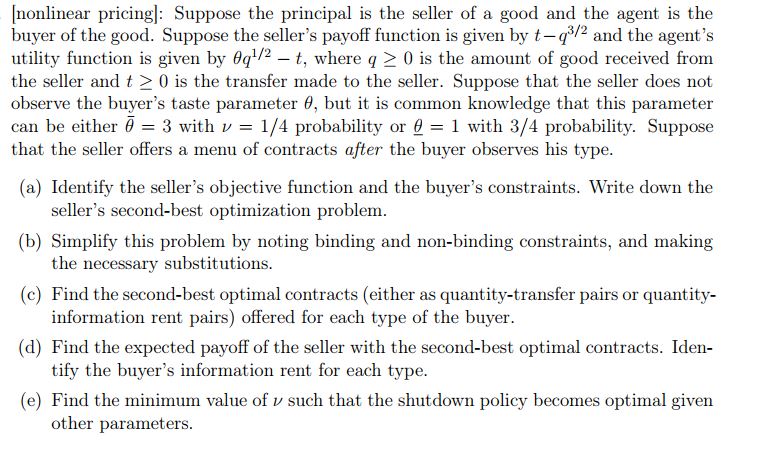
[nonlinear pricing]: Suppose the principal is the seller of a good and the agent is the buyer of the good. Suppose the seller's payo function is given by tqW2 and the agent's utility function is given by 69-1" 2 t, where q 2 (l is the amount of good received from the seller and t 2 {l is the transfer made to the seller. Suppose that the seller does not observe the buyer's taste parameter B, but it is common knowledge that this parameter can be either F = 3 with tr = 1f4 probability or Q = 1 with 3M probability. Suppose that the seller offers a menu of contracts after the buyer observes his type. (a) Identify the seller's objective function and the buyer's constraints. Write down the seller's second-best optimization problem. (b) Simplify this problem by noting binding and non-binding constraints, and making the necessary substitutions. (c) Find the second-best optimal contracts {either as quantity-transfer pails or quantity- information rent pairs) offered for each type of the buyer. (d) Find the expected payoff of the seller with the second-best optimal contracts. Iden- tify the buyer's information rent for each type. (e) Find the minimum value of 1: such that the shutdown poh'Cy becomes optimal given other parameters
Step by Step Solution
There are 3 Steps involved in it

Get step-by-step solutions from verified subject matter experts
 Study Help