





Question: https://www.ted.com/talks/laurie_santos_a_monkey_economy_as_irrational_as_ours?language=en(Links to an external site.) Initial post is due Friday, and two replies to the posts of others is due Sunday. The initial post should

https://www.ted.com/talks/laurie_santos_a_monkey_economy_as_irrational_as_ours?language=en(Links to an external site.)
https://www.ted.com/talks/laurie_santos_a_monkey_e
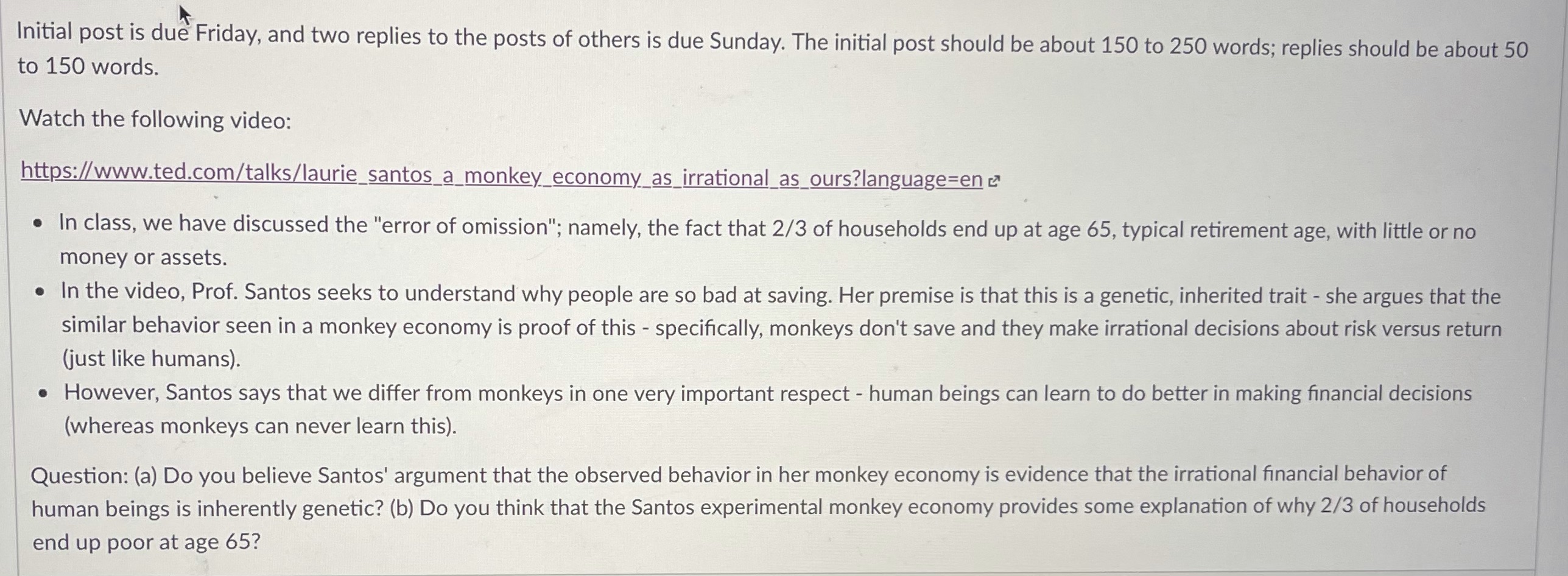
Initial post is due Friday, and two replies to the posts of others is due Sunday. The initial post should be about 150 to 250 words; replies should be about 50 to 150 words. Watch the following video: https://www.ted.com/talks/laurie_santos_a_monkey_economy_as_irrational_as_ours? language=enc . In class, we have discussed the "error of omission"; namely, the fact that 2/3 of households end up at age 65, typical retirement age, with little or no money or assets. . In the video, Prof. Santos seeks to understand why people are so bad at saving. Her premise is that this is a genetic, inherited trait - she argues that the similar behavior seen in a monkey economy is proof of this - specifically, monkeys don't save and they make irrational decisions about risk versus return (just like humans). . However, Santos says that we differ from monkeys in one very important respect - human beings can learn to do better in making financial decisions (whereas monkeys can never learn this). Question: (a) Do you believe Santos' argument that the observed behavior in her monkey economy is evidence that the irrational financial behavior of human beings is inherently genetic? (b) Do you think that the Santos experimental monkey economy provides some explanation of why 2/3 of households end up poor at age 65

Step by Step Solution

There are 3 Steps involved in it

1 Expert Approved Answer
Step: 1 Unlock blur-text-image

Question Has Been Solved by an Expert!

Get step-by-step solutions from verified subject matter experts

Step: 2 Unlock
Step: 3 Unlock

Students Have Also Explored These Related Finance Questions!