







Question: httpszfrappletskcvs.carphotoelectricEechhotoElectric. html At the bottom. set photon density to ill and voltage to I] Click options metals magnesium. 1} [6} There is a minimum required
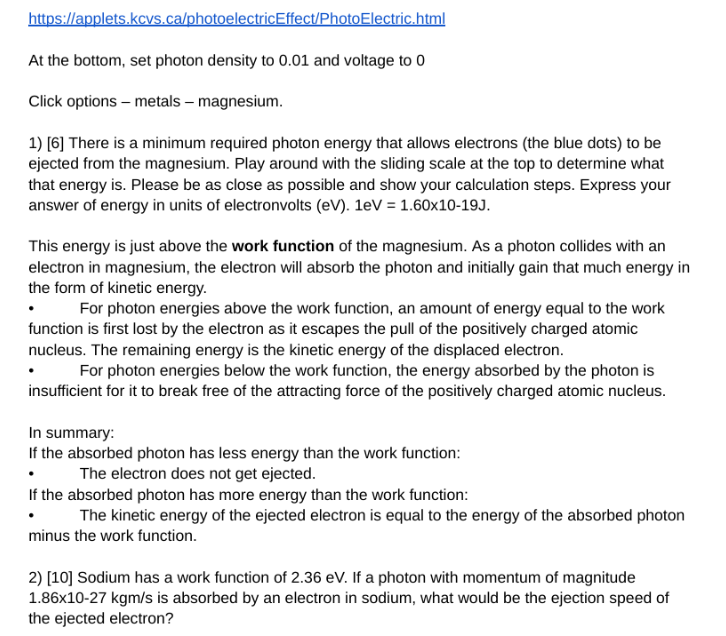
httpszfrappletskcvs.carphotoelectricEechhotoElectric. html At the bottom. set photon density to ill and voltage to I] Click options metals magnesium. 1} [6} There is a minimum required photon energy that allows electrons (the blue dots] to be ejected from the magnesium. Play around with the sliding scale at the top to determine what that energy is. Please be as close as possible and show your calculation steps. Express your answer of energy in units of electronvolts fey). 1e'vr = lxlu-IQJ. This energy is just above the wont function of the magnesium. As a photon collides with an electron in magnesium. the electron will absorb the photon and initially gain that much energy in the form of kinetic energy. . For photon energies above the work function. an amount of energy equal to the work function is rst lost by the electron as it escapes the pull of the positively charged atomic nucleus. The remaining energy is the kinetic energy of the displaced electron. . For photon energies below the work function. the energy absorbed by the photon is insufcient for it to break free of the attracting force of the positively charged atomic nucleus. In summary: If the absorbed photon has less energy than the work function: . The electron does not get ejected. If the absorbed photon has more energy than the work function: - The kinetic energy of the ejected electron is equal to the energy of the absorbed photon minus the work function. 2} [1D] Sodium has a work function of 2.35 ev. if a photon with momentum of magnitude Latino-2? kgmfs is absorbed by an electron in sodium, what would he the ejection speed of the ejected electron
Step by Step Solution
There are 3 Steps involved in it

Get step-by-step solutions from verified subject matter experts
 Study Help