







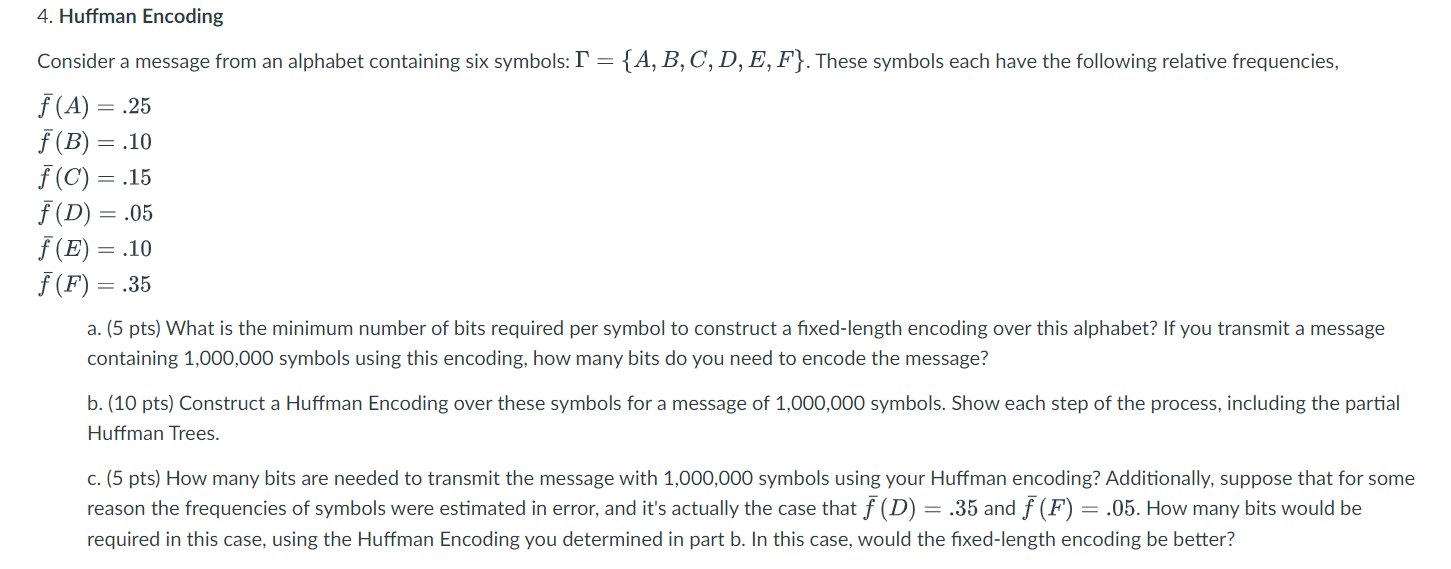
Question: Huffman Encoding Consider a message from an alphabet containing six symbols: = { A , B , C , D , E , F }
Huffman Encoding
Consider a message from an alphabet containing six symbols: These symbols each have the following relative frequencies,
a pts What is the minimum number of bits required per symbol to construct a fixedlength encoding over this alphabet? If you transmit a message
containing symbols using this encoding, how many bits do you need to encode the message?
b pts Construct a Huffman Encoding over these symbols for a message of symbols. Show each step of the process, including the partial
Huffman Trees.
c pts How many bits are needed to transmit the message with symbols using your Huffman encoding? Additionally, suppose that for some
reason the frequencies of symbols were estimated in error, and it's actually the case that and How many bits would be
required in this case, using the Huffman Encoding you determined in part b In this case, would the fixedlength encoding be better?
Step by Step Solution
There are 3 Steps involved in it
1 Expert Approved Answer
Step: 1 Unlock

Question Has Been Solved by an Expert!
Get step-by-step solutions from verified subject matter experts
Step: 2 Unlock
Step: 3 Unlock
 Study Help