Question: HUMA 14 - Week 8 - Assignment 1. Read Week 8 Class Slides. There are two Chapters we are covering for this week - Chapter
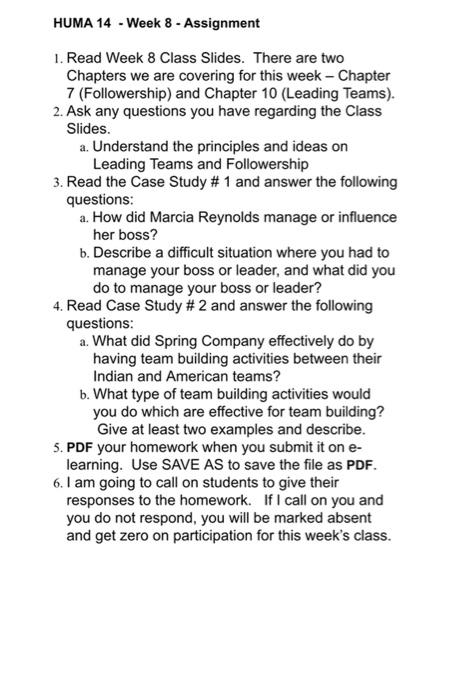
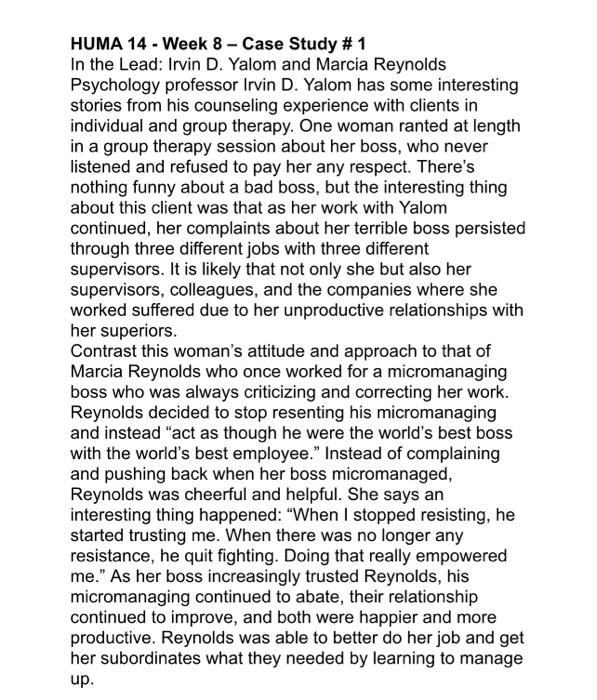
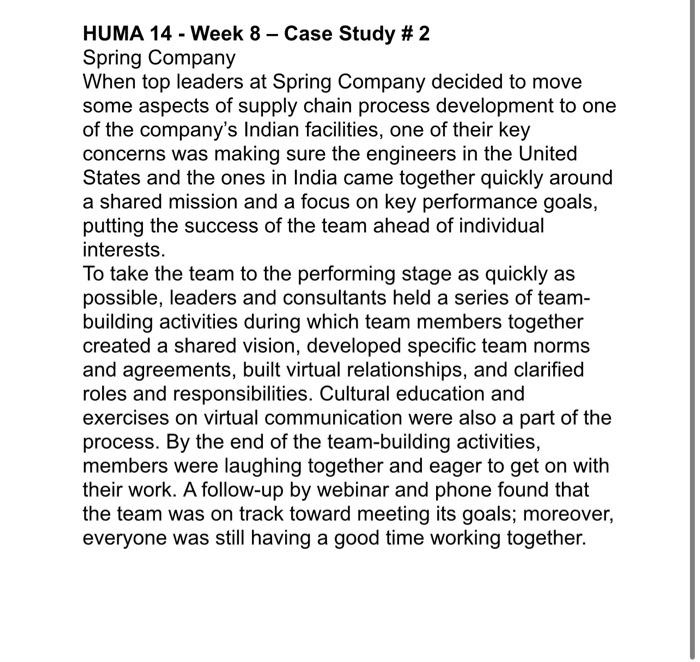
HUMA 14 - Week 8 - Assignment 1. Read Week 8 Class Slides. There are two Chapters we are covering for this week - Chapter 7 (Followership) and Chapter 10 (Leading Teams). 2. Ask any questions you have regarding the Class Slides. a. Understand the principles and ideas on Leading Teams and Followership 3. Read the Case Study # 1 and answer the following questions: a. How did Marcia Reynolds manage or influence her boss? b. Describe a difficult situation where you had to manage your boss or leader, and what did you do to manage your boss or leader? 4. Read Case Study # 2 and answer the following questions: a. What did Spring Company effectively do by having team building activities between their Indian and American teams? b. What type of team building activities would you do which are effective for team building? Give at least two examples and describe. 5. PDF your homework when you submit it on e- learning. Use SAVE AS to save the file as PDF. 6. I am going to call on students to give their responses to the homework. If I call on you and you do not respond, you will be marked absent and get zero on participation for this week's class. HUMA 14 - Week 8 - Case Study # 1 In the Lead: Irvin D. Yalom and Marcia Reynolds Psychology professor Irvin D. Yalom has some interesting stories from his counseling experience with clients in individual and group therapy. One woman ranted at length in a group therapy session about her boss, who never listened and refused to pay her any respect. There's nothing funny about a bad boss, but the interesting thing about this client was that as her work with Yalom continued, her complaints about her terrible boss persisted through three different jobs with three different supervisors. It is likely that not only she but also her supervisors, colleagues, and the companies where she worked suffered due to her unproductive relationships with her superiors. Contrast this woman's attitude and approach to that of Marcia Reynolds who once worked for a micromanaging boss who was always criticizing and correcting her work. Reynolds decided to stop resenting his micromanaging and instead "act as though he were the world's best boss with the world's best employee." Instead of complaining and pushing back when her boss micromanaged, Reynolds was cheerful and helpful. She says an interesting thing happened: "When I stopped resisting, he started trusting me. When there was no longer any resistance, he quit fighting. Doing that really empowered me." As her boss increasingly trusted Reynolds, his micromanaging continued to abate, their relationship continued to improve, and both were happier and more productive. Reynolds was able to better do her job and get her subordinates what they needed by learning to manage up. HUMA 14 - Week 8 - Case Study #2 Spring Company When top leaders at Spring Company decided to move some aspects of supply chain process development to one of the company's Indian facilities, one of their key concerns was making sure the engineers in the United States and the ones in India came together quickly around a shared mission and a focus on key performance goals, putting the success of the team ahead of individual interests. To take the team to the performing stage as quickly as possible, leaders and consultants held a series of team- building activities during which team members together created a shared vision, developed specific team norms and agreements, built virtual relationships, and clarified roles and responsibilities. Cultural education and exercises on virtual communication were also a part of the process. By the end of the team-building activities, members were laughing together and eager to get on with their work. A follow-up by webinar and phone found that the team was on track toward meeting its goals; moreover, everyone was still having a good time working together









 Study Help