



Question: human resources management A Compensation Strategy Must be Dynamic to a Crisis such as COVID-19, Experts Say The coronavirus pandemic has upended scores of traditional
human resources management 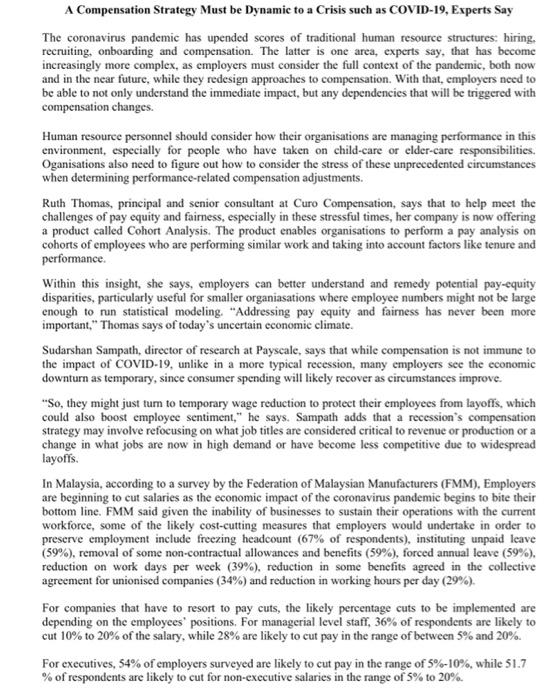
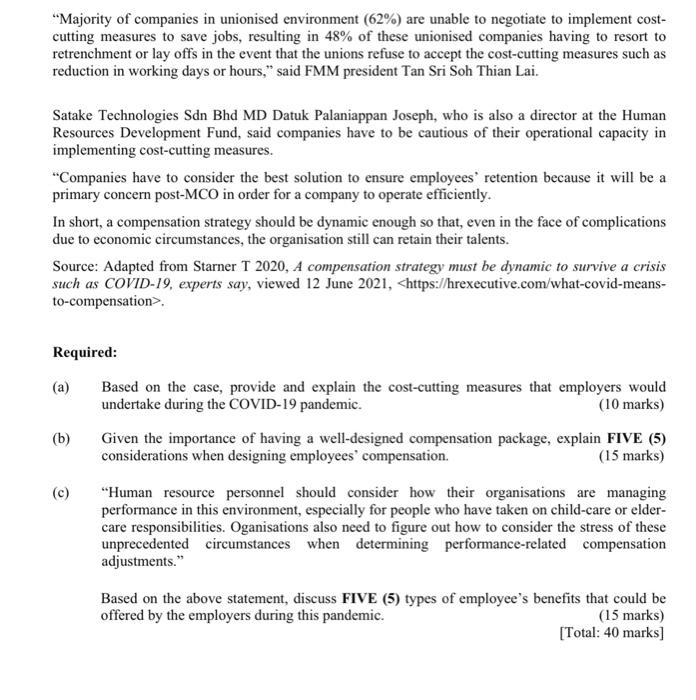
A Compensation Strategy Must be Dynamic to a Crisis such as COVID-19, Experts Say The coronavirus pandemic has upended scores of traditional human resource structures: hiring, recruiting, onboarding and compensation. The latter is one area, experts say, that has become increasingly more complex, as employers must consider the full context of the pandemic, both now and in the near future, while they redesign approaches to compensation. With that, employers need to be able to not only understand the immediate impact, but any dependencies that will be triggered with compensation changes. Human resource personnel should consider how their organisations are managing performance in this environment, especially for people who have taken on child-care or elder-care responsibilities. Oganisations also need to figure out how to consider the stress of these unprecedented circumstances when determining performance-related compensation adjustments. Ruth Thomas, principal and senior consultant at Curo Compensation, says that to help meet the challenges of pay equity and fairness, especially in these stressful times, her company is now offering a product called Cohort Analysis. The product enables organisations to perform a pay analysis on cohorts of employees who are performing similar work and taking into account factors like tenure and performance Within this insight, she says, employers can better understand and remedy potential pay-equity disparities, particularly useful for smaller organiasations where employee numbers might not be large enough to run statistical modeling. "Addressing pay equity and fairness has never been more important," Thomas says of today's uncertain economic climate. Sudarshan Sampath, director of research at Payscale, says that while compensation is not immune to the impact of COVID-19, unlike in a more typical recession, many employers see the economic downturn as temporary, since consumer spending will likely recover as circumstances improve. So, they might just tum to temporary wage reduction to protect their employees from layoffs, which could also boost employee sentiment," he says. Sampath adds that a recession's compensation strategy may involve refocusing on what job titles are considered critical to revenue or production or a change in what jobs are now in high demand or have become less competitive due to widespread layoffs. In Malaysia, according to a survey by the Federation of Malaysian Manufacturers (FMM), Employers are beginning to cut salaries as the economic impact of the coronavirus pandemie begins to bite their bottom line. FMM said given the inability of businesses to sustain their operations with the current workforce, some of the likely cost-cutting measures that employers would undertake in order to preserve employment include freezing headcount (67% of respondents), instituting unpaid leave (59%), removal of some non-contractual allowances and benefits (59%), forced annual leave (59%), reduction on work days per week (39%) reduction in some benefits agreed in the collective agreement for unionised companies (34%) and reduction in working hours per day (29%). For companies that have to resort to pay cuts, the likely percentage cuts to be implemented are depending on the employees' positions, For managerial level staff, 36% of respondents are likely to cut 10% to 20% of the salary, while 28% are likely to cut pay in the range of between 5% and 20% For executives, 54% of employers surveyed are likely to cut pay in the range of 5%-10%, while 51.7 % of respondents are likely to cut for non-executive salaries in the range of 5% to 20%. Majority of companies in unionised environment (62%) are unable to negotiate to implement cost- cutting measures to save jobs, resulting in 48% of these unionised companies having to resort to retrenchment or lay offs in the event that the unions refuse to accept the cost-cutting measures such as reduction in working days or hours," said FMM president Tan Sri Soh Thian Lai. Satake Technologies Sdn Bhd MD Datuk Palaniappan Joseph, who is also a director at the Human Resources Development Fund, said companies have to be cautious of their operational capacity in implementing cost-cutting measures. "Companies have to consider the best solution to ensure employees' retention because it will be a primary concern post-MCO in order for a company to operate efficiently. In short, a compensation strategy should be dynamic enough so that, even in the face of complications due to economic circumstances, the organisation still can retain their talents. Source: Adapted from Starner T 2020, A compensation strategy must be dynamic to survive a crisis such as COVID-19, experts say, viewed 12 June 2021, Step by Step Solution
There are 3 Steps involved in it
1 Expert Approved Answer
Step: 1 Unlock

Question Has Been Solved by an Expert!
Get step-by-step solutions from verified subject matter experts
Step: 2 Unlock
Step: 3 Unlock