







Question: HW HELP: please answer the following question, make sure all parts are answered. it doesnt have to be a google slide, it can be done
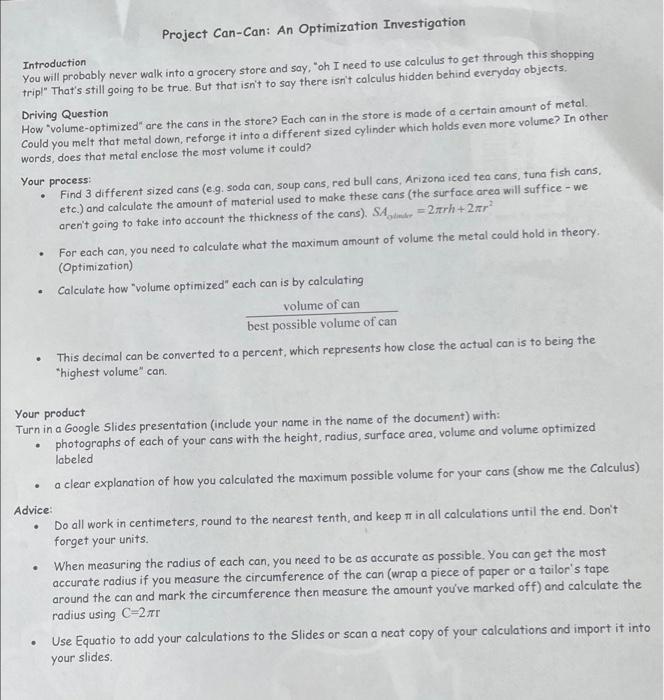
Project Can-Can: An Optimization Investigation You will probably never walk into a grocery store and say, "oh I need to use calculus to get through this shopping Introduction tripl" That's still going to be true. But that isn't to say there isn't colculus hidden behind everyday objects. How "volume-optimized" are the cans in the store? Each can in the store is made of a certain amount of metal. Driving Question Could you melt that metal down, reforge it into a different sized cylinder which holds even more volume? In other words, does that metal enclose the most volume it could? - Find 3 different sized cans (e.g. soda can, soup cans, red bull cans, Arizona iced tea cans, tuna fish cans. Your process: etc.) and calculate the amount of material used to make these cans (the surface area will suffice-we aren't going to take into account the thickness of the cans). SAolin+r=2rh+2r2 - For each can, you need to calculate what the maximum amount of volume the metal could hold in theory: (Optimization) - Calculate how "volume optimized" each can is by calculating bestpossiblevolumeofcanvolumeofcan - This decimal can be converted to a percent, which represents how close the actual can is to being the "highest volume" can. Your product Turn in a Google Slides presentation (include your name in the name of the document) with: - photographs of each of your cans with the height, radius, surface area, volume and volume optimized labeled - a clear explanation of how you calculated the maximum possible volume for your cans (show me the Calculus) - Do all work in centimeters, round to the nearest tenth, and keep in all colculations until the end. Don't Advice: forget your units. - When measuring the radius of each can, you need to be as accurate as possible. You can get the most accurate radius if you measure the circumference of the can (wrap a piece of paper or a tailor's tape around the can and mark the circumference then measure the amount you've marked off) and calculate the radius using C=2r - Use Equatio to add your calculations to the Slides or scan a neat copy of your calculations and import it int your slides. Project Can-Can: An Optimization Investigation You will probably never walk into a grocery store and say, "oh I need to use calculus to get through this shopping Introduction tripl" That's still going to be true. But that isn't to say there isn't colculus hidden behind everyday objects. How "volume-optimized" are the cans in the store? Each can in the store is made of a certain amount of metal. Driving Question Could you melt that metal down, reforge it into a different sized cylinder which holds even more volume? In other words, does that metal enclose the most volume it could? - Find 3 different sized cans (e.g. soda can, soup cans, red bull cans, Arizona iced tea cans, tuna fish cans. Your process: etc.) and calculate the amount of material used to make these cans (the surface area will suffice-we aren't going to take into account the thickness of the cans). SAolin+r=2rh+2r2 - For each can, you need to calculate what the maximum amount of volume the metal could hold in theory: (Optimization) - Calculate how "volume optimized" each can is by calculating bestpossiblevolumeofcanvolumeofcan - This decimal can be converted to a percent, which represents how close the actual can is to being the "highest volume" can. Your product Turn in a Google Slides presentation (include your name in the name of the document) with: - photographs of each of your cans with the height, radius, surface area, volume and volume optimized labeled - a clear explanation of how you calculated the maximum possible volume for your cans (show me the Calculus) - Do all work in centimeters, round to the nearest tenth, and keep in all colculations until the end. Don't Advice: forget your units. - When measuring the radius of each can, you need to be as accurate as possible. You can get the most accurate radius if you measure the circumference of the can (wrap a piece of paper or a tailor's tape around the can and mark the circumference then measure the amount you've marked off) and calculate the radius using C=2r - Use Equatio to add your calculations to the Slides or scan a neat copy of your calculations and import it int your slides
Step by Step Solution
There are 3 Steps involved in it

Get step-by-step solutions from verified subject matter experts
 Study Help