







Question: I am absolutely lost with this problem. It needs to be on matlab and I don't know how to do it. I would really like
I am absolutely lost with this problem. It needs to be on matlab and I don't know how to do it. I would really like to understand how to do it, not just the answers.
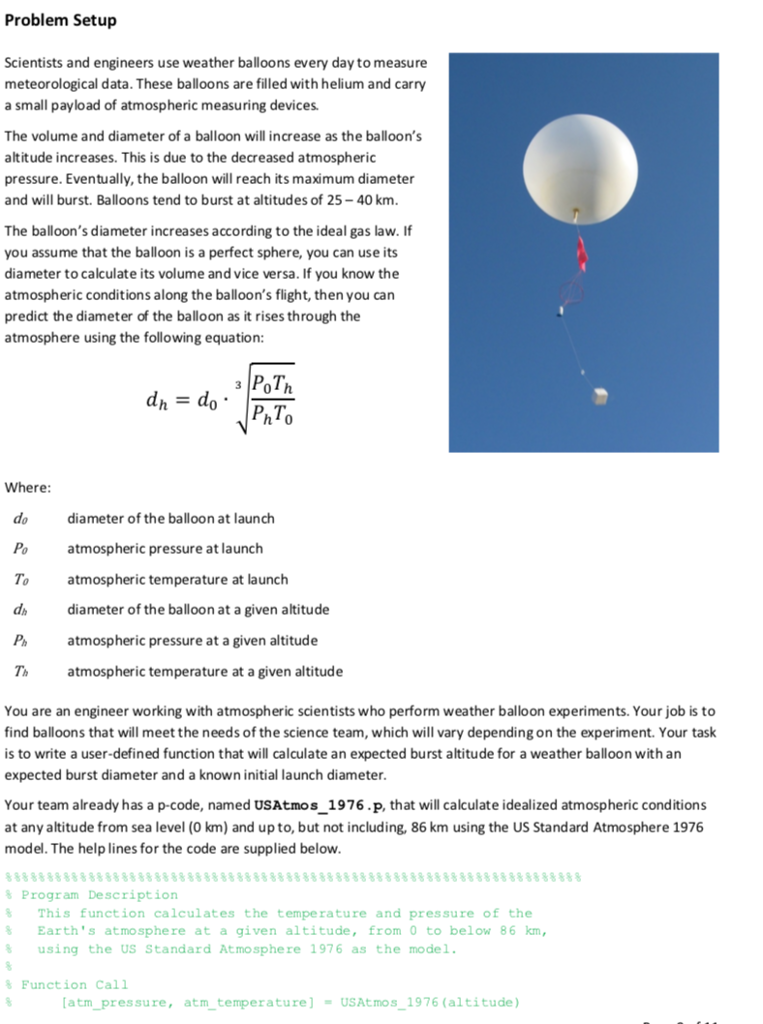
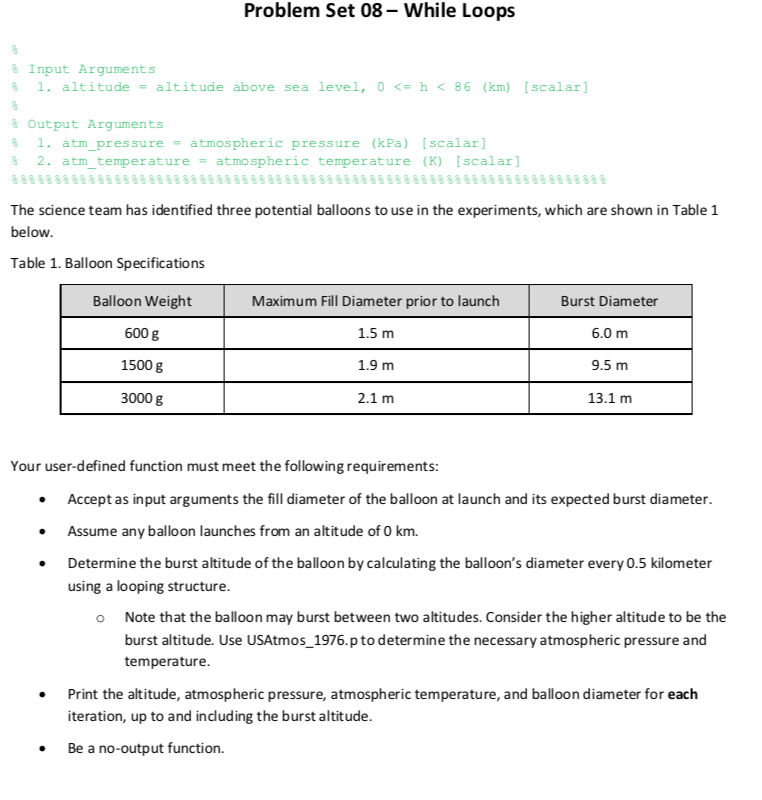
Problem Setup Scientists and engineers use weather balloons every day to measure meteorological data. These balloons are filled with helium and carry a small payload of atmospheric measuring devices The volume and diameter of a balloon will increase as the balloon's altitude increases. This is due to the decreased atmospheric pressure. Eventually, the balloon will reach its maximum diameter and will burst. Balloons tend to burst at altitudes of 25-40 km The balloon's diameter increases according to the ideal gas law. If you assume that the balloon is a perfect sphere, you can use its diameter to calculate its volume and vice versa. If you know the atmospheric conditions along the balloon's flight, then you carn predict the diameter of the balloon as it rises through the atmosphere using the following equation: 0 P^T h 0 Where diameter of the balloon at launch atmospheric pressure at launch atmospheric temperature at launch diameter of the balloon at a given altitude atmospheric pressure at a given altitude atmospheric temperature at a given altitude do Po To dr Ph Th You are an engineer working with atmospheric scientists who perform weather balloon experiments. Your job is to find balloons that will meet the needs of the science team, which will vary depending on the experiment. Your task is to write a user-defined function that will calculate an expected burst altitude for a weather balloon with an expected burst diameter and a known initial launch diameter Your team already has a p-code, named USAtmos_1976.p, that will calculate idealized atmospheric conditions at any altitude from sea level (0 km) and upto, but not including, 86 km using the US Standard Atmosphere 1976 model. The help lines for the code are supplied below Program Description % This funct ion calculates the temperature and pressure of the \ Earth's atmosphere at a given altitude, from 0 to below 86 km, using the US Standard Atmosphere 1976 as the mode1 Function Cal1 [atm-pressure, atm-temperature] USAtmos-1976 (altitude) = Problem Setup Scientists and engineers use weather balloons every day to measure meteorological data. These balloons are filled with helium and carry a small payload of atmospheric measuring devices The volume and diameter of a balloon will increase as the balloon's altitude increases. This is due to the decreased atmospheric pressure. Eventually, the balloon will reach its maximum diameter and will burst. Balloons tend to burst at altitudes of 25-40 km The balloon's diameter increases according to the ideal gas law. If you assume that the balloon is a perfect sphere, you can use its diameter to calculate its volume and vice versa. If you know the atmospheric conditions along the balloon's flight, then you carn predict the diameter of the balloon as it rises through the atmosphere using the following equation: 0 P^T h 0 Where diameter of the balloon at launch atmospheric pressure at launch atmospheric temperature at launch diameter of the balloon at a given altitude atmospheric pressure at a given altitude atmospheric temperature at a given altitude do Po To dr Ph Th You are an engineer working with atmospheric scientists who perform weather balloon experiments. Your job is to find balloons that will meet the needs of the science team, which will vary depending on the experiment. Your task is to write a user-defined function that will calculate an expected burst altitude for a weather balloon with an expected burst diameter and a known initial launch diameter Your team already has a p-code, named USAtmos_1976.p, that will calculate idealized atmospheric conditions at any altitude from sea level (0 km) and upto, but not including, 86 km using the US Standard Atmosphere 1976 model. The help lines for the code are supplied below Program Description % This funct ion calculates the temperature and pressure of the \ Earth's atmosphere at a given altitude, from 0 to below 86 km, using the US Standard Atmosphere 1976 as the mode1 Function Cal1 [atm-pressure, atm-temperature] USAtmos-1976 (altitude) =
Step by Step Solution
There are 3 Steps involved in it

Get step-by-step solutions from verified subject matter experts
 Study Help