







Question: I am confuse on the steps. how do you get to the solution. Can you show all steps on how to get to the solution.
I am confuse on the steps. how do you get to the solution. Can you show all steps on how to get to the solution.

![solution. [c] Substitute the expressions for guy" and 3;" that you obtained](https://dsd5zvtm8ll6.cloudfront.net/si.experts.images/questions/2024/10/67126a8fc94b5_17567126a8fb0680.jpg)
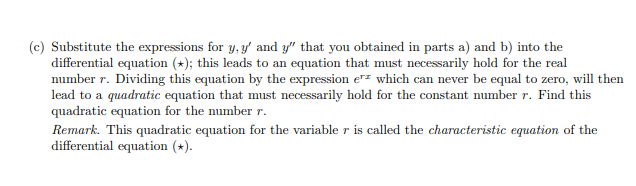
[c] Substitute the expressions for guy" and 3;" that you obtained in parts a] and b} into the dienential equation {1:}: this leads to an equation that must necessarily hold for the real number 1'. Dividing this equation by the expression e" 1which can never be equal to zero, 1will then lead to a. quadratic equation that must necessarily hold for the constant number 1'. Find this quadratic equation for the number 1'. Remark. This quadratic equation for the variable 1' is called the characteristic equation of the diHeDential equation it} (d) Solve the characteristic equation from part c) in order to find the two complex solutions for r. Hint. Use either the completing the square method, or the quadratic formula.1. Consider1 the hemogenorus linear seoond order differential equation 3;" - 1419' + 53y = {*1 FDIIDW the presentation of the example in the handwritten notes for clam 14 on Get 19 closely.r to eventuallgj.r nd the general solution to this differential equation. That is: [a] The first key idea is the same as in our solutions of the questions on homework 11, namely.r we assume that a solution y has the form 3; = e\" for son1e constant real number I" [b] Using the he}:r idea from part a}, compute the derivatives y\" and the y\
Step by Step Solution
There are 3 Steps involved in it

Get step-by-step solutions from verified subject matter experts
 Study Help