







Question: I am having a hard time understanding the question, Please help with the example Question: Read Reading 1.1: Using Targeted Analytics to Improve Talent Decisions
I am having a hard time understanding the question, Please help with the example
Question:
Read Reading 1.1: Using Targeted Analytics to Improve Talent Decisions in the text. Select an organization that you have some familiarity with. Look at Figure 2: Work Design Embedded in Human Capital & Business Model Approaches, and pay particular attention to Work Design That Maximizes Engagement and Org Performance. Compare and contrast the information provided with your selected organization and how it conducts talent decisions. What are the advantages? What are the disadvantages? What additional factors and information are necessary when making human resources decisions? Be sure and develop your responses fully.
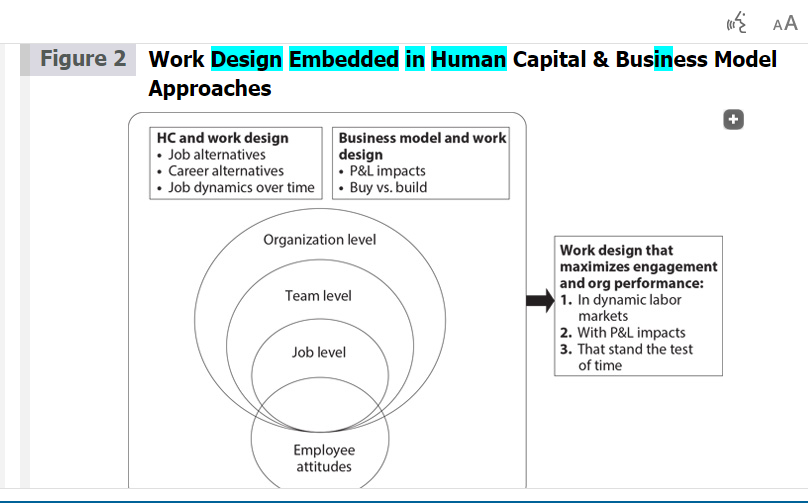
Reading 1.1 Using Targeted Analytics to Improve Talent Decisions Alec Levenson The past decade saw the emergence of analytics as a potential force for driving data-based decision making in HR (Lawler, Levenson, and Boudreau, 2004; Levenson, 2005). At the beginning of the decade, 'human resources analytics" was not part of the language of business. Today, at the end of the decade, a Google search for the same term produces more than 1.5 million results. When the topic of HR analytics was raised at the Center for Effective Organizations annual sponsors meeting in 2003, it was not part of the formal agenda and there were no established courses or seminars on the topic in the HR consulting and training space. Today, an ever-expanding array of providers and content work to train and certify practitioners in HR analytics and automate HR analysis. Yet despite the apparent progress, there still is much uncertainty regarding how best to design, apply and integrate analytics into the daily workings of the HR function. The challenge lies in understanding what analytics to apply where, and the time and resources needed to achieve true insights. This article discusses the variety of analytics and skills that can be used to achieve business insights related to HR and talent. Case study examples illustrate the importance of matching the analytic method to the issue under study. There is a good-news/bad-news story. The bad news is that the statistical skills needed to do technically sophisticated analysis tend not to be located in HR, and, when they are located in HR, tend to be concentrated in HR analytics centers of excellence. The good news is that the limited availability of advanced statistical skills does not always restrict HR professionals' ability to do meaningful analytics. What matters most is knowing what analytics to apply and where to apply them. l AA Figure 2 Work Design Embedded in Human Capital & Business Model Approaches + HC and work design Business model and work Job alternatives design Career alternatives P&L impacts Job dynamics over time. Buy vs. build Organization level Team level Work design that maximizes engagement and org performance: 1. In dynamic labor markets 2. With P&L impacts 3. That stand the test of time Job level Employee attitudes
Step by Step Solution
There are 3 Steps involved in it

Get step-by-step solutions from verified subject matter experts
 Study Help