







Question: I am solving this in Python 3.8 with Spyder IDE. I am not using Matlab, and do not want the handwritten Matlab answer other students
I am solving this in Python 3.8 with Spyder IDE. I am not using Matlab, and do not want the handwritten Matlab answer other students have gotten please
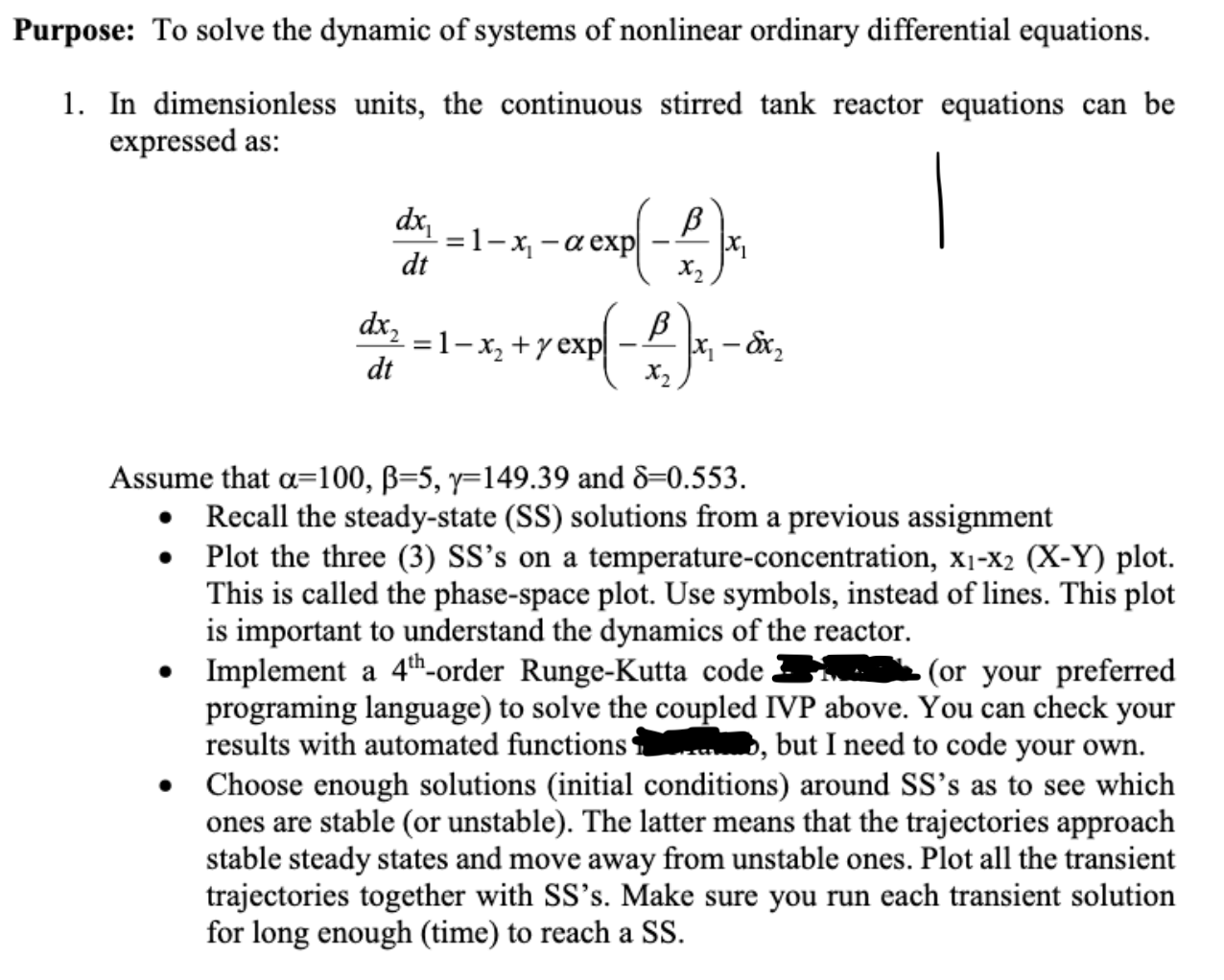
Purpose: To solve the dynamic of systems of nonlinear ordinary differential equations. 1. In dimensionless units, the continuous stirred tank reactor equations can be expressed as: dx, dt =1-x; -a exp| explosion B dx, dt =1- x2 + y exp| |x-&x, x2 Assume that a=100, B=5, y=149.39 and 8=0.553. Recall the steady-state (SS) solutions from a previous assignment Plot the three (3) SS's on a temperature-concentration, X1-X2 (X-Y) plot. This is called the phase-space plot. Use symbols, instead of lines. This plot is important to understand the dynamics of the reactor. Implement a 4th-order Runge-Kutta code - (or your preferred programing language) to solve the coupled IVP above. You can check your results with automated functions .., but I need to code your own. Choose enough solutions (initial conditions) around SS's as to see which ones are stable (or unstable). The latter means that the trajectories approach stable steady states and move away from unstable ones. Plot all the transient trajectories together with SS's. Make sure you run each transient solution for long enough (time) to reach a SS. Purpose: To solve the dynamic of systems of nonlinear ordinary differential equations. 1. In dimensionless units, the continuous stirred tank reactor equations can be expressed as: dx, dt =1-x; -a exp| explosion B dx, dt =1- x2 + y exp| |x-&x, x2 Assume that a=100, B=5, y=149.39 and 8=0.553. Recall the steady-state (SS) solutions from a previous assignment Plot the three (3) SS's on a temperature-concentration, X1-X2 (X-Y) plot. This is called the phase-space plot. Use symbols, instead of lines. This plot is important to understand the dynamics of the reactor. Implement a 4th-order Runge-Kutta code - (or your preferred programing language) to solve the coupled IVP above. You can check your results with automated functions .., but I need to code your own. Choose enough solutions (initial conditions) around SS's as to see which ones are stable (or unstable). The latter means that the trajectories approach stable steady states and move away from unstable ones. Plot all the transient trajectories together with SS's. Make sure you run each transient solution for long enough (time) to reach a SS
Step by Step Solution
There are 3 Steps involved in it

Get step-by-step solutions from verified subject matter experts
 Study Help