







Question: I am trying to follow along with an example problem but there are parts where they say to do something but don't explain how to
I am trying to follow along with an example problem but there are parts where they say to do something but don't explain how to do that step. They say "Begin by finding a basis ..." but don't show how to find the basis. That is the part I need help with.
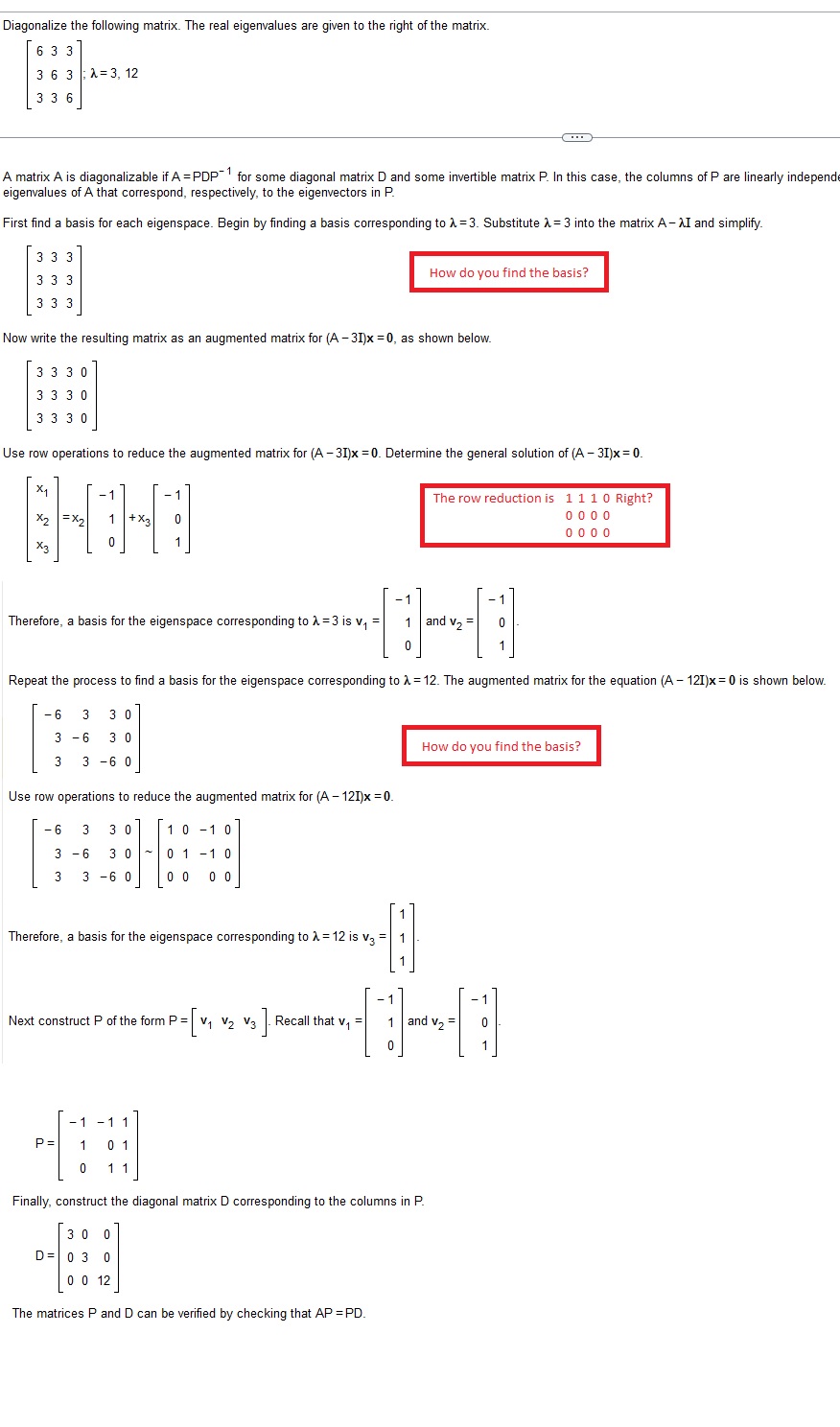
Diagonalize the following matrix. The real eigenvalues are given to the right of the matrix. 63 3 3 6 3 ; 2= 3, 12 3 3 6 A matrix A is diagonalizable if A = PDP"' for some diagonal matrix D and some invertible matrix P. In this case, the columns of P are linearly independ eigenvalues of A that correspond, respectively, to the eigenvectors in P. First find a basis for each eigenspace. Begin by finding a basis corresponding to A =3. Substitute A = 3 into the matrix A- XI and simplify. 3 3 3 3 3 How do you find the basis? 3 3 Now write the resulting matrix as an augmented matrix for (A -31)x =0, as shown below. 33 30 3 3 3 0 3 3 3 0 Use row operations to reduce the augmented matrix for (A -31)x =0. Determine the general solution of (A - 31)x = 0. The row reduction is 1 1 1 0 Right? 000 0 0 0 0 0 Therefore, a basis for the eigenspace corresponding to A = 3 is w, =| and v2 -: ] Repeat the process to find a basis for the eigenspace corresponding to * = 12. The augmented matrix for the equation (A - 121)x = 0 is shown below. - 6 3 3 3 3 0 How do you find the basis? 3 3 -60 Use row operations to reduce the augmented matrix for (A - 121)x =0. -6 3 0 10 3 3 0 3 3 -60 0 0 Therefore, a basis for the eigenspace corresponding to A = 12 is v3 = Next construct P of the form P = |V, V2 V3 - Recall that v, -|1|and v2- a P= Finally, construct the diagonal matrix D corresponding to the columns in P. 30 0 3 0 0 0 12 The matrices P and D can be verified by checking that AP = PD
Step by Step Solution
There are 3 Steps involved in it

Get step-by-step solutions from verified subject matter experts
 Study Help