







Question: I am trying to plot N(K,v) in Matlab. I have recorded data for the current-voltage charcteristic curves but do not know how to use this
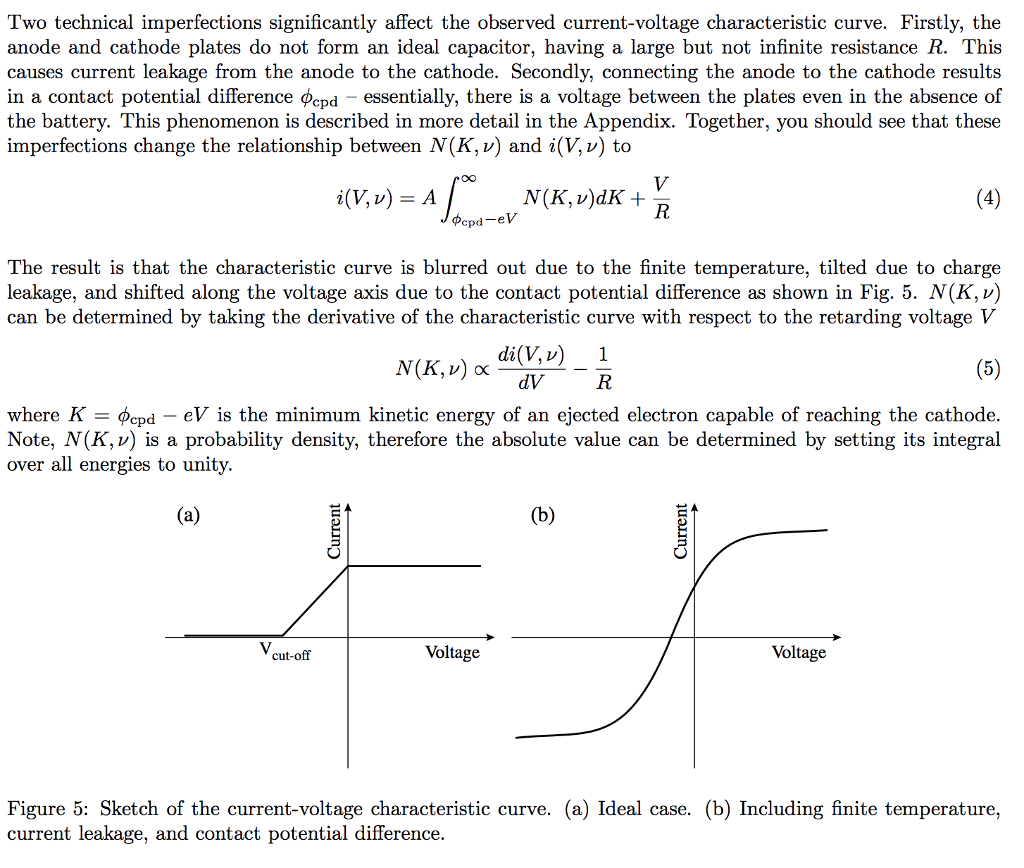
 I am trying to plot N(K,v) in Matlab. I have recorded data for the current-voltage charcteristic curves but do not know how to use this data to plot N(K,v), which is a kinetic energy distribution. Also, how do I express N(K,v) as a probability density?
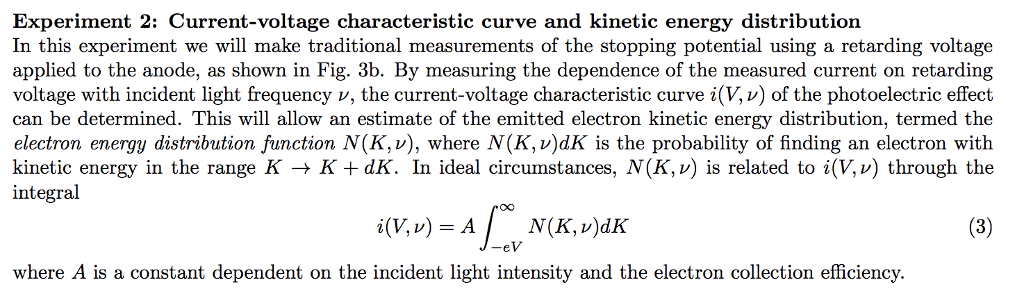
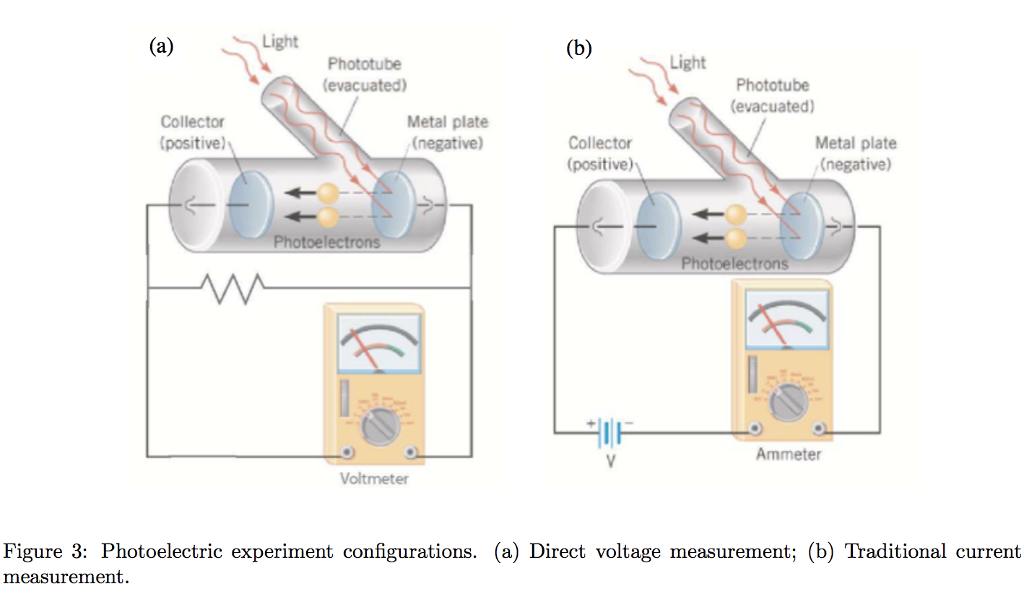
Experiment 2: Current-voltage characteristic curve and kinetic energy distribution In this experiment we will make traditional measurements of the stopping potential using a retarding voltage applied to the anode, as shown in Fig. 3b. By measuring the dependence of the measured current on retarding voltage with incident light frequency v, the current-voltage characteristic curve i(V, v) of the photoelectric effect can be determined. This will allow an estimate of the emitted electron kinetic energy distribution, termed the electron energy distribution function N(K, v), where N(K, v)dK is the probability of finding an electron with kinetic energy in the range K - K +dK. In ideal circumstances, N(K,v) is related to i(V,v) through the integral where A is a constant dependent on the incident light intensity and the electron collection efficiency. Experiment 2: Current-voltage characteristic curve and kinetic energy distribution In this experiment we will make traditional measurements of the stopping potential using a retarding voltage applied to the anode, as shown in Fig. 3b. By measuring the dependence of the measured current on retarding voltage with incident light frequency v, the current-voltage characteristic curve i(V, v) of the photoelectric effect can be determined. This will allow an estimate of the emitted electron kinetic energy distribution, termed the electron energy distribution function N(K, v), where N(K, v)dK is the probability of finding an electron with kinetic energy in the range K - K +dK. In ideal circumstances, N(K,v) is related to i(V,v) through the integral where A is a constant dependent on the incident light intensity and the electron collection efficiency
Step by Step Solution
There are 3 Steps involved in it

Get step-by-step solutions from verified subject matter experts
 Study Help