



Question: I asked this question, but the answer to (b) was cut off in the middle. I want a more detailed explanation of (b). The patch
I asked this question, but the answer to (b) was cut off in the middle. I want a more detailed explanation of (b).
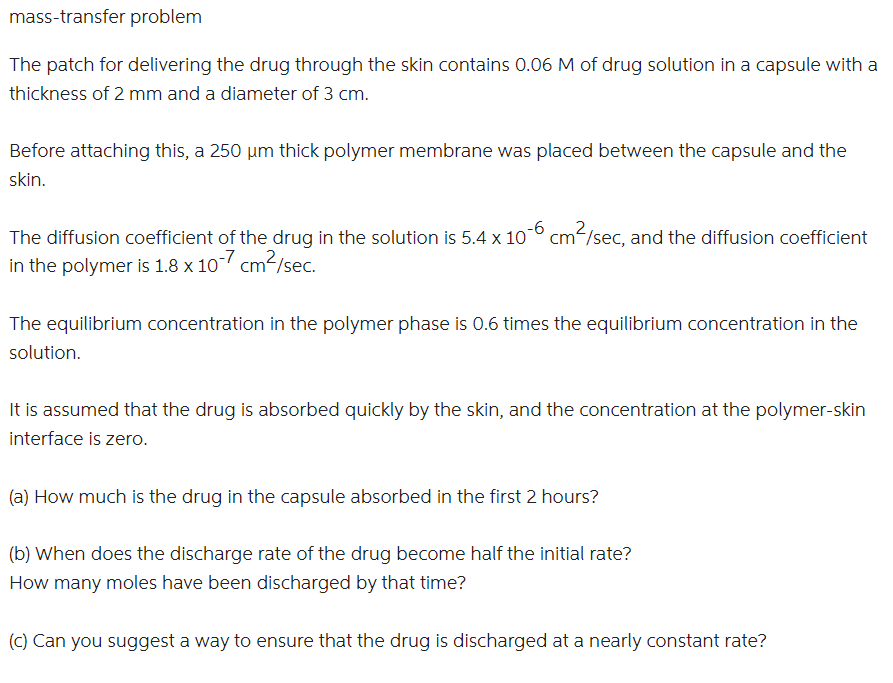
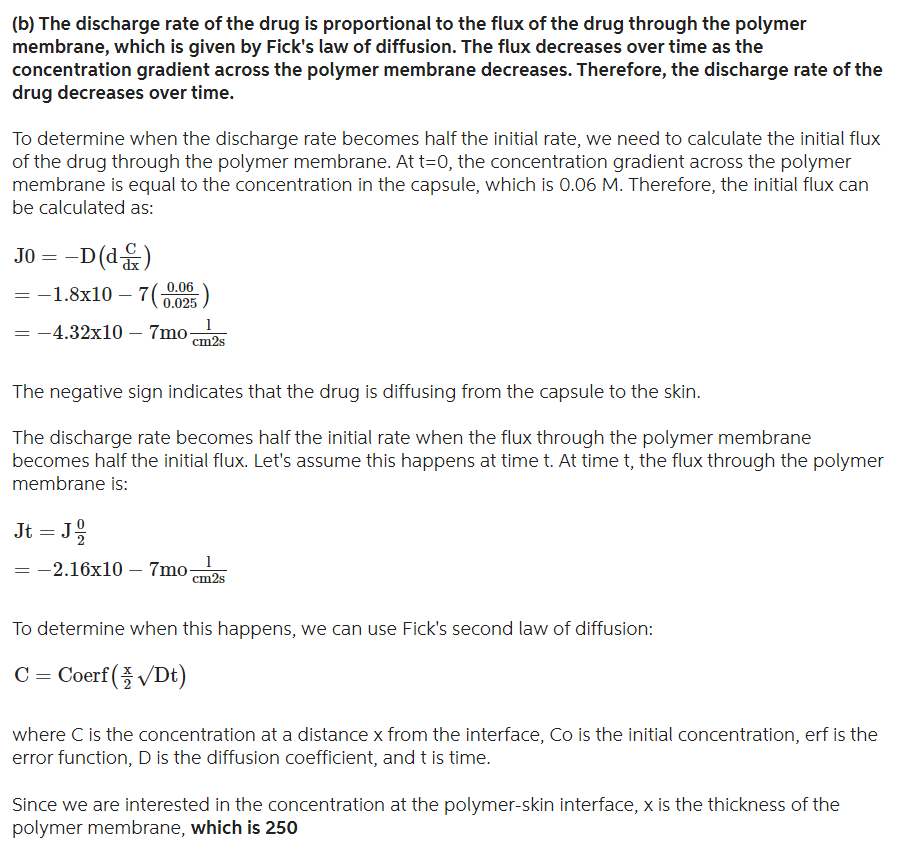
The patch for delivering the drug through the skin contains 0.06M of drug solution in a capsule with a thickness of 2mm and a diameter of 3cm. Before attaching this, a 250m thick polymer membrane was placed between the capsule and the skin. The diffusion coefficient of the drug in the solution is 5.4106cm2/sec, and the diffusion coefficient in the polymer is 1.8107cm2/sec. The equilibrium concentration in the polymer phase is 0.6 times the equilibrium concentration in the solution. It is assumed that the drug is absorbed quickly by the skin, and the concentration at the polymer-skin interface is zero. (a) How much is the drug in the capsule absorbed in the first 2 hours? (b) When does the discharge rate of the drug become half the initial rate? How many moles have been discharged by that time? (c) Can you suggest a way to ensure that the drug is discharged at a nearly constant rate? (b) The discharge rate of the drug is proportional to the flux of the drug through the polymer membrane, which is given by Fick's law of diffusion. The flux decreases over time as the concentration gradient across the polymer membrane decreases. Therefore, the discharge rate of the drug decreases over time. To determine when the discharge rate becomes half the initial rate, we need to calculate the initial flux of the drug through the polymer membrane. At t=0, the concentration gradient across the polymer membrane is equal to the concentration in the capsule, which is 0.06M. Therefore, the initial flux can be calculated as: J0=D(ddxC)=1.8107(0.0250.06)=4.32x10⁷mocm2s1 The negative sign indicates that the drug is diffusing from the capsule to the skin. The discharge rate becomes half the initial rate when the flux through the polymer membrane becomes half the initial flux. Let's assume this happens at time t. At time t, the flux through the polymer membrane is: Jt=J20=2.16107mocm2s1 To determine when this happens, we can use Fick's second law of diffusion: C=Coerf(2xDt) where C is the concentration at a distance x from the interface, C is the initial concentration, erf is the error function, D is the diffusion coefficient, and t is time. Since we are interested in the concentration at the polymer-skin interface, x is the thickness of the polymer membrane, which is 250
Step by Step Solution
There are 3 Steps involved in it

Get step-by-step solutions from verified subject matter experts