







Question: I basically konw the answer but I also need explanations on why the answer is correct. If a question requires a numerical answer, provide a
I basically konw the answer but I also need explanations on why the answer is correct. If a question requires a numerical answer, provide a formula that helps to solve it.
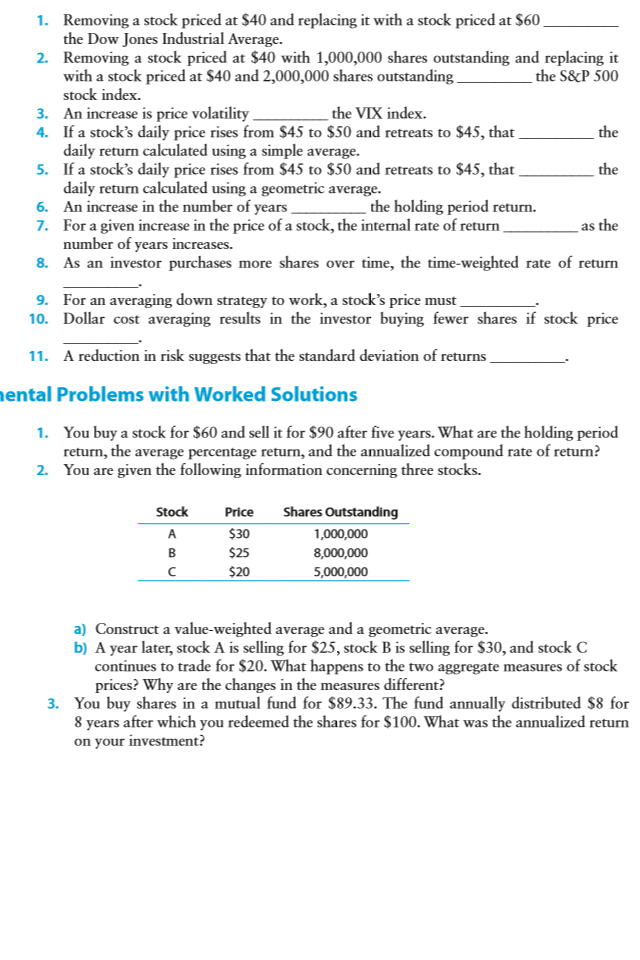
1. Removing a stock priced at $40 and replacing it with a stock priced at $60 the Dow Jones Industrial Average. 2. Removing a stock priced at $40 with 1,000,000 shares outstanding and replacing it with a stock priced at $40 and 2,000,000 shares outstanding the S&P 500 stock index. 3. An increase is price volatility the VIX index. 4. If a stock's daily price rises from $45 to $50 and retreats to $45, that the daily return calculated using a simple average. 5. If a stock's daily price rises from $45 to $50 and retreats to $45, that the daily return calculated using a geometric average. 6. An increase in the number of years the holding period return. 7. For a given increase in the price of a stock, the internal rate of return number of years increases. 8. As an investor purchases more shares over time, the time-weighted rate of return 9. For an averaging down strategy to work, a stock's price must 10. Dollar cost averaging results in the investor buying fewer shares if stock price as the 11. A reduction in risk suggests that the standard deviation of returns hental Problems with Worked Solutions 1. You buy a stock for $60 and sell it for $90 after five years. What are the holding period return, the average percentage return, and the annualized compound rate of return? 2. You are given the following information concerning three stocks. Stock A B Price $30 $25 $20 Shares Outstanding 1,000,000 8,000,000 5,000,000 a) Construct a value-weighted average and a geometric average. b) A year later, stock A is selling for $25, stock B is selling for $30, and stock C continues to trade for $20. What happens to the two aggregate measures of stock prices? Why are the changes in the measures different? 3. You buy shares in a mutual fund for $89.33. The fund annually distributed $8 for 8 years after which you redeemed the shares for $100. What was the annualized return on your investment? 1. Removing a stock priced at $40 and replacing it with a stock priced at $60 the Dow Jones Industrial Average. 2. Removing a stock priced at $40 with 1,000,000 shares outstanding and replacing it with a stock priced at $40 and 2,000,000 shares outstanding the S&P 500 stock index. 3. An increase is price volatility the VIX index. 4. If a stock's daily price rises from $45 to $50 and retreats to $45, that the daily return calculated using a simple average. 5. If a stock's daily price rises from $45 to $50 and retreats to $45, that the daily return calculated using a geometric average. 6. An increase in the number of years the holding period return. 7. For a given increase in the price of a stock, the internal rate of return number of years increases. 8. As an investor purchases more shares over time, the time-weighted rate of return 9. For an averaging down strategy to work, a stock's price must 10. Dollar cost averaging results in the investor buying fewer shares if stock price as the 11. A reduction in risk suggests that the standard deviation of returns hental Problems with Worked Solutions 1. You buy a stock for $60 and sell it for $90 after five years. What are the holding period return, the average percentage return, and the annualized compound rate of return? 2. You are given the following information concerning three stocks. Stock A B Price $30 $25 $20 Shares Outstanding 1,000,000 8,000,000 5,000,000 a) Construct a value-weighted average and a geometric average. b) A year later, stock A is selling for $25, stock B is selling for $30, and stock C continues to trade for $20. What happens to the two aggregate measures of stock prices? Why are the changes in the measures different? 3. You buy shares in a mutual fund for $89.33. The fund annually distributed $8 for 8 years after which you redeemed the shares for $100. What was the annualized return on your investment
Step by Step Solution
There are 3 Steps involved in it

Get step-by-step solutions from verified subject matter experts
 Study Help