



Question: I. Consider the following set of processes: Process Arrival Time CPU Burst Time Priority PI P2 P3 P4 5 0 7 4 6 7 5
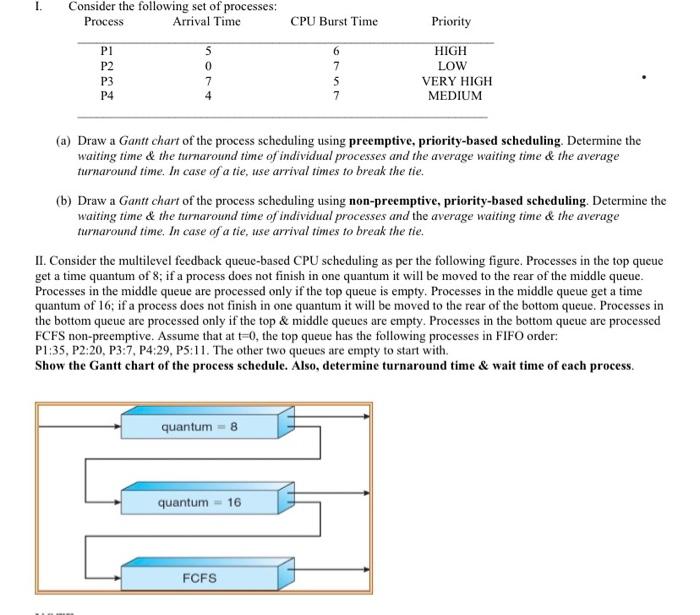
I. Consider the following set of processes: Process Arrival Time CPU Burst Time Priority PI P2 P3 P4 5 0 7 4 6 7 5 7 HIGH LOW VERY HIGH MEDIUM (a) Draw a Gantt chart of the process scheduling using preemptive, priority-based scheduling. Determine the waiting time & the turnaround time of individual processes and the average waiting time & the average turnaround time. In case of a tie, use arrival times to break the tie. (b) Draw a Gantt chart of the process scheduling using non-preemptive, priority-based scheduling. Determine the waiting time & the turnaround time of individual processes and the average waiting time & the average furnaround time. In case of a tie, use arrival times to break the tie, II. Consider the multilevel feedback queue-based CPU scheduling as per the following figure. Processes in the top queue get a time quantum of 8; if a process does not finish in one quantum it will be moved to the rear of the middle queue. Processes in the middle queue are processed only if the top queue is empty. Processes in the middle queue get a time quantum of 16; if a process does not finish in one quantum it will be moved to the rear of the bottom queue. Processes in the bottom queue are processed only if the top & middle queues are empty. Processes in the bottom queue are processed FCFS non-preemptive. Assume that at t=0, the top queue has the following processes in FIFO order: P1:35, P2:20, P3:7, P4:29, P5:11. The other two queues are empty to start with Show the Gantt chart of the process schedule. Also, determine turnaround time & wait time of each process. quantum = 8 quantum = 16 FCFS
Step by Step Solution
There are 3 Steps involved in it

Get step-by-step solutions from verified subject matter experts