







Question: I dont know what I am doing wrong in this problem. I found the PVA by using the formula (124000)*(1-(1.069)^-34)/.069 = 1611179.52. Then I used
I dont know what I am doing wrong in this problem. I found the PVA by using the formula (124000)*(1-(1.069)^-34)/.069 = 1611179.52. Then I used FVA = PVA = 1611179.52 = C(1.069)^N -1/.069 to find annual depostie amount, but I am still getting the wrong answer. Can someone help me showing the step by solving the problem without skiping the step so that I can detect my mistakes and learn from you? I would really apprecite it. Please dont use EXCEL to solve it otherwise I would not be able to follow please. 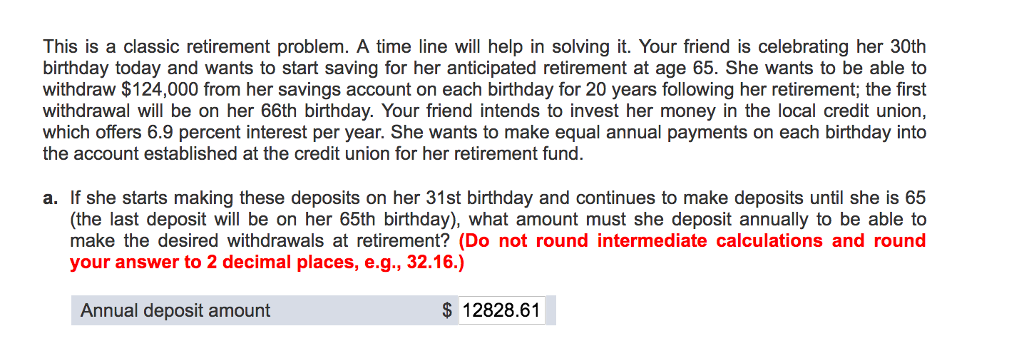
This is a classic retirement problem. A time line will help in solving it. Your friend is celebrating her 30th birthday today and wants to start saving for her anticipated retirement at age 65. She wants to be able to withdraw $124,000 from her savings account on each birthday for 20 years following her retirement, the first withdrawal will be on her 66th birthday. Your friend intends to invest her money in the local credit union, which offers 6.9 percent interest per year. She wants to make equal annual payments on each birthday into the account established at the credit union for her retirement fund a. If she starts making these deposits on her 31 birthday and continues to make deposits until she is 65 (the last deposit will be on her 65th birthday), what amount must she deposit annually to be able to make the desired withdrawals at retirement? (Do not round intermediate calculations and round your answer to 2 decimal places, e.g., 32.16.) 12828.61 Annual deposit amount
Step by Step Solution
There are 3 Steps involved in it

Get step-by-step solutions from verified subject matter experts
 Study Help