







Question: I. Explain what does an address represents in the case of a processor. Define the 5 types of 2. Show the encoding of the following
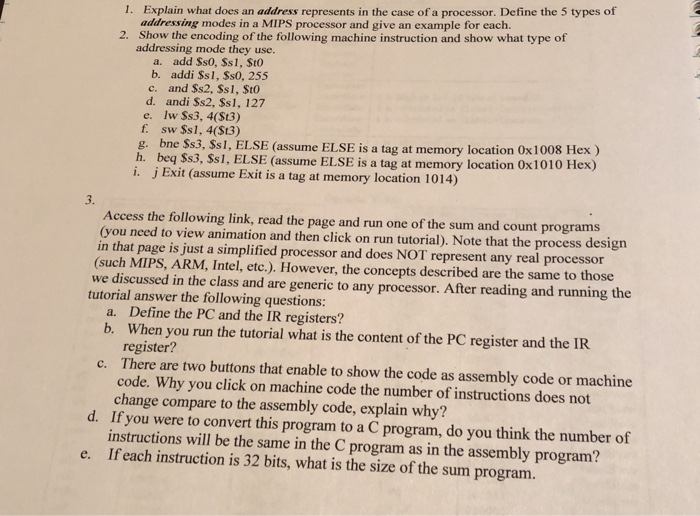
I. Explain what does an address represents in the case of a processor. Define the 5 types of 2. Show the encoding of the following machine instruction and show what type of addressing modes in a MIPS processor and give an example for each. addressing mode they use. a. add Ss0, Ss1, St0 b. addi $s1, Ss0, 255 c. and Ss2, Ss1, Sto d. andi Ss2, Ss1, 127 e. lw Ss3, 4(St3) f sw Ss1, 4(St3) g. bne Ss3, Ss1, ELSE (assume ELSE is a tag at memory location 0x1008 Hex) h. beq Ss3, Ss1, ELSE (assume ELSE is a tag at memory location Ox1010 Hex) i. j Exit (assume Exit is a tag at memory location 1014) 3. Access the following link, read the page and run one of the sum and count programs (you need to view ani in that page is just a simplified processor and does NOT represent any real processor (such MIPS, ARM, Intel, etc.,). However, the concepts described are the same to those mation and then click on run tutorial). Note that the process design we discussed in the class and are generic to any processor. After reading and running the tutorial answer the following questions: a. Define the PC and the IR registers? b. When you run the tutorial what is the content of the PC register and the IR register? c. There are two buttons that enable to show the code as assembly code or machine d. If you were to convert this program to a C program, do you think the number of e. If each instruction is 32 bits, what is the size of the sum program. code. Why you click on machine code the number of instructions does not change compare to the assembly code, explain why? instructions will be the same in the C program as in the assembly program
Step by Step Solution
There are 3 Steps involved in it

Get step-by-step solutions from verified subject matter experts
 Study Help