







Question: I got A - D right. But I keep getting E. wrong.Can someone help? PA 4-6 Atlas Inc. is a toy bicycle manufacturing... Atlas Inc.
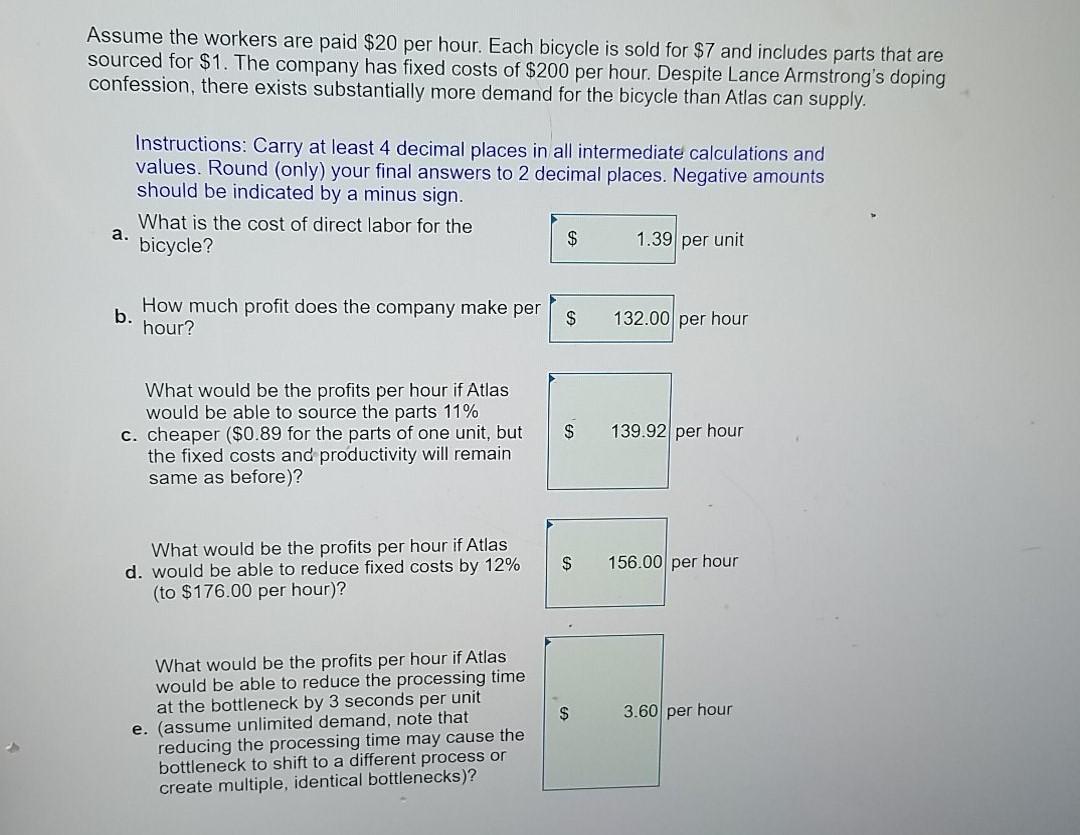
I got A - D right. But I keep getting E. wrong.Can someone help?
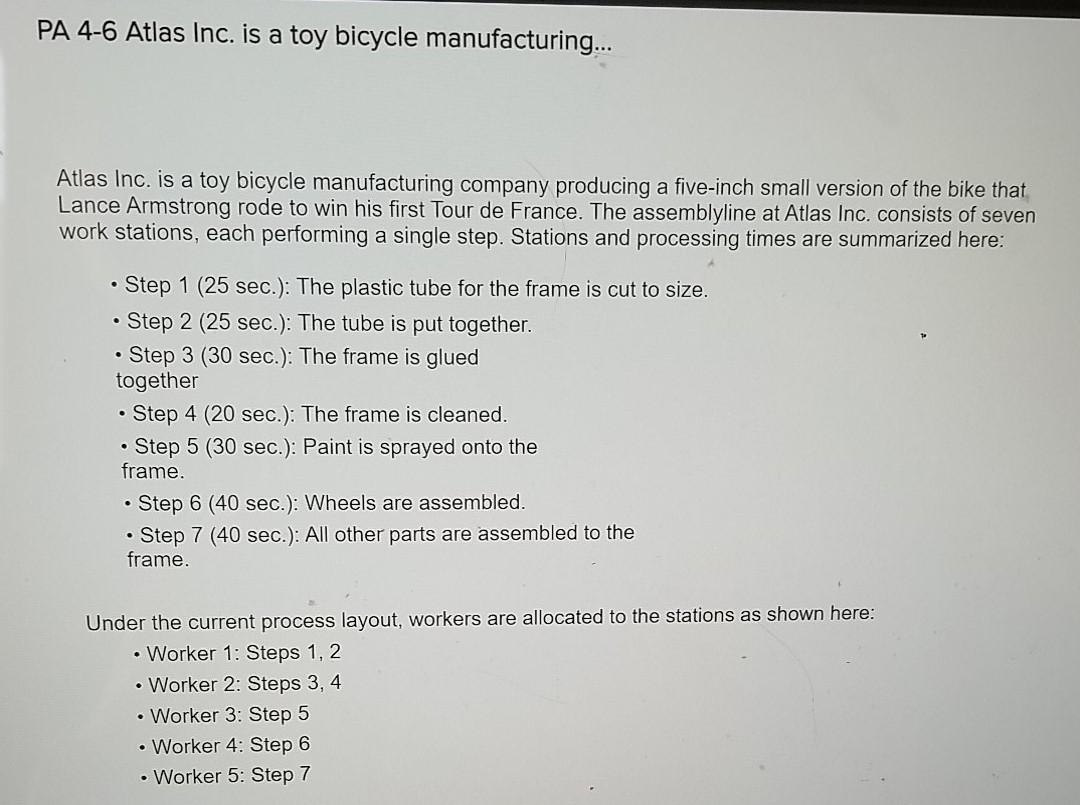
PA 4-6 Atlas Inc. is a toy bicycle manufacturing... Atlas Inc. is a toy bicycle manufacturing company producing a five-inch small version of the bike that Lance Armstrong rode to win his first Tour de France. The assemblyline at Atlas Inc. consists of seven work stations, each performing a single step. Stations and processing times are summarized here: . Step 1 (25 sec.): The plastic tube for the frame is cut to size. Step 2 (25 sec.): The tube is put together. . Step 3 (30 sec.): The frame is glued together Step 4 (20 sec.): The frame is cleaned. Step 5 (30 sec.). Paint is sprayed onto the frame. Step 6 (40 sec.): Wheels are assembled. Step 7 (40 sec.): All other parts are assembled to the frame. Under the current process layout, workers are allocated to the stations as shown here: Worker 1: Steps 1, 2 Worker 2: Steps 3, 4 Worker 3: Step 5 Worker 4: Step 6 Worker 5: Step 7 Assume the workers are paid $20 per hour. Each bicycle is sold for $7 and includes parts that are sourced for $1. The company has fixed costs of $200 per hour. Despite Lance Armstrong's doping confession, there exists substantially more demand for the bicycle than Atlas can supply. Instructions: Carry at least 4 decimal places in all intermediate calculations and values. Round (only) your final answers to 2 decimal places. Negative amounts should be indicated by a minus sign. What is the cost of direct labor for the $ 1.39 per unit bicycle? a. b. How much profit does the company make per hour? S 132.00 per hour What would be the profits per hour if Atlas would be able to source the parts 11% C. cheaper ($0.89 for the parts of one unit, but the fixed costs and productivity will remain same as before)? S 139.92 per hour $ 156.00 per hour What would be the profits per hour if Atlas d. would be able to reduce fixed costs by 12% (to $176.00 per hour)? $ 3.60 per hour What would be the profits per hour if Atlas would be able to reduce the processing time at the bottleneck by 3 seconds per unit e. (assume unlimited demand, note that reducing the processing time may cause the bottleneck to shift to a different process or create multiple, identical bottlenecks)Step by Step Solution
There are 3 Steps involved in it
1 Expert Approved Answer
Step: 1 Unlock

Question Has Been Solved by an Expert!
Get step-by-step solutions from verified subject matter experts
Step: 2 Unlock
Step: 3 Unlock
 Study Help