



Question: I got questions 10 kinda, need help with question 11. If 10 is wrong let me know why please Part 3: Modeling viral load and
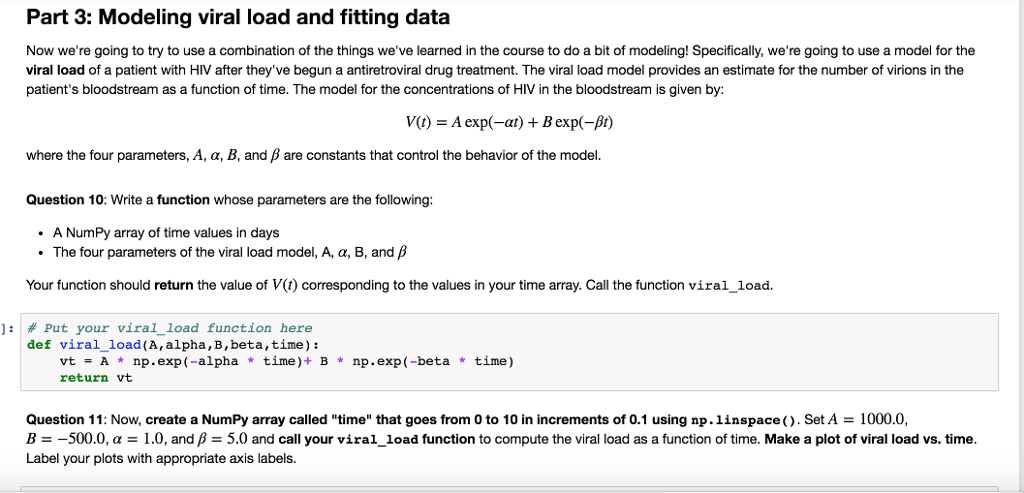 I got questions 10 kinda, need help with question 11. If 10 is wrong let me know why please
Part 3: Modeling viral load and fitting data Now we're going to try to use a combination of the things we've learned in the course to do a bit of modeling! Specifically, we're going to use a model for the viral load of a patient with HIV after they've begun a antiretroviral drug treatment. The viral load model provides an estimate for the number of virions in the patient's bloodstream as a function of time. The model for the concentrations of HIV in the bloodstream is given by: V(1) = A exp(-at) + B exp(-) Where the four parameters, A, , B, and are constants that control the behavior of the model. following: A NumPy array of time values in days The four parameters of the viral load model, A, , B, and Your function should return the value of V(t) corresponding to the values in your time array. Call the function viral load :Put your viral_load function here def viral_load(A,alpha, B,beta, time): vt = A * np . exp (-alpha * time ) + B * np . exp(-beta * time) return vt Question 11: Now, create a Numpy array called "time" that goes from 0 to 10 in increments of 0.1 using np. linspace ( ). Set A = 1000.0, B =-5000, = 1.0, and = 5.0 and call your viral-load function to compute the viral load as a function of time. Make a plot of viral load vs. time Label your plots with appropriate axis labels
Step by Step Solution
There are 3 Steps involved in it

Get step-by-step solutions from verified subject matter experts