







Question: I got these wrong here are the comments #14 and #15 You forgot about the force of gravity which is also working vertically. Draw an
I got these wrong here are the comments "#14 and #15 You forgot about the force of gravity which is also working vertically. Draw an FBD, write the net force equation, and go from there.
#16 You need to separate the 2 objects into 2 different FBDs, and work from there. Just like you did in #17.
#18 the mass is correct but not the tension force
#24 the mass is correct but the acceleration of 2.8 m/s^2 is not.
#25 incorrect, did not finis/h answering this question"
handwri.te corrections show all steps
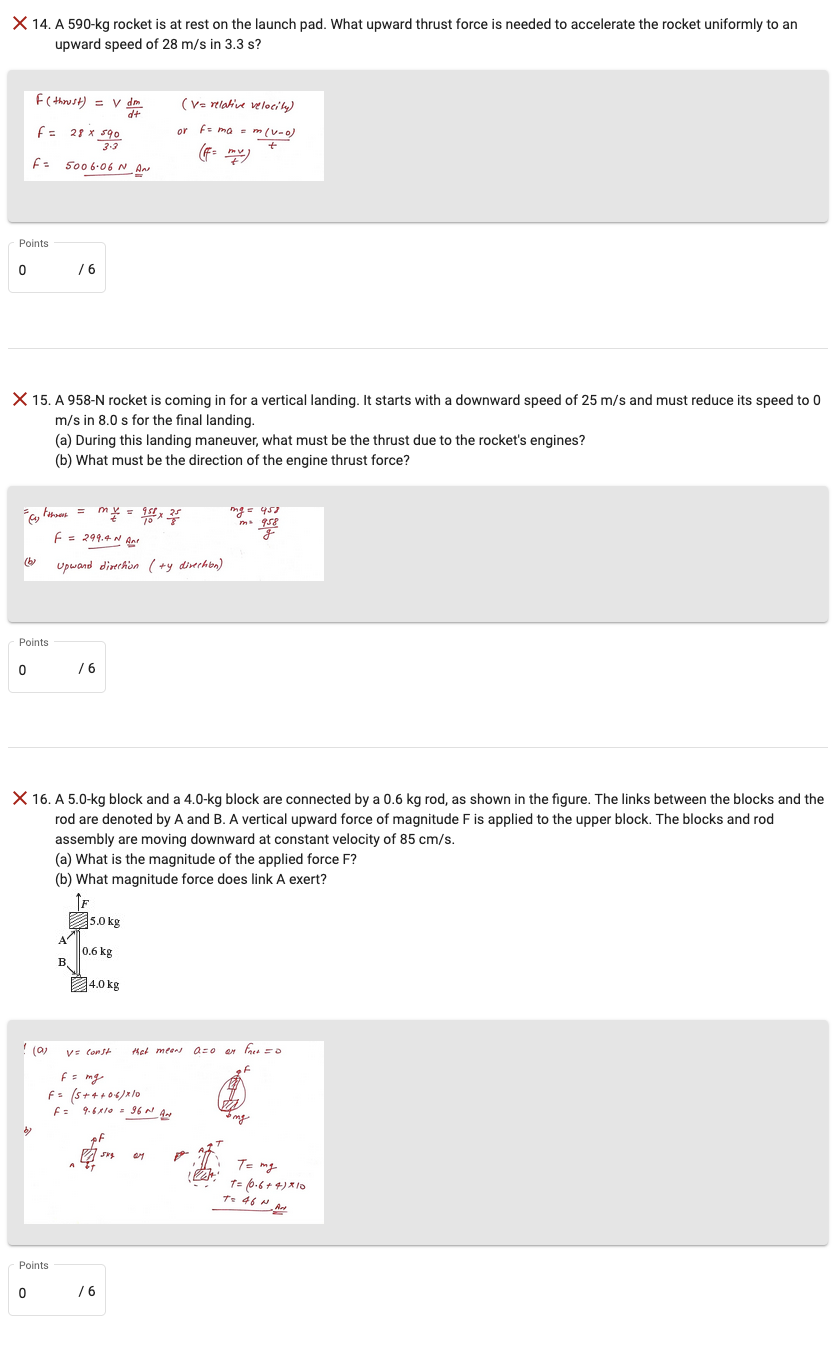
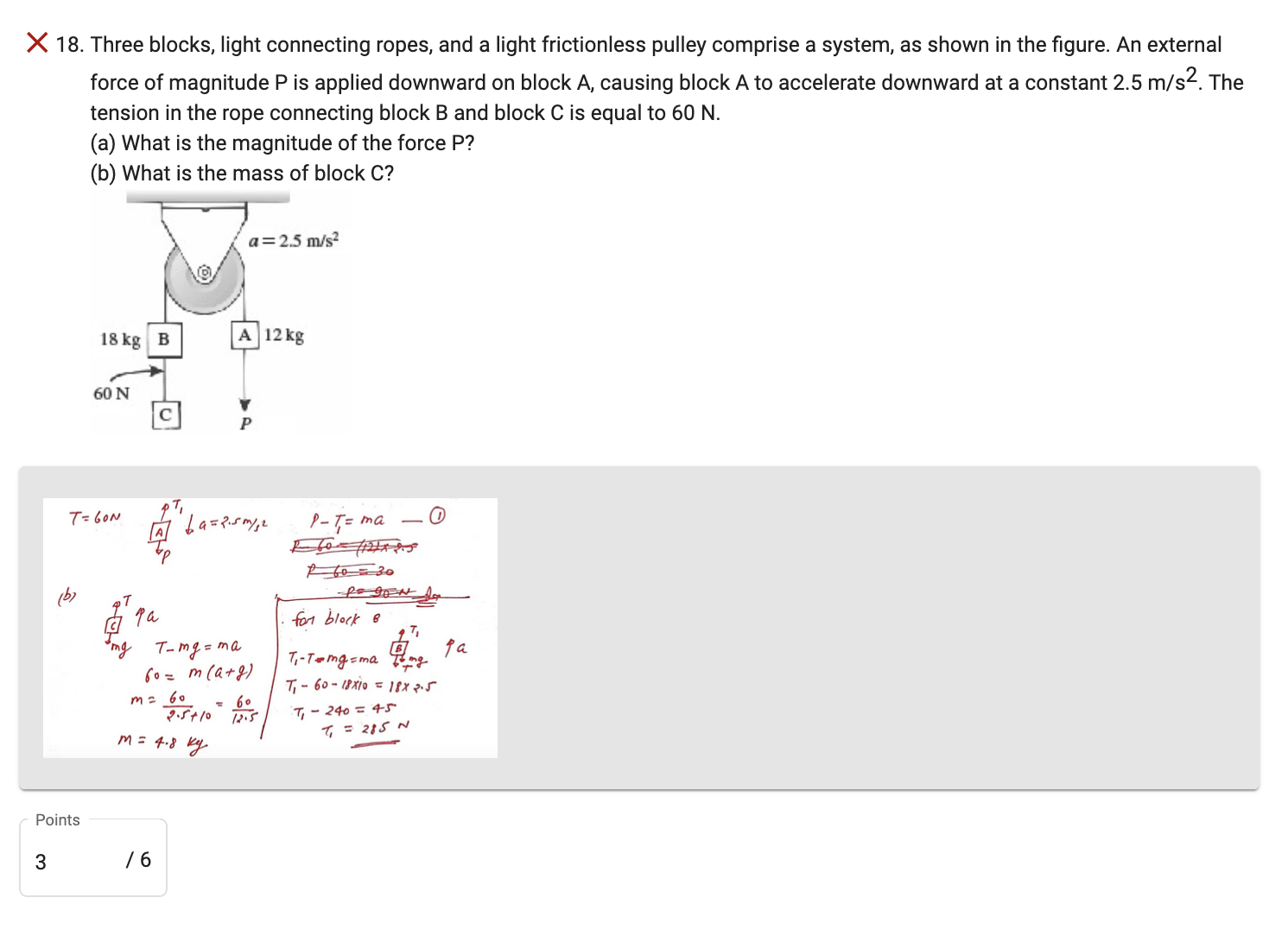
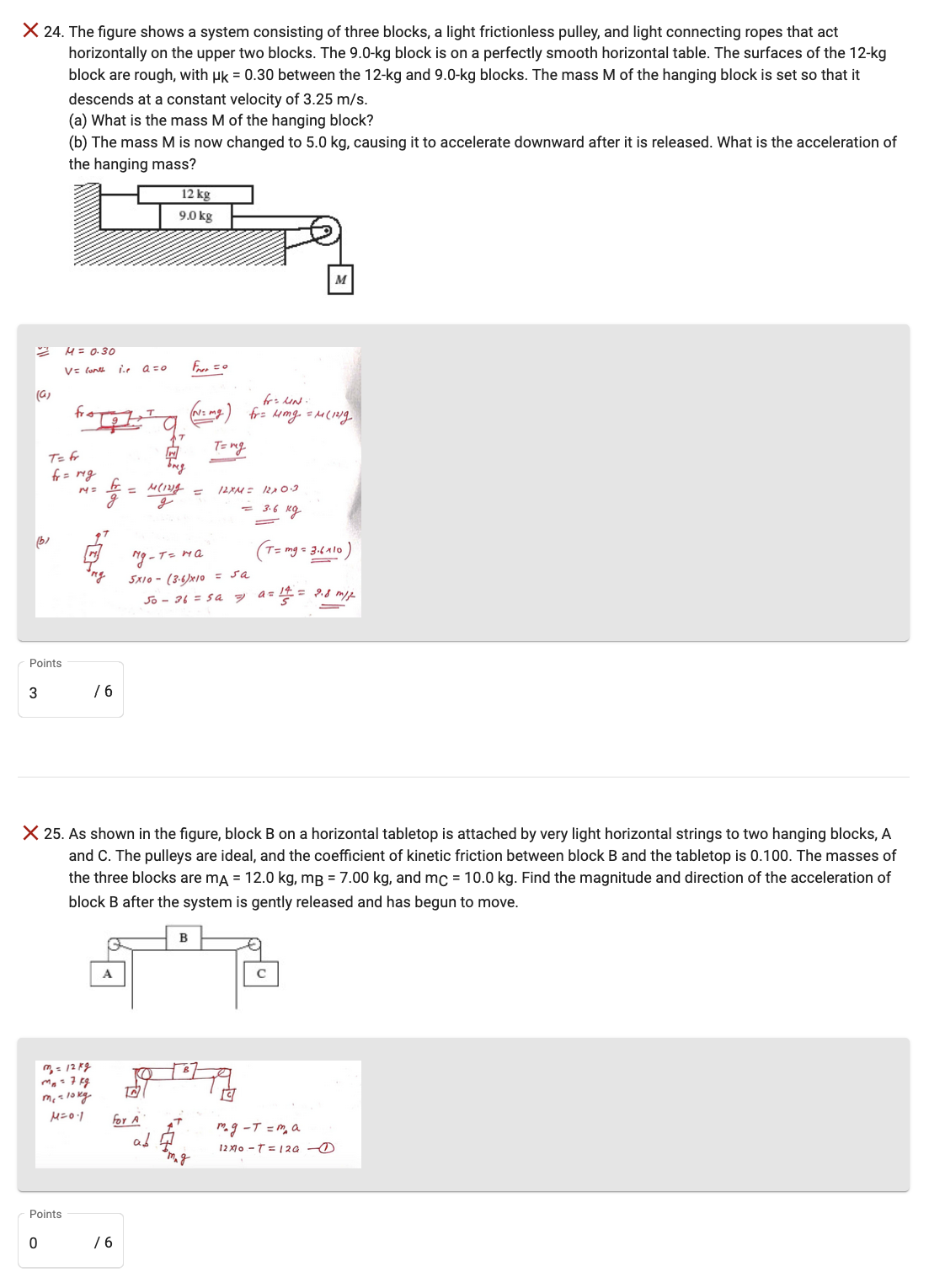
X 14. A 590-kg rocket is at rest on the launch pad. What upward thrust force is needed to accelerate the rocket uniformly to an upward speed of 28 m/s in 3.3 s? F ( thrust ) = V dm ( v = relative velocity ) f = 28 x 590 or F= ma = m ( v-o) 3.3 F = (F= my) 500 6.06 N And Points 0 16 X 15. A 958-N rocket is coming in for a vertical landing. It starts with a downward speed of 25 m/s and must reduce its speed to 0 m/s in 8.0 s for the final landing. (a) During this landing maneuver, what must be the thrust due to the rocket's engines? (b) What must be the direction of the engine thrust force? my = 451 F = 299.4 N And Upwand direction ( ty divechen ) Points 0 16 X 16. A 5.0-kg block and a 4.0-kg block are connected by a 0.6 kg rod, as shown in the figure. The links between the blocks and the rod are denoted by A and B. A vertical upward force of magnitude F is applied to the upper block. The blocks and rod assembly are moving downward at constant velocity of 85 cm/s. (a) What is the magnitude of the applied force F? (b) What magnitude force does link A exert? F 5.0 kg 0.6 kg B. 4.0 kg V= Const Met meant Q=0 on hand =0 F = my F= ( 5+ + +06/ x10 F = 9.6x10 = 96 Am T = my 7= 16.6+ 4)x10 T = 46 N And Points /6X 18. Three blocks, light connecting ropes, and a light frictionless pulley comprise a system, as shown in the figure. An external force of magnitude P is applied downward on block A, causing block A to accelerate downward at a constant 2.5 m/s2. The tension in the rope connecting block B and block C is equal to 60 N. (a) What is the magnitude of the force P? (b) What is the mass of block C? a=2.5 m/s2 18 kg B A 12 kg 60 N C T= GON PT, P-T= ma - O To P 60 = 30 for block 8 T- mg = ma T,-T-mg=ma fa 60 = m ( a+ 9 ) T - 60- 18x10 = 18X 2.5 m= 60 = 60 2.5+ 10 12.5 T1 - 240 = 45 T1 = 285 N M = 4.8 ky Points 3 16X 24. The gure shows a system consisting of three blocks. a light frictionless pulley, and light connecting ropes that act horizontally on the upper two blocks. The 9.0kg block is on a perfectly smooth horizontal table. The surfaces of the 12kg block are rough. with pk = 0.30 between the 12kg and 9.0kg blocks. The mass M of the hanging block is set so that it descends at a constant velocity of 3.25 mis. (a) What is the mass M of the hanging block? (b) The mass M is now changed to 5.0 kg, causing it to accelerate downward after it is released. What is the acceleration of the hanging mass? ? p 4% W;-T'~ r10. (15:15:21?) "0" Jxro- {f-yrrv = I\" .romw'a 7 4:3: \"We Points X 25. As shown in the gure, block B on a horizontal tabletop is attached by very light horizontal strings to two hanging blocks. A and C. The pulleys are ideal, and the coefcient of kinetic friction between block B and the tabletop is 0.100. The masses of the three blocks are my; = 12.0 kg, m3 = 7.00 kg, and me = 10.0 kg. Find the magnitude and direction of the acceleration of block B after the system is gently released and has begun to move. Points 0 l6
Step by Step Solution
There are 3 Steps involved in it

Get step-by-step solutions from verified subject matter experts
 Study Help