







Question: I have enough time to wait for the answer to the question. If you want, you can send it to my e-mail address. Thank you

I have enough time to wait for the answer to the question. If you want, you can send it to my e-mail address. Thank you :)
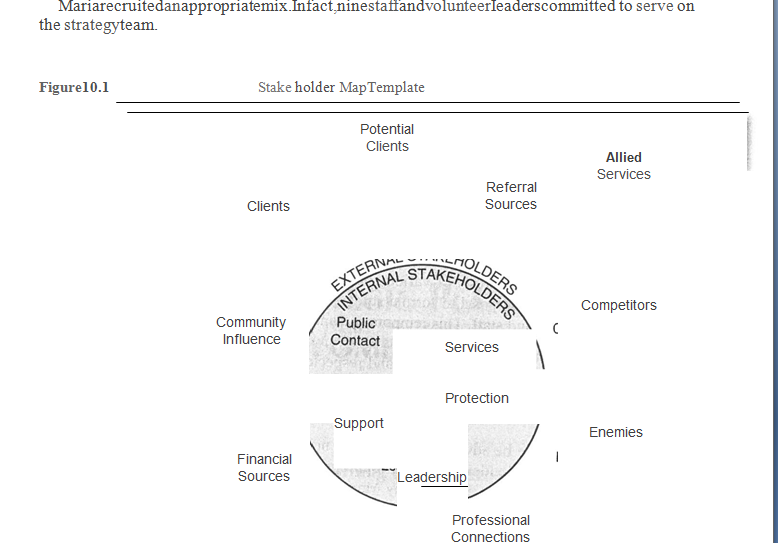
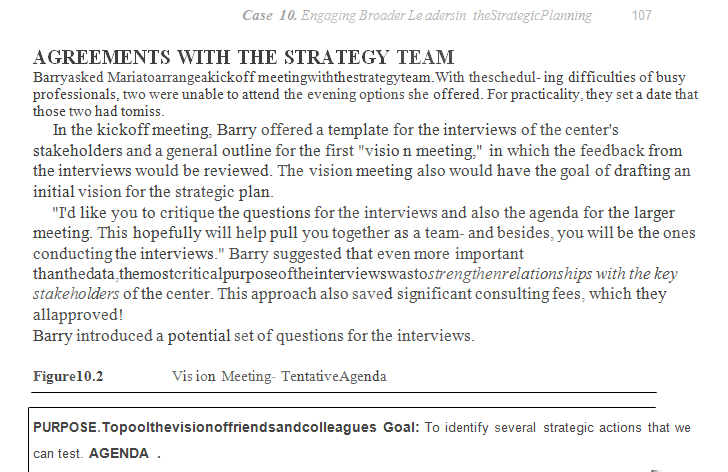
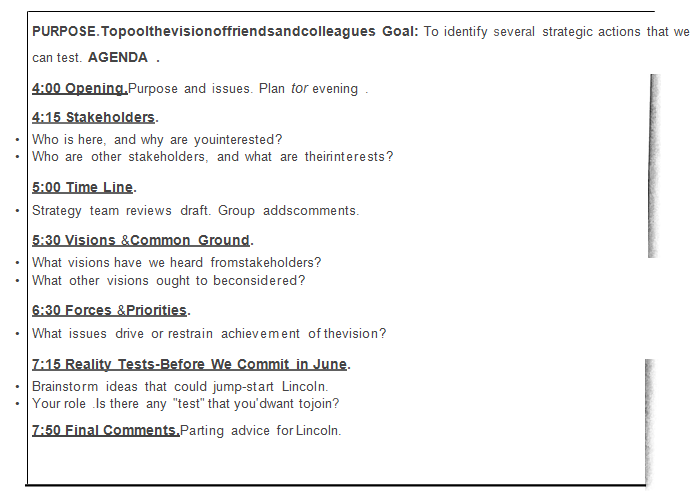
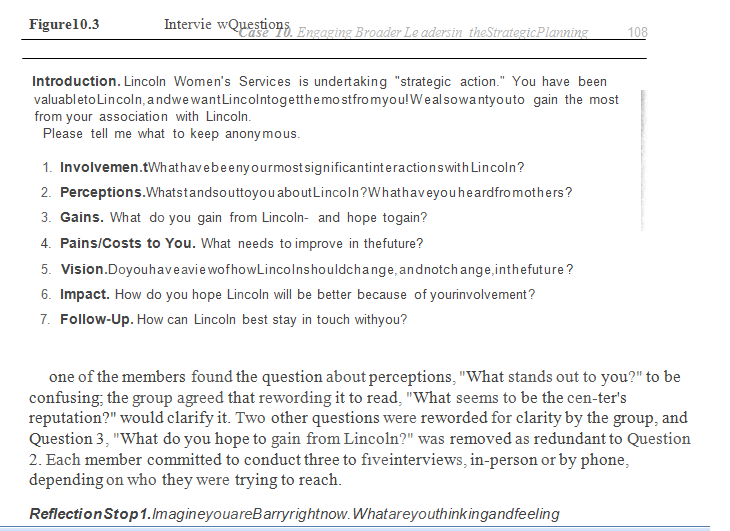
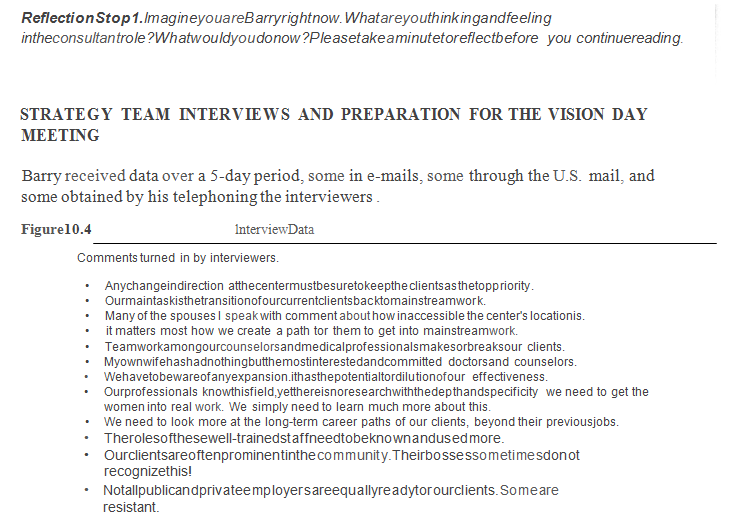
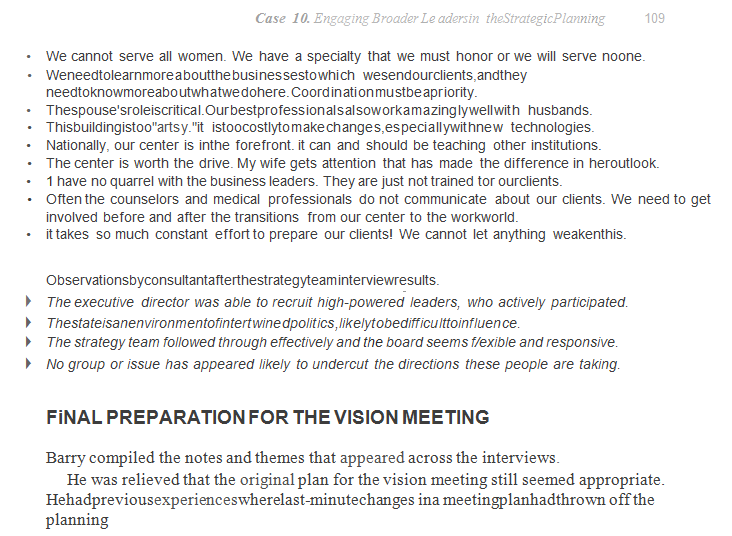
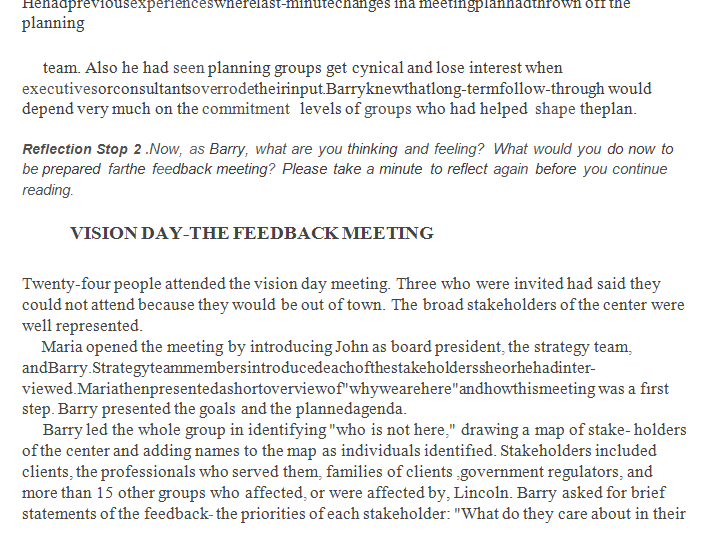
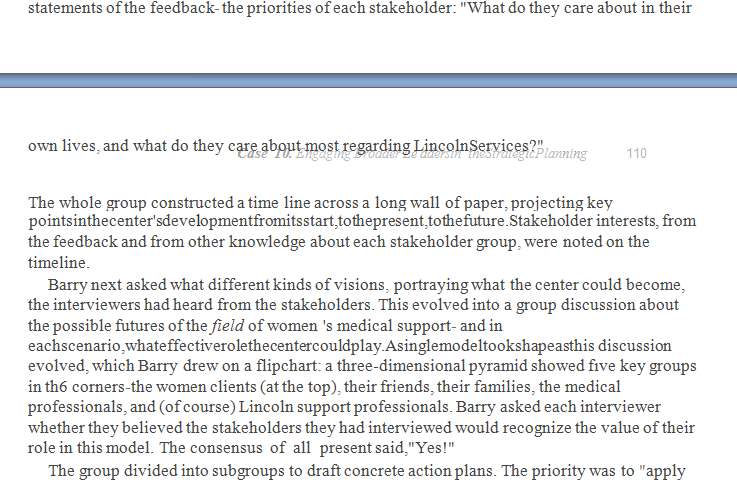
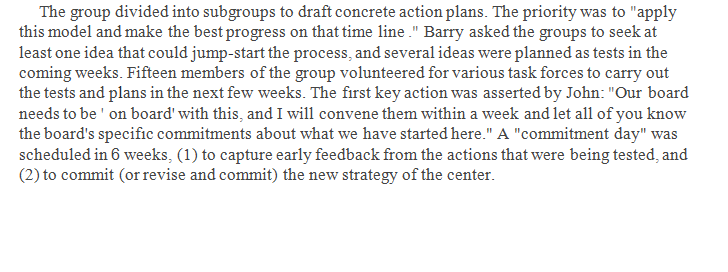
ENGAGINGBROADERLEADERSINTHESTRATEGICPLANNINGOF LINCOLNWOMEN'SSERvicEs Learning Objectives To sharpen your negotiation for effective feedback on the first contact with aclient. To encourage you to promote safe, early tests that provide empirical feedback-quickly confirming, refuting, or expanding perception data from surveys or interviews. To keep your eye on whatever continues after the intervention - in the situations and actions that are usually much more important than the intervention or its directresults. Maria Worthington was looking for a strategic planning facilitator for the Lincoln Women's Services Center, a not-for-profit organization that focuses on the career progressofyoungwomenwithmoderatetoseveremedical conditionsinaneastem U.S.city." Maria, the executive director, and John Balmore, the board chair, were referred to Barry Kravich, an OD consultant with many years of strategic planning experience in a wide variety of institutions, yet who had no background in the center's professionalspecialty. INITIAL AGREEMENTS ABOUT THE PRIORITIES AND APPROACH INITIAL AGREEMENTS ABOUT THE PRIORITIES AND APPROACH In the first meeting when Barry asked Maria foran overview ofthe situation, she emphasized that the center was growing steadily. "We have been enjoying success because we make a difference in the lives of women who often face a difficult time at work yet have strong career abilities. We have the funding, and we have the support." However, there was a very physical obstacle to their growth: "Our officesshare this building with another state-sponsored program, and they also need the space." Their landlord a progressive state govemment, was not in a position to initiate new construction on the architectural-landmark structure, located in a densely built urban neighbor-hood. "There is no easy place to expand, and our reputation depends on maintaining the continuity we have achieved in this unified space." Maria foresaw a potentially difficult competition with the other program Barry inquired about the interests of various people associated with the center, and Maria saw value in Barry's proposal to forma strategy team that could represent stake-holders beyond the board and staff. This temporary team would interview a broad array of groups affected by the center's programs, including spouses of clients, medical profes-sionals, the businesses they served the state, and respected leaders in their professional field. Getting input from a full range of stakeholders would create opportunities to con- sider a full range of strategic issues- including issues that may have unexpected bearing on the space squeeze. The strategy team would be advisory. They would not determine strategy, but would communicateaboutitandhelpidentifyoptionsappropriateforthecenter Strategywould remain the board's responsibility, informed by Maria as executive director as well as the strategy team'sresults. The center had received acceptance for a government grant supporting strategic plan- ning The center had received acceptance for a government grant supporting strategic plan- ning, and the government agency would require updates on theprogress. Barry probed to identify as wide a range of stakeholders as possible. He applied a "circle" model of stakeholders, to draw out "who affects us and who do we affect?" Maria easily identified a breadth of stakeholders, including experts from the profes- sionalfield on which the center was based, serving medically disadvantaged women. Mariabelievedthatthefieldexpertslikelywouldbeinterestedinaddingtheirperspective in the center's planning and would also be served themselves by the involvement with this institution Barry offered two questions for recruiting a team that could initiate sustainable strate-gic planning. (1) Can leaders be chosen who together will have enough influence to get the strategy executed? (2) Would some try to control the direction to their own biases instead of working as a team? Maria conferred with John for the board perspective, and key board members agreed that Maria had the professional relationships that could enable her to recruit a team with sufficientstature and interest in the cause. Barrysuggestedastartingtemplate: twospousesofclients twoemployees(represent-ing professionals and staff) and two medical leaders from outside the center. This group would need to include at least one active board member and one person well-connected to the businesses that theyserved. INTERNAL STAKEHOLDERS Mariarecruitedanappropriatemix.Infact ninestaffandvolunteerleaderscommitted to serve on the strategyteam Figure10.1 Stake holder Map Template Potential Clients Allied Services Referral Clients Sources Competitors Community Public C Influence Contact Services LHOLDERS EXTERNAL Protection Support Enemies Financial Sources Leadership Professional Connections Case 10. Engaging Broader Leadersin the StrategicPlanning 107 AGREEMENTS WITH THE STRATEGY TEAM Barryasked Mariatoarrangeakickoff meetingwiththestrategyteam. With theschedul-ing difficulties of busy professionals, two were unable to attend the evening options she offered. For practicality, they set a date that those two had tomiss. In the kickoff meeting, Barry offered a template for the interviews of the center's stakeholders and a general outline for the first "vision meeting," in which the feedback from the interviews would be reviewed. The vision meeting also would have the goal of drafting an initial vision for the strategic plan. "I'd like you to critique the questions for the interviews and also the agenda for the larger meeting. This hopefully will help pull you together as a team-and besides, you will be the ones conducting the interviews." Barry suggested that even more important thanthedata-themostcriticalpurposeoftheinterviewswastostrengthenrelationships with the key stakeholders of the center. This approach also saved significant consulting fees, which they allapproved! Barry introduced a potential set of questions for the interviews. Figure10.2 Vision Meeting- Tentative Agenda PURPOSE. Topoolthevisionoffriendsandcolleagues Goal: To identify several strategic actions that we can test. AGENDA. PURPOSE. Topoolthevisionoffriendsandcolleagues Goal: To identify several strategic actions that we can test. AGENDA. 4:00 Opening.Purpose and issues. Plan tor evening 4:15 Stakeholders. Who is here, and why are youinterested? Who are other stakeholders, and what are theirinterests? 5:00 Time Line Strategy team reviews draft. Group addscomments. 5:30 Visions & Common Ground. What visions have we heard fromstakeholders? What other visions ought to beconsidered? 6:30 Forces &Priorities. What issues drive or restrain achievement of thevision? 7:15 Reality Tests-Before We Commit in June. Brainstorm ideas that could jump-start Lincoln Your role Is there any "test" that you'dwant tojoin? 7:50 Final Comments.Parting advice for Lincoln. Figure10.3 Intervie wQuestions. Engaging Broader Leadersin theStrategicPlanning 108 Introduction. Lincoln Women's Services is undertaking "strategic action." You have been valuableto Lincoln, andwewantLincolntogetthe mostfromyou! We alsowantyouto gain the most from your association with Lincoln. Please tell me what to keep anonymous 1. Involvemen.tWhat havebeenyourmostsignificantinteractionswith Lincoln? 2. Perceptions.Whatstandsouttoyou aboutLincoln?Whathaveyou heardfro mothers? 3. Gains. What do you gain from Lincoln- and hope togain? 4. Pains/Costs to You. What needs to improve in the future? 5. Vision.DoyouhaveaviewofhowLincolnshouldchange andnotchange,inthefuture? 6. Impact. How do you hope Lincoln will be better because of yourinvolvement? 7. Follow-Up. How can Lincoln best stay in touch withyou? one of the members found the question about perceptions, "What stands out to you?" to be confusing, the group agreed that rewording it to read, "What seems to be the cen-ter's reputation?" would clarify it. Two other questions were reworded for clarity by the group, and Question 3, "What do you hope to gain from Lincoln?" was removed as redundant to Question 2. Each member committed to conduct three to fiveinterviews, in-person or by phone, depending on who they were trying to reach. Reflection Stop 1. ImagineyouareBarryrightnow. Whatareyouthinkingandfeeling Reflection Stop 1.ImagineyouareBarryrightnow. Whatareyouthinkingandfeeling intheconsultantrole? Whatwouldyoudonow?Pleasetakeaminutetoreflectbefore you continuereading. STRATEGY TEAM INTERVIEWS AND PREPARATION FOR THE VISION DAY MEETING Barry received data over a 5-day period, some in e-mails, some through the U.S. mail, and some obtained by his telephoning the interviewers. Figure10.4 InterviewData Comments turned in by interviewers. Anychangeindirection atthecentermustbesuretokeepthe clients asthetoppriority. Ourmaintaskisthetransitionofourcurrentclientsbacktomainstreamwork. Many of the spouses I speak with comment about how inaccessible the center's locationis. it matters most how we create a path tor them to get into mainstreamwork. Teamworkamongourcounselorsandmedicalprofessionalsmakesorbreaksour clients. Myownwifehashadnothingbutthemostinterestedandcommitted doctorsand counselors. Wehavetobewareofanyexpansion.ithasthepotentialtordilutionofour effectiveness. Ourprofessionals knowthisfield,yetthereisnoresearchwiththedepthandspecificity we need to get the women into real work. We simply need to learn much more about this. We need to look more at the long-term career paths of our clients, beyond their previousjobs. Therolesofthesewell-trainedstaffneedtobeknownandusedmore. Ourclientsareoftenprominentinthe community. Theirbossessometime sdonot recognizethis! Notallpublicandprivateemployersareequallyreadytorourclients. Someare resistant Case 10. Engaging Broader Leadersin the StrategicPlanning 109 We cannot serve all women. We have a specialty that we must honor or we will serve noone. Weneedtolearnmoreaboutthe businessesto which wesendourclients, andthey needtoknowmoreaboutwhatwedohere. Coordination mustbe apriority. Thespouse'sroleiscritical.Ourbestprofessionals alsoworkamazinglywell with husbands. Thisbuildingistoo"artsy."it istoocostlyto make changes, especiallywithnew technologies. Nationally, our center is inthe forefront. it can and should be teaching other institutions. The center is worth the drive. My wife gets attention that has made the difference in heroutlook. 1 have no quarrel with the business leaders. They are just not trained tor ourclients. Often the counselors and medical professionals do not communicate about our clients. We need to get involved before and after the transitions from our center to the workworld. it takes so much constant effort to prepare our clients! We cannot let anything weakenthis. Observationsbyconsultantafterthestrategyteaminterviewresults. The executive director was able to recruit high-powered leaders, who actively participated. Thestateisanenvironmentofintertwinedpolitics, likelytobedifficulttoinfluence. The strategy team followed through effectively and the board seems f/exible and responsive. No group or issue has appeared likely to undercut the directions these people are taking. FINAL PREPARATION FOR THE VISION MEETING Barry compiled the notes and themes that appeared across the interviews. He was relieved that the original plan for the vision meeting still seemed appropriate. Hehadpreviousexperienceswherelast-minutechanges ina meetingplanhadthrown off the planning Henaopreviousexperienceswherelast-minutechanges ina meetingplannaathrown on the planning team. Also he had seen planning groups get cynical and lose interest when executivesorconsultantsoverrodetheirinput.Barryknewthatlong-termfollow-through would depend very much on the commitment levels of groups who had helped shape theplan. Reflection Stop 2.Now, as Barry, what are you thinking and feeling? What would you do now to be prepared farthe feedback meeting? Please take a minute to reflect again before you continue reading VISION DAY-THE FEEDBACK MEETING Twenty-four people attended the vision day meeting. Three who were invited had said they could not attend because they would be out of town. The broad stakeholders of the center were well represented. Maria opened the meeting by introducing John as board president, the strategy team, andBarry Strategyteammembersintroducedeachofthestakeholderssheorhehadinter- viewed. Mariathenpresentedashortoverviewof"whywearehere"andhowthismeeting was a first step. Barry presented the goals and the plannedagenda. Barry led the whole group in identifying "who is not here," drawing a map of stake-holders of the center and adding names to the map as individuals identified. Stakeholders included clients, the professionals who served them families of clients government regulators, and more than 15 other groups who affected or were affected by, Lincoln. Barry asked for brief statements of the feedback-the priorities of each stakeholder: "What do they care about in their statements of the feedback-the priorities of each stakeholder: "What do they care about in their own lives, and what do they care about most regarding LincolnServices Planning 110 The whole group constructed a time line across a long wall of paper, projecting key pointsinthecenter'sdevelopmentfromitsstart,tothepresent, tothefuture Stakeholder interests, from the feedback and from other knowledge about each stakeholder group were noted on the timeline. Barry next asked what different kinds of visions, portraying what the center could become, the interviewers had heard from the stakeholders. This evolved into a group discussion about the possible futures of the field of women 's medical support and in eachscenario, whateffectiverolethecentercouldplay.Asinglemodeltookshapeasthis discussion evolved, which Barry drew on a flipchart: a three-dimensional pyramid showed five key groups in th6 corners-the women clients at the top), their friends, their families, the medical professionals, and of course) Lincoln support professionals. Barry asked each interviewer whether they believed the stakeholders they had interviewed would recognize the value of their role in this model. The consensus of all present said, "Yes!" The group divided into subgroups to draft concrete action plans. The priority was to "apply The group divided into subgroups to draft concrete action plans. The priority was to "apply this model and make the best progress on that time line." Barry asked the groups to seek at least one idea that could jump-start the process, and several ideas were planned as tests in the coming weeks. Fifteen members of the group volunteered for various task forces to carry out the tests and plans in the next few weeks. The first key action was asserted by John: "Our board needs to be on board' with this, and I will convene them within a week and let all of you know the board's specific commitments about what we have started here." A "commitment day" was scheduled in 6 weeks, (1) to capture early feedback from the actions that were being tested and (2) to commit (or revise and commit) the new strategy of the center. 2. To whom do you believe feedback should be presented? What advantages and disadvantages do you see in presenting this feedback to staff only, to the board (or a board committee), or to a group larger than the 24 who were there? ENGAGINGBROADERLEADERSINTHESTRATEGICPLANNINGOF LINCOLNWOMEN'SSERvicEs Learning Objectives To sharpen your negotiation for effective feedback on the first contact with aclient. To encourage you to promote safe, early tests that provide empirical feedback-quickly confirming, refuting, or expanding perception data from surveys or interviews. To keep your eye on whatever continues after the intervention - in the situations and actions that are usually much more important than the intervention or its directresults. Maria Worthington was looking for a strategic planning facilitator for the Lincoln Women's Services Center, a not-for-profit organization that focuses on the career progressofyoungwomenwithmoderatetoseveremedical conditionsinaneastem U.S.city." Maria, the executive director, and John Balmore, the board chair, were referred to Barry Kravich, an OD consultant with many years of strategic planning experience in a wide variety of institutions, yet who had no background in the center's professionalspecialty. INITIAL AGREEMENTS ABOUT THE PRIORITIES AND APPROACH INITIAL AGREEMENTS ABOUT THE PRIORITIES AND APPROACH In the first meeting when Barry asked Maria foran overview ofthe situation, she emphasized that the center was growing steadily. "We have been enjoying success because we make a difference in the lives of women who often face a difficult time at work yet have strong career abilities. We have the funding, and we have the support." However, there was a very physical obstacle to their growth: "Our officesshare this building with another state-sponsored program, and they also need the space." Their landlord a progressive state govemment, was not in a position to initiate new construction on the architectural-landmark structure, located in a densely built urban neighbor-hood. "There is no easy place to expand, and our reputation depends on maintaining the continuity we have achieved in this unified space." Maria foresaw a potentially difficult competition with the other program Barry inquired about the interests of various people associated with the center, and Maria saw value in Barry's proposal to forma strategy team that could represent stake-holders beyond the board and staff. This temporary team would interview a broad array of groups affected by the center's programs, including spouses of clients, medical profes-sionals, the businesses they served the state, and respected leaders in their professional field. Getting input from a full range of stakeholders would create opportunities to con- sider a full range of strategic issues- including issues that may have unexpected bearing on the space squeeze. The strategy team would be advisory. They would not determine strategy, but would communicateaboutitandhelpidentifyoptionsappropriateforthecenter Strategywould remain the board's responsibility, informed by Maria as executive director as well as the strategy team'sresults. The center had received acceptance for a government grant supporting strategic plan- ning The center had received acceptance for a government grant supporting strategic plan- ning, and the government agency would require updates on theprogress. Barry probed to identify as wide a range of stakeholders as possible. He applied a "circle" model of stakeholders, to draw out "who affects us and who do we affect?" Maria easily identified a breadth of stakeholders, including experts from the profes- sionalfield on which the center was based, serving medically disadvantaged women. Mariabelievedthatthefieldexpertslikelywouldbeinterestedinaddingtheirperspective in the center's planning and would also be served themselves by the involvement with this institution Barry offered two questions for recruiting a team that could initiate sustainable strate-gic planning. (1) Can leaders be chosen who together will have enough influence to get the strategy executed? (2) Would some try to control the direction to their own biases instead of working as a team? Maria conferred with John for the board perspective, and key board members agreed that Maria had the professional relationships that could enable her to recruit a team with sufficientstature and interest in the cause. Barrysuggestedastartingtemplate: twospousesofclients twoemployees(represent-ing professionals and staff) and two medical leaders from outside the center. This group would need to include at least one active board member and one person well-connected to the businesses that theyserved. INTERNAL STAKEHOLDERS Mariarecruitedanappropriatemix.Infact ninestaffandvolunteerleaderscommitted to serve on the strategyteam Figure10.1 Stake holder Map Template Potential Clients Allied Services Referral Clients Sources Competitors Community Public C Influence Contact Services LHOLDERS EXTERNAL Protection Support Enemies Financial Sources Leadership Professional Connections Case 10. Engaging Broader Leadersin the StrategicPlanning 107 AGREEMENTS WITH THE STRATEGY TEAM Barryasked Mariatoarrangeakickoff meetingwiththestrategyteam. With theschedul-ing difficulties of busy professionals, two were unable to attend the evening options she offered. For practicality, they set a date that those two had tomiss. In the kickoff meeting, Barry offered a template for the interviews of the center's stakeholders and a general outline for the first "vision meeting," in which the feedback from the interviews would be reviewed. The vision meeting also would have the goal of drafting an initial vision for the strategic plan. "I'd like you to critique the questions for the interviews and also the agenda for the larger meeting. This hopefully will help pull you together as a team-and besides, you will be the ones conducting the interviews." Barry suggested that even more important thanthedata-themostcriticalpurposeoftheinterviewswastostrengthenrelationships with the key stakeholders of the center. This approach also saved significant consulting fees, which they allapproved! Barry introduced a potential set of questions for the interviews. Figure10.2 Vision Meeting- Tentative Agenda PURPOSE. Topoolthevisionoffriendsandcolleagues Goal: To identify several strategic actions that we can test. AGENDA. PURPOSE. Topoolthevisionoffriendsandcolleagues Goal: To identify several strategic actions that we can test. AGENDA. 4:00 Opening.Purpose and issues. Plan tor evening 4:15 Stakeholders. Who is here, and why are youinterested? Who are other stakeholders, and what are theirinterests? 5:00 Time Line Strategy team reviews draft. Group addscomments. 5:30 Visions & Common Ground. What visions have we heard fromstakeholders? What other visions ought to beconsidered? 6:30 Forces &Priorities. What issues drive or restrain achievement of thevision? 7:15 Reality Tests-Before We Commit in June. Brainstorm ideas that could jump-start Lincoln Your role Is there any "test" that you'dwant tojoin? 7:50 Final Comments.Parting advice for Lincoln. Figure10.3 Intervie wQuestions. Engaging Broader Leadersin theStrategicPlanning 108 Introduction. Lincoln Women's Services is undertaking "strategic action." You have been valuableto Lincoln, andwewantLincolntogetthe mostfromyou! We alsowantyouto gain the most from your association with Lincoln. Please tell me what to keep anonymous 1. Involvemen.tWhat havebeenyourmostsignificantinteractionswith Lincoln? 2. Perceptions.Whatstandsouttoyou aboutLincoln?Whathaveyou heardfro mothers? 3. Gains. What do you gain from Lincoln- and hope togain? 4. Pains/Costs to You. What needs to improve in the future? 5. Vision.DoyouhaveaviewofhowLincolnshouldchange andnotchange,inthefuture? 6. Impact. How do you hope Lincoln will be better because of yourinvolvement? 7. Follow-Up. How can Lincoln best stay in touch withyou? one of the members found the question about perceptions, "What stands out to you?" to be confusing, the group agreed that rewording it to read, "What seems to be the cen-ter's reputation?" would clarify it. Two other questions were reworded for clarity by the group, and Question 3, "What do you hope to gain from Lincoln?" was removed as redundant to Question 2. Each member committed to conduct three to fiveinterviews, in-person or by phone, depending on who they were trying to reach. Reflection Stop 1. ImagineyouareBarryrightnow. Whatareyouthinkingandfeeling Reflection Stop 1.ImagineyouareBarryrightnow. Whatareyouthinkingandfeeling intheconsultantrole? Whatwouldyoudonow?Pleasetakeaminutetoreflectbefore you continuereading. STRATEGY TEAM INTERVIEWS AND PREPARATION FOR THE VISION DAY MEETING Barry received data over a 5-day period, some in e-mails, some through the U.S. mail, and some obtained by his telephoning the interviewers. Figure10.4 InterviewData Comments turned in by interviewers. Anychangeindirection atthecentermustbesuretokeepthe clients asthetoppriority. Ourmaintaskisthetransitionofourcurrentclientsbacktomainstreamwork. Many of the spouses I speak with comment about how inaccessible the center's locationis. it matters most how we create a path tor them to get into mainstreamwork. Teamworkamongourcounselorsandmedicalprofessionalsmakesorbreaksour clients. Myownwifehashadnothingbutthemostinterestedandcommitted doctorsand counselors. Wehavetobewareofanyexpansion.ithasthepotentialtordilutionofour effectiveness. Ourprofessionals knowthisfield,yetthereisnoresearchwiththedepthandspecificity we need to get the women into real work. We simply need to learn much more about this. We need to look more at the long-term career paths of our clients, beyond their previousjobs. Therolesofthesewell-trainedstaffneedtobeknownandusedmore. Ourclientsareoftenprominentinthe community. Theirbossessometime sdonot recognizethis! Notallpublicandprivateemployersareequallyreadytorourclients. Someare resistant Case 10. Engaging Broader Leadersin the StrategicPlanning 109 We cannot serve all women. We have a specialty that we must honor or we will serve noone. Weneedtolearnmoreaboutthe businessesto which wesendourclients, andthey needtoknowmoreaboutwhatwedohere. Coordination mustbe apriority. Thespouse'sroleiscritical.Ourbestprofessionals alsoworkamazinglywell with husbands. Thisbuildingistoo"artsy."it istoocostlyto make changes, especiallywithnew technologies. Nationally, our center is inthe forefront. it can and should be teaching other institutions. The center is worth the drive. My wife gets attention that has made the difference in heroutlook. 1 have no quarrel with the business leaders. They are just not trained tor ourclients. Often the counselors and medical professionals do not communicate about our clients. We need to get involved before and after the transitions from our center to the workworld. it takes so much constant effort to prepare our clients! We cannot let anything weakenthis. Observationsbyconsultantafterthestrategyteaminterviewresults. The executive director was able to recruit high-powered leaders, who actively participated. Thestateisanenvironmentofintertwinedpolitics, likelytobedifficulttoinfluence. The strategy team followed through effectively and the board seems f/exible and responsive. No group or issue has appeared likely to undercut the directions these people are taking. FINAL PREPARATION FOR THE VISION MEETING Barry compiled the notes and themes that appeared across the interviews. He was relieved that the original plan for the vision meeting still seemed appropriate. Hehadpreviousexperienceswherelast-minutechanges ina meetingplanhadthrown off the planning Henaopreviousexperienceswherelast-minutechanges ina meetingplannaathrown on the planning team. Also he had seen planning groups get cynical and lose interest when executivesorconsultantsoverrodetheirinput.Barryknewthatlong-termfollow-through would depend very much on the commitment levels of groups who had helped shape theplan. Reflection Stop 2.Now, as Barry, what are you thinking and feeling? What would you do now to be prepared farthe feedback meeting? Please take a minute to reflect again before you continue reading VISION DAY-THE FEEDBACK MEETING Twenty-four people attended the vision day meeting. Three who were invited had said they could not attend because they would be out of town. The broad stakeholders of the center were well represented. Maria opened the meeting by introducing John as board president, the strategy team, andBarry Strategyteammembersintroducedeachofthestakeholderssheorhehadinter- viewed. Mariathenpresentedashortoverviewof"whywearehere"andhowthismeeting was a first step. Barry presented the goals and the plannedagenda. Barry led the whole group in identifying "who is not here," drawing a map of stake-holders of the center and adding names to the map as individuals identified. Stakeholders included clients, the professionals who served them families of clients government regulators, and more than 15 other groups who affected or were affected by, Lincoln. Barry asked for brief statements of the feedback-the priorities of each stakeholder: "What do they care about in their statements of the feedback-the priorities of each stakeholder: "What do they care about in their own lives, and what do they care about most regarding LincolnServices Planning 110 The whole group constructed a time line across a long wall of paper, projecting key pointsinthecenter'sdevelopmentfromitsstart,tothepresent, tothefuture Stakeholder interests, from the feedback and from other knowledge about each stakeholder group were noted on the timeline. Barry next asked what different kinds of visions, portraying what the center could become, the interviewers had heard from the stakeholders. This evolved into a group discussion about the possible futures of the field of women 's medical support and in eachscenario, whateffectiverolethecentercouldplay.Asinglemodeltookshapeasthis discussion evolved, which Barry drew on a flipchart: a three-dimensional pyramid showed five key groups in th6 corners-the women clients at the top), their friends, their families, the medical professionals, and of course) Lincoln support professionals. Barry asked each interviewer whether they believed the stakeholders they had interviewed would recognize the value of their role in this model. The consensus of all present said, "Yes!" The group divided into subgroups to draft concrete action plans. The priority was to "apply The group divided into subgroups to draft concrete action plans. The priority was to "apply this model and make the best progress on that time line." Barry asked the groups to seek at least one idea that could jump-start the process, and several ideas were planned as tests in the coming weeks. Fifteen members of the group volunteered for various task forces to carry out the tests and plans in the next few weeks. The first key action was asserted by John: "Our board needs to be on board' with this, and I will convene them within a week and let all of you know the board's specific commitments about what we have started here." A "commitment day" was scheduled in 6 weeks, (1) to capture early feedback from the actions that were being tested and (2) to commit (or revise and commit) the new strategy of the center. 2. To whom do you believe feedback should be presented? What advantages and disadvantages do you see in presenting this feedback to staff only, to the board (or a board committee), or to a group larger than the 24 who were thereStep by Step Solution
There are 3 Steps involved in it
1 Expert Approved Answer
Step: 1 Unlock

Question Has Been Solved by an Expert!
Get step-by-step solutions from verified subject matter experts
Step: 2 Unlock
Step: 3 Unlock
 Study Help