







Question: I have Prepared below Implementation strategy for the above case could you please review it and advice if its fine to proceed with my assignment?
I have Prepared below Implementation strategy for the above case could you please review it and advice if its fine to proceed with my assignment?
Strategic implementation:
Sony should be concerned to do important restructuring and development so as to compete with Apple incorporation. All the formulated strategies and tactics against immediate competitors will be implemented at this stage.
Strategy planning concern the future.
It is the process of obtaining the goals set by the management for the company for the future and how they can achieve it.
It looks at the wider picture and usually its flexible when it comes to achievement of goals for the organization.
Company Sony led behind as company Apple had launched new division of gadgets in music such as I-pod, I-pad etc. Though Apple took over the market, Sony was successful in bringing out products such as portable music player, gaming device, compact disc, laptop computer and many more due to close interaction among the diversified units.
Sony is an example of what happens when a company falls blindly in love with its brand Tim Calkins, a marketing professor at northwestern university
The corporate structure of Sony is a conglomerate with distinct and unrelated businesses. There are about eight major business divisions spread across the globe with one CEO for entire organization. But, the profit and loss of the separate businesses are consolidated at the top Sony management.
Sony, at present seem to have lesser resources to drive all the business units, because most of the business units are not growing as much as other companies in the respective industries. The company is lacking sharp business focus, integrating leadership, coordinated organizational structure and sufficient resources to drive the business growth
- Too Broad business spectrum made todays Sony
- Sony was the king of electronics, but now are in nowhere
Splitting Sony
The benefits of splitting Sony as proposed can gain the lost business focus, can hire responsible and well-coordinated organization, innovation of new products, and sharper marketing efforts.
However, the division of the company shall put complex challenges on the employees of the organization, because they are not exposed to cross functional and collectively responding operations.
Benefits
- Independently managed businesses leading maximized profits
- Improved managerial focus on each business leading more suitable strategies
Drawbacks
- Requires thorough preparation
- Often take years of steady work
- Many resources and departments need to be allocated
Recommendations to restructure Sony
Sony should incorporate independent CEOs for each division in the business units as due to lack of higher management, the company is facing problem. The apex management can act as a coordinating and guiding mechanism to these business units to bring focus to the business activities and respond to the market needs quickly.
- 8 restructuring efforts in past 13 years, but all failed
- They failed to track consumer preference, was lack of consolidation of business groups and faced with heavy restructuring costs
- They need to reinvent their R&D and marketing department
- They need to regain their focus and core competencies like their quality and differentiated products.
Things Sony Can do to improve its productivity
- Focus resources on understanding consumers and develop digital eco-system to retain and attract consumers instead of trying competitors
- Have a centralized headquarter where key management forms the cross-functional team to manage the division (top-down approach)
- Invest more resources into core business instead of overdiversifying to other services as their non-core businesses (e.g. financial services) outperform their core business (e.g. mobile products & communications)
- all these needs a clear strategy/vision to operate effectively (otherwise each division will still operate on its own)
- Cannibalizes its own business, Sony must be more willing to not stick to its same own winning formula
- Apple scanned its landscape & looked beyond the horizon to come up with new products (scan product landscape & engage in trend spotting) Japan, Taiwan (science park: high patent filing rates)
Sonys Generic Strategy (Porters Model)
Sony Corporation uses differentiation as its generic strategy for competitive advantage. Differentiation involves products that are unique in comparison to other products in the market. In applying this generic strategy, Sony integrates features that make its products attractive and profitable. For example, novelty and uniqueness were among the factors that lead to the success of the PlayStation. In using the differentiation generic strategy, Sony must continue innovating novel product features to take care of competitive advantage against competitors like Nintendo.
The differentiation generic competitive strategy highlights the importance of product uniqueness in ensuring profitable business. In applying differentiation, a strategic objective is to extend the speed of innovation to spice up Sonys competitive advantage. A financial objective supported this generic strategy is to attenuate production costs altogether segments of the business. Fulfilling this objective contributes to competitive advantage by increasing Sonys business efficiency and corresponding profitability.
Sonys Intensive Strategies (Intensive Growth Strategies)
- Market Penetration.
Sony Corporations primary intensive growth strategy is penetration. This intensive strategy aims to grow the business by increasing sales in markets where the corporate currently operates. For example, Sony grows its business by intensifying its marketing campaigns to sell more PlayStation units. The objective is to attract more customers and obtain a larger market share. Sony uses its differentiation generic strategy to make competitive advantage to support penetration. In implementing the penetration intensive growth strategy, product uniqueness enables the corporate to draw in and retain more customers. A strategic objective linked to the present intensive strategy is to flexibly adjust marketing campaigns to make sure Sonys competitiveness against other firms within the financial services, entertainment, gaming, and electronics markets.
- Product Development.
Product development is applied as a secondary intensive strategy to grow Sonys business. In this intensive growth strategy, the goal is to develop products better than the competition. For example, Sony continues to innovate its gaming products, which are a key growth driver that outperforms competitors. This intensive growth strategy supports the generic strategy of differentiation in terms of product design. Sonys innovation efforts make sure that novel and unique products features are emphasized. A strategic objective supported the merchandise development intensive strategy is to grow the corporate by rolling out new breakthrough products. These products must possess competitive advantage supported novel features or design that embody Sonys mission statement and vision statement.
- Market Development.
Sony Corporation uses market development as a supporting intensive growth strategy. The company grows by entering new markets or market segments in implementing this intensive strategy. For example, Sony can introduce its products to developing markets where it still doesn't have major presence. The company can also find a new application for its products to create a new market for them. Sonys generic competitive strategy of differentiation supports this intensive strategy by making products attractive to new target customers. Based on market development, a strategic objective is to grow the corporate by entering new market segments.
- Diversification.
Diversification is that the least significant among Sonys intensive growth strategies. Growth through new business development is that the goal of this intensive strategy. Diversifications significance has decreased due to Sonys decision to specialize in fewer products. These products have the very best competitive advantage within the product mix (Read: Sonys Marketing Mix). For example, the corporate now focuses on three main businesses: (1) Devices, Game and Network Services, (2) Pictures, and (3) Music. The generic strategy of differentiation is applied during this intensive strategy in terms of using product uniqueness to make competitive advantage necessary to grow Sonys core businesses. This intensive growth strategy results in the strategic objective of finding new business opportunities to expand the corporate.
They appointed the first foreign chairman, Howard Stringer to head the company with the aim to secure Sonys main ground and hope that an outsider will assist Sony to think outside the box that is different from what every Indian think and does.
Sony is also working on the green environment and providing the customers not only equipment which provide them best musical or gaming experience but also which are environmental friendly to play it part in making the world a green world and being giving the customers the image of the social responsibility of the company and building its reputation back which has been damage due to all the bad strategic choices made by the company management in the past.
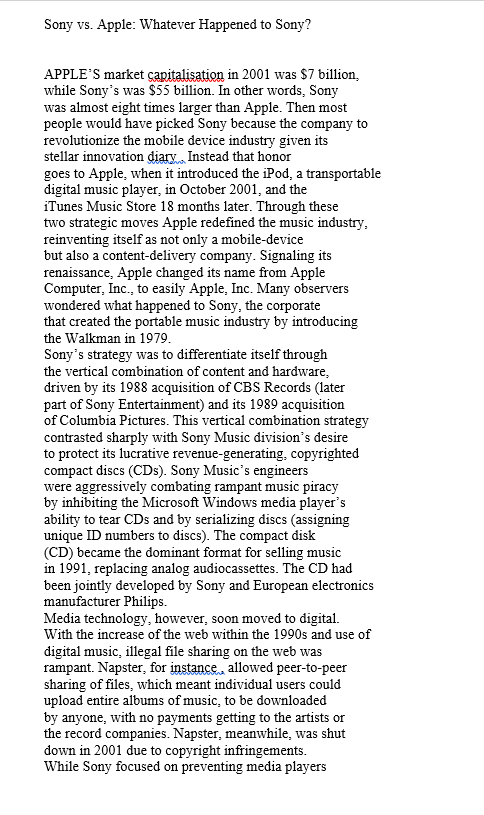
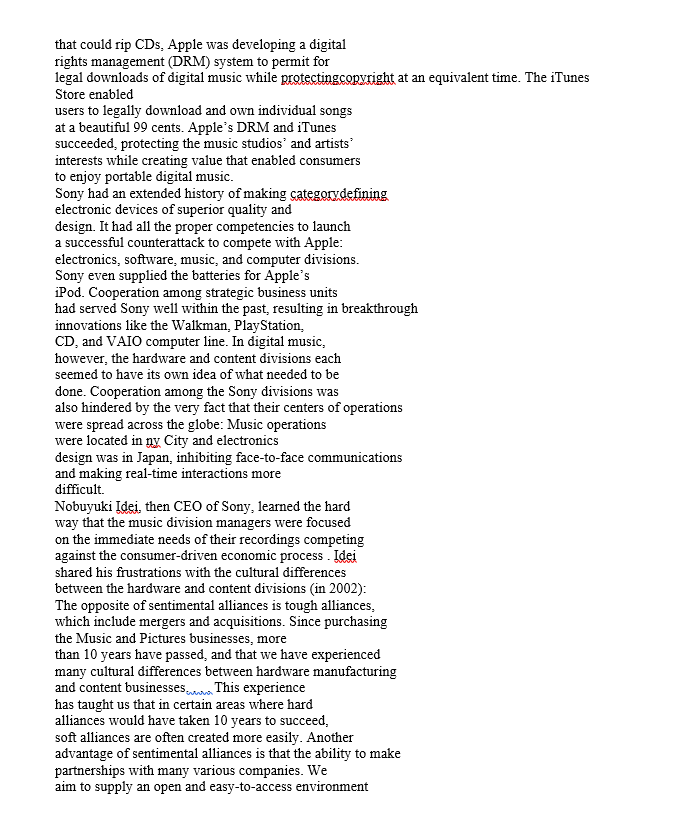
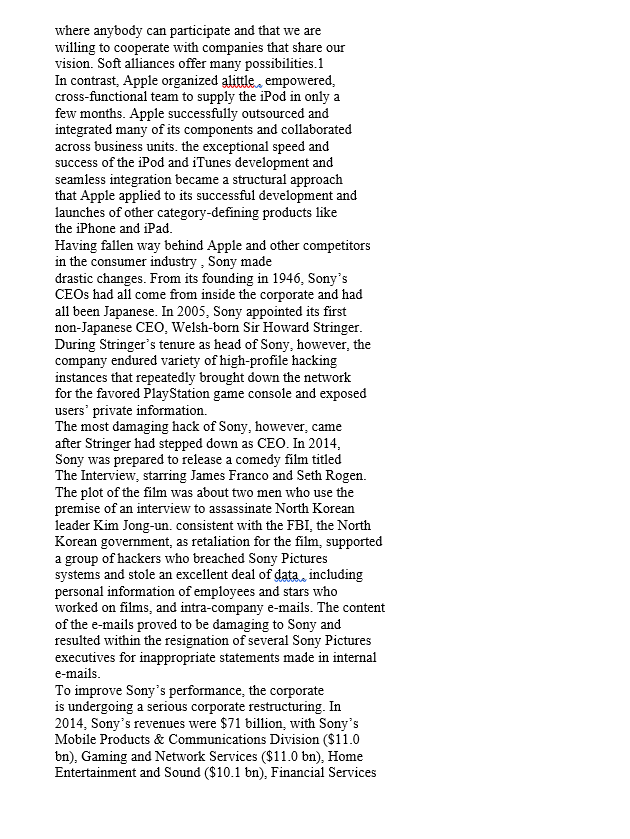
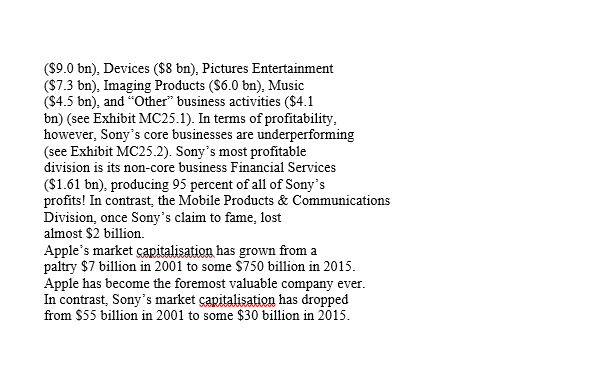
that could rip CDs. Apple was developing a digital rights management (DRM) system to permit for legal downloads of digital music while protectingcopyright at an equivalent time. The iTunes Store enabled users to legally download and own individual songs at a beautiful 99 cents. Apple's DRM and iTunes succeeded, protecting the music studios' and artists interests while creating value that enabled consumers to enjoy portable digital music. Sony had an extended history of making categorydefining electronic devices of superior quality and design. It had all the proper competencies to launch a successful counterattack to compete with Apple: electronics, software, music, and computer divisions. Sony even supplied the batteries for Apple's iPod. Cooperation among strategic business units had served Sony well within the past, resulting in breakthrough innovations like the Walkman, PlayStation CD, and VAIO computer line. In digital music, however, the hardware and content divisions each seemed to have its own idea of what needed to be done. Cooperation among the Sony divisions was also hindered by the very fact that their centers of operations were spread across the globe: Music operations were located in ny City and electronics design was in Japan, inhibiting face-to-face communications and making real-time interactions more difficult. Nobuyuki Idei, then CEO of Sony, learned the hard way that the music division managers were focused on the immediate needs of their recordings competing against the consumer-driven economic process. Idei shared his frustrations with the cultural differences between the hardware and content divisions (in 2002): The opposite of sentimental alliances is tough alliances, which include mergers and acquisitions. Since purchasing the Music and Pictures businesses, more than 10 years have passed, and that we have experienced many cultural differences between hardware manufacturing and content businesses. This experience has taught us that in certain areas where hard alliances would have taken 10 years to succeed, soft alliances are often created more easily. Another advantage of sentimental alliances is that the ability to make partnerships with many various companies. We aim to supply an open and easy-to-access environment where anybody can participate and that we are willing to cooperate with companies that share our vision. Soft alliances offer many possibilities.1 In contrast, Apple organized alittle empowered, cross-functional team to supply the iPod in only a few months. Apple successfully outsourced and integrated many of its components and collaborated across business units. the exceptional speed and success of the iPod and iTunes development and seamless integration became a structural approach that Apple applied to its successful development and launches of other category-defining products like the iPhone and iPad. Having fallen way behind Apple and other competitors in the consumer industry, Sony made drastic changes. From its founding in 1946, Sony's CEOs had all come from inside the corporate and had all been Japanese. In 2005, Sony appointed its first non-Japanese CEO, Welsh-born Sir Howard Stringer. During Stringer's tenure as head of Sony, however, the company endured variety of high-profile hacking instances that repeatedly brought down the network for the favored PlayStation game console and exposed users' private information. The most damaging hack of Sony, however, came after Stringer had stepped down as CEO. In 2014, Sony was prepared to release a comedy film titled The Interview, starring James Franco and Seth Rogen. The plot of the film was about two men who use the premise of an interview to assassinate North Korean leader Kim Jong-un. consistent with the FBI, the North Korean government, as retaliation for the film, supported a group of hackers who breached Sony Pictures systems and stole an excellent deal of data, including personal information of employees and stars who worked on films, and intra-company e-mails. The content of the e-mails proved to be damaging to Sony and resulted within the resignation of several Sony Pictures executives for inappropriate statements made in internal e-mails. To improve Sony's performance, the corporate is undergoing a serious corporate restructuring. In 2014, Sony's revenues were $71 billion, with Sony's Mobile Products & Communications Division ($11.0 bn), Gaming and Network Services ($11.0 bn) Home Entertainment and Sound ($10.1 bn), Financial Services ($9.0 bn). Devices ($8 bn), Pictures Entertainment ($7.3 bn), Imaging Products ($6.0 bn), Music ($4.5 bn), and "Other" business activities ($4.1 bn) (see Exhibit MC25.1). In terms of profitability, however, Sony's core businesses are underperforming (see Exhibit MC25.2). Sony's most profitable division is its non-core business Financial Services ($1.61 bn), producing 95 percent of all of Sony's profits! In contrast, the Mobile Products & Communications Division, once Sony's claim to fame, lost almost $2 billion. Apple's market capitalisation has grown from a paltry $7 billion in 2001 to some $750 billion in 2015. Apple has become the foremost valuable company ever. In contrast, Sony's market capitalisation has dropped from $55 billion in 2001 to some $30 billion in 2015Step by Step Solution
There are 3 Steps involved in it

Get step-by-step solutions from verified subject matter experts
 Study Help