



Question: I have to make a presentation in a short time on the path to the fraud case study, need help to write the solutions (how
I have to make a presentation in a short time on the path to the fraud case study, need help to write the solutions (how to prevent fraud ) attaching pages from the book
of case study
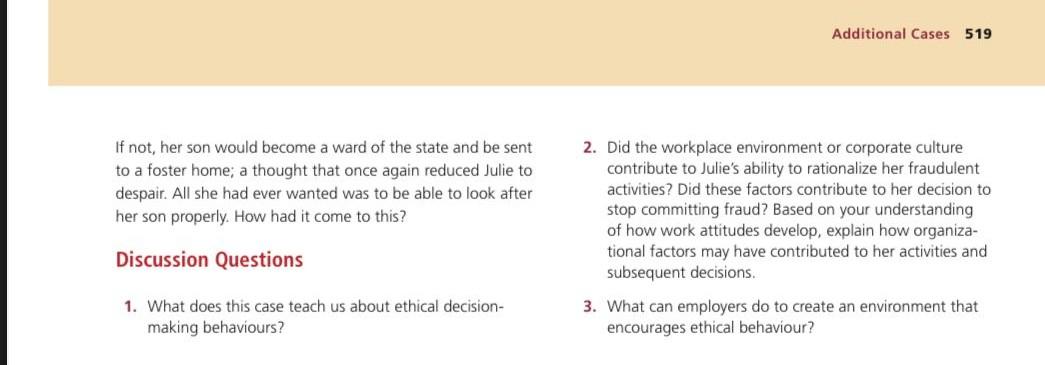
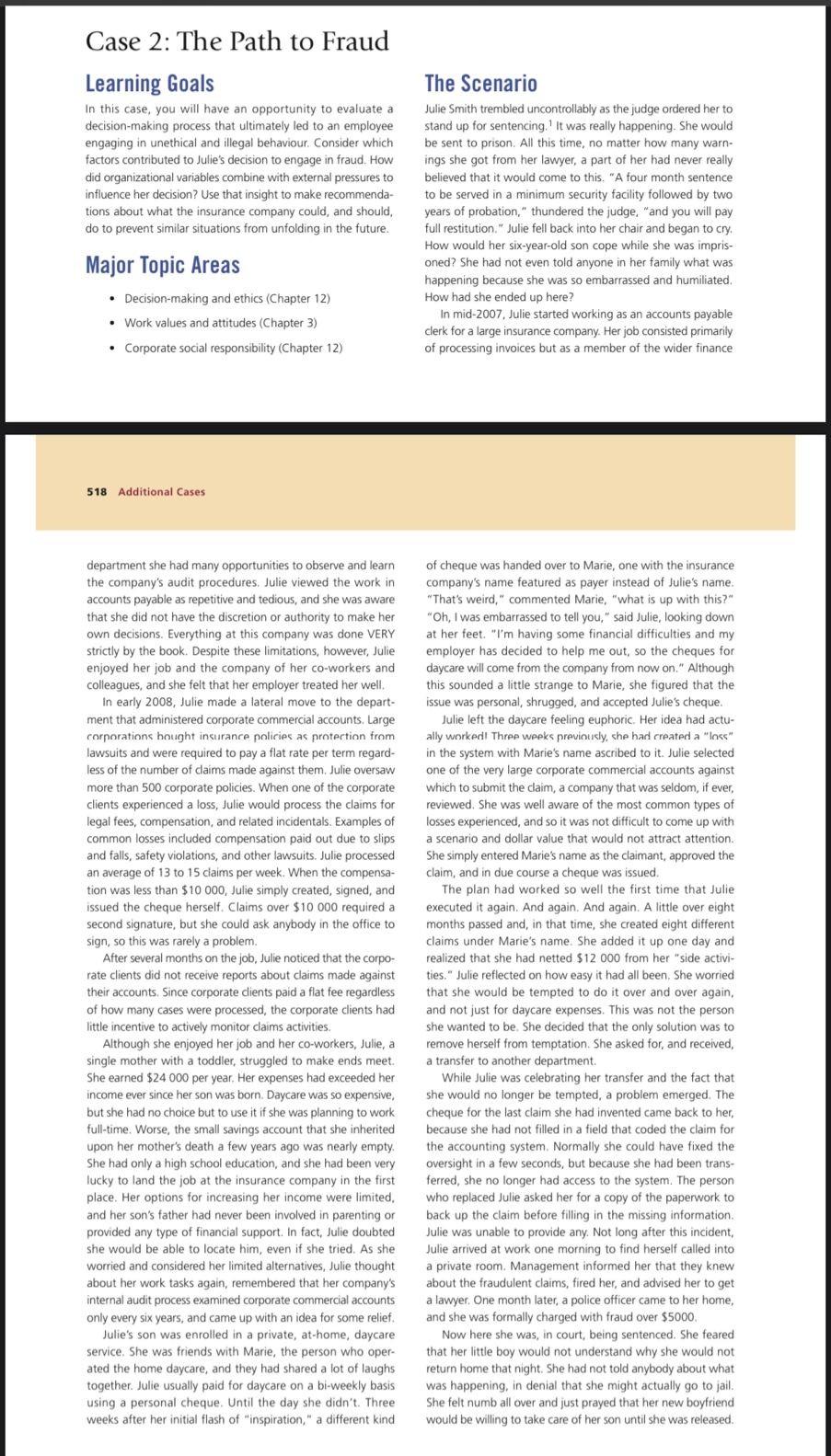
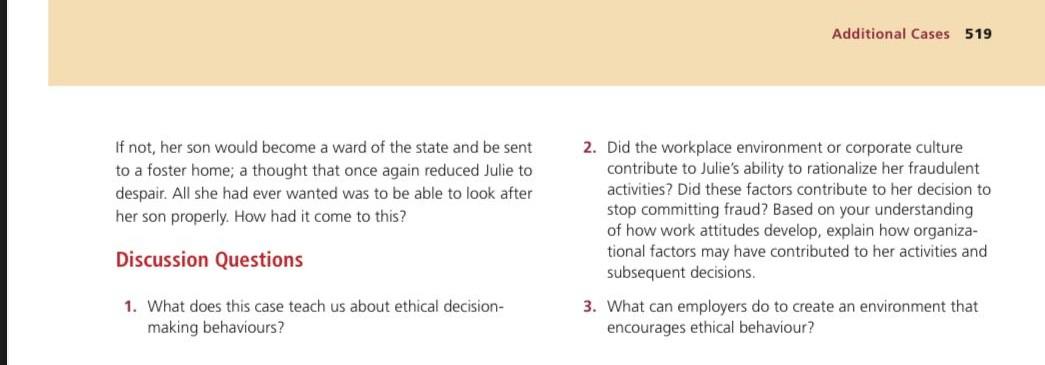
Additional Cases 519 If not, her son would become a ward of the state and be sent to a foster home; a thought that once again reduced Julie to despair. All she had ever wanted was to be able to look after her son properly. How had it come to this? 2. Did the workplace environment or corporate culture contribute to Julie's ability to rationalize her fraudulent activities? Did these factors contribute to her decision to stop committing fraud? Based on your understanding of how work attitudes develop, explain how organiza- tional factors may have contributed to her activities and subsequent decisions. 3. What can employers do to create an environment that encourages ethical behaviour? Discussion Questions 1. What does this case teach us about ethical decision- making behaviours? Case 2: The Path to Fraud Learning Goals In this case, you will have an opportunity to evaluate a decision-making process that ultimately led to an employee engaging in unethical and illegal behaviour. Consider which factors contributed to Julie's decision to engage in fraud. How did organizational variables combine with external pressures to influence her decision? Use that insight to make recommenda- tions about what the insurance company could, and should, do to prevent similar situations from unfolding in the future. The Scenario Julie Smith trembled uncontrollably as the judge ordered her to stand up for sentencing. It was really happening. She would be sent to prison. All this time, no matter how many warn- ings she got from her lawyer, a part of her had never really believed that it would come to this. "A four month sentence to be served in a minimum security facility followed by two years of probation," thundered the judge, and you will pay full restitution.Julie fell back into her chair and began to cry How would her six-year-old son cope while she was impris- oned? She had not even told anyone in her family what was happening because she was so embarrassed and humiliated. How had she ended up here? In mid-2007. Julie started working as an accounts payable clerk for a large insurance company. Her job consisted primarily of processing invoices but as a member of the wider finance Major Topic Areas Decision-making and ethics (Chapter 12) Work values and attitudes (Chapter 3) Corporate social responsibility (Chapter 12) 518 Additional Cases department she had many opportunities to observe and learn the company's audit procedures, Julie viewed the work in accounts payable as repetitive and tedious, and she was aware that she did not have the discretion or authority to make her own decisions. Everything at this company was done VERY strictly by the book. Despite these limitations, however, Julie enjoyed her job and the company of her co-workers and colleagues, and she felt that her employer treated her well. In early 2008, Julie made a lateral move to the depart- ment that administered corporate commercial accounts. Large corporations bought insurance policies as protection from lawsuits and were required to pay a flat rate per term regard- less of the number of claims made against them, Julie oversaw more than 500 corporate policies. When one of the corporate clients experienced a loss, Julie would process clain legal fees, compensation, and related incidentals. Examples of common losses included compensation paid out due to slips and falls, safety violations, and other lawsuits. Julie processed an average of 13 to 15 claims per week. When the compensa tion was less than $10 000, Julie simply created, signed, and issued the cheque herself. Claims over $10 000 required a second signature, but she could ask anybody in the office to sign, so this was rarely a problem. After several months on the job, Julie noticed that the corpo- rate clients did not receive reports about claims made against their accounts. Since corporate clients paid a flat fee regardless of how many cases were processed, the corporate clients had little incentive to actively monitor claims activities Although she enjoyed her job and her co-workers, Julie, a single mother with a toddler, struggled to make ends meet. She earned $24 000 per year. Her expenses had exceeded her income ever since her son was born. Daycare was so expensive, but she had no choice but to use it if she was planning to work full-time. Worse, the small savings account that she inherited upon her mother's death a few years ago was nearly empty She had only a high school education, and she had been very lucky to land the job at the insurance company in the first place. Her options for increasing her income were limited, and her son's father had never been involved in parenting or provided any type of financial support. In fact, Julie doubted she would be able to locate him, even if she tried. As she worried and considered her limited alternatives, Julie thought about her work tasks again, remembered that her company's internal audit process examined corporate commercial accounts only every six years, and came up with an idea for some relief Julie's son was enrolled in a private, at-home, daycare service. She was friends with Marie, the person who oper- ated the home daycare, and they had shared a lot of laughs together. Julie usually paid for daycare on a bi-weekly basis using a personal cheque. Until the day she didn't. Three weeks after her initial flash of "inspiration," a different kind of cheque was handed over to Marie, one with the insurance company's name featured as payer instead of Julie's name. "That's weird," commented Marie, "what is up with this?" "Oh, I was embarrassed to tell you," said Julie, looking down at her feet. "I'm having some financial difficulties and my employer has decided to help me out, so the cheques for daycare will come from the company from now on." Although this sounded a little strange to Marie, she figured that the issue was personal, shrugged, and accepted Julie's cheque. Julie left the daycare feeling euphoric. Her idea had actu- ally worked! Three weeks previously, she had created a "Ins" in the system with Marie's name ascribed to it. Julie selected one of the very large corporate commercial accounts against which to submit the claim, a company that was seldom, if ever, reviewed. She was well aware the most common types of losses experienced, and so it was not difficult to come up with a scenario and dollar value that would not attract attention. She simply entered Marie's name as the claimant, approved the claim, and in due course a cheque was issued The plan had worked so well the first time that Julie executed it again. And again. And again. A little over eight months passed and, in that time, she created eight different claims under Marie's name. She added it up one day and realized that she had netted $12 000 from her "side activi- ties." Julie reflected on how easy it had all been. She worried that she would be tempted to do it over and over again, and not just for daycare expenses. This was not the person she wanted to be. She decided that the only solution was to remove herself from temptation. She asked for, and received, a transfer to another department. While Julie was celebrating her transfer and the fact that she would no longer be tempted, a problem emerged. The cheque for the last claim she had invented came back to her, because she had not filled in a field that coded the claim for the accounting system. Normally she could have fixed the oversight in a few seconds, but because she had been trans- ferred, she no longer had access to the system. The person who replaced Julie asked her for a copy of the paperwork to back up the claim before filling in the missing information. Julie was unable to provide any. Not long after this incident, Julie arrived at work one morning to find herself called into a private room. Management informed her that they knew about the fraudulent claims, fired her, and advised her to get a lawyer. One month later, a police officer came to her home, and she was formally charged with fraud over $5000 Now here she was, in court, being sentenced. She feared that her little boy would not understand why she would not return home that night. She had not told anybody about what was happening, in denial that she might actually go to jail. She felt numb all over and just prayed that her new boyfriend would be willing to take care of her son until she was released. Additional Cases 519 If not, her son would become a ward of the state and be sent to a foster home; a thought that once again reduced Julie to despair. All she had ever wanted was to be able to look after her son properly. How had it come to this? 2. Did the workplace environment or corporate culture contribute to Julie's ability to rationalize her fraudulent activities? Did these factors contribute to her decision to stop committing fraud? Based on your understanding of how work attitudes develop, explain how organiza- tional factors may have contributed to her activities and subsequent decisions. 3. What can employers do to create an environment that encourages ethical behaviour? Discussion Questions 1. What does this case teach us about ethical decision- making behavioursStep by Step Solution
There are 3 Steps involved in it
1 Expert Approved Answer
Step: 1 Unlock

Question Has Been Solved by an Expert!
Get step-by-step solutions from verified subject matter experts
Step: 2 Unlock
Step: 3 Unlock