







Question: please help me to answer the 6 questions Harvard case study format for write up from my case study International financial crises... thank you! CASE
please help me to answer the 6 questions Harvard case study format for write up from my case study International financial crises...
thank you!
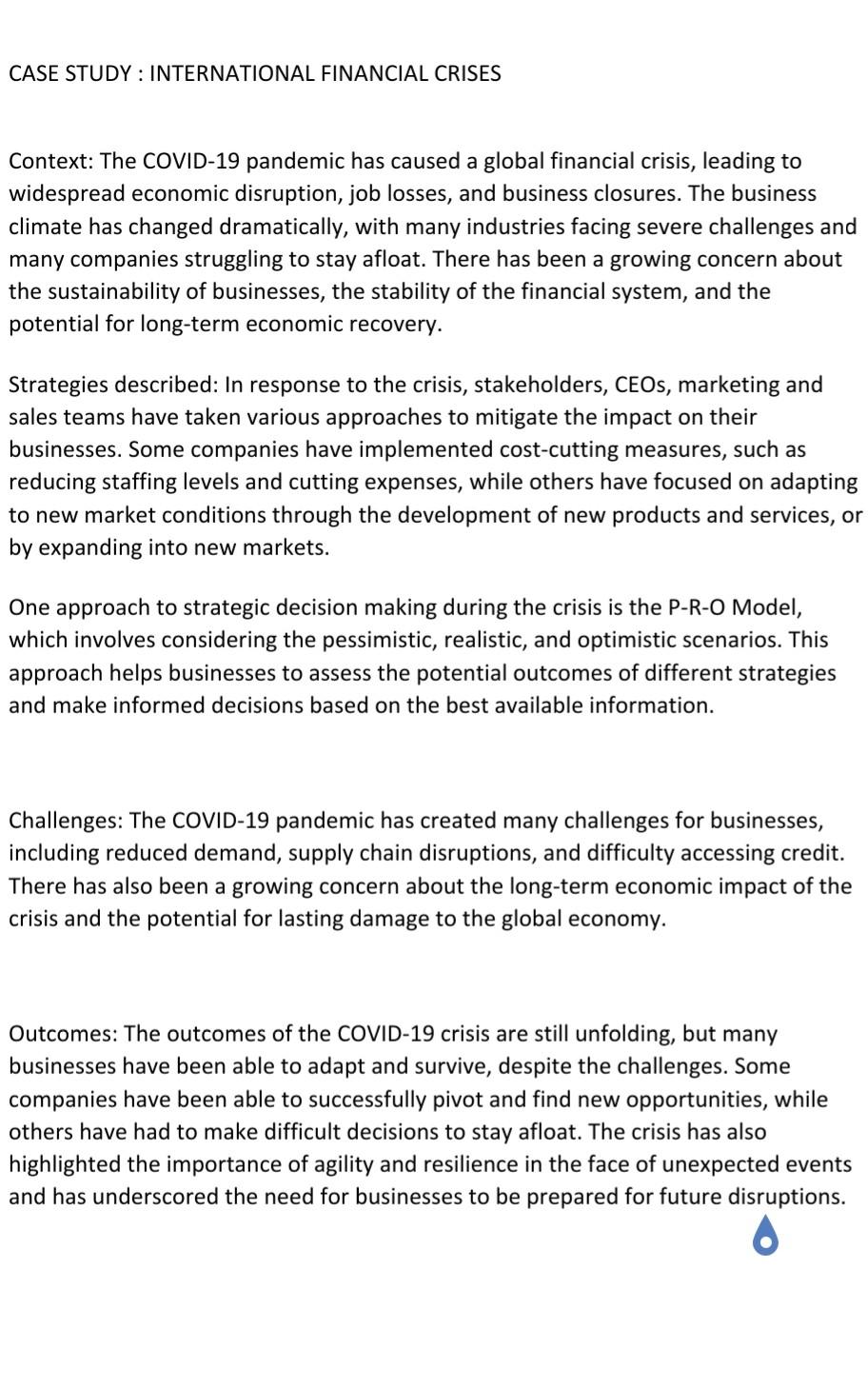
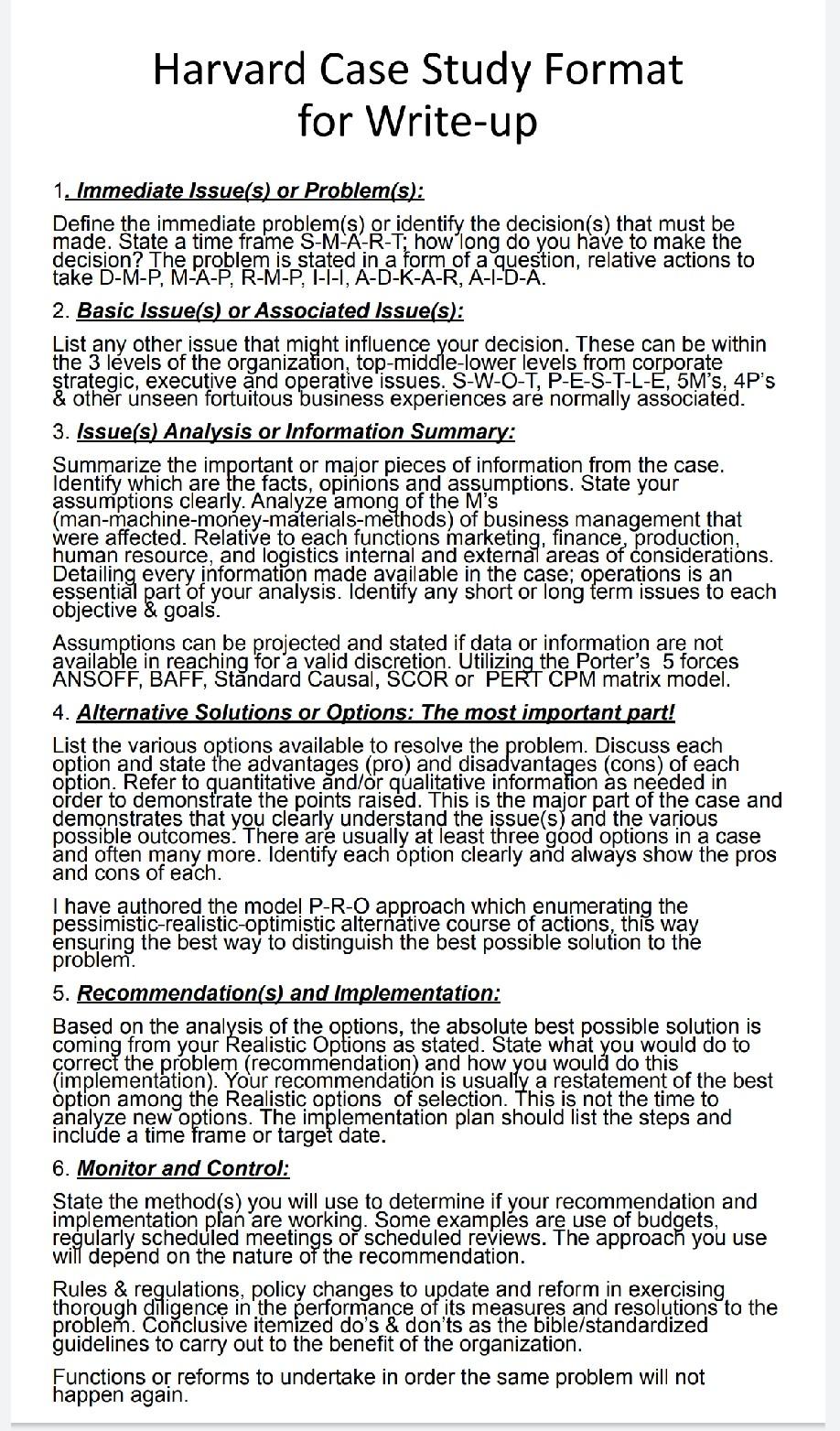
CASE STUDY : INTERNATIONAL FINANCIAL CRISES Context: The COVID-19 pandemic has caused a global financial crisis, leading to widespread economic disruption, job losses, and business closures. The business climate has changed dramatically, with many industries facing severe challenges and many companies struggling to stay afloat. There has been a growing concern about the sustainability of businesses, the stability of the financial system, and the potential for long-term economic recovery. Strategies described: In response to the crisis, stakeholders, CEOs, marketing and sales teams have taken various approaches to mitigate the impact on their businesses. Some companies have implemented cost-cutting measures, such as reducing staffing levels and cutting expenses, while others have focused on adapting to new market conditions through the development of new products and services, or by expanding into new markets. One approach to strategic decision making during the crisis is the P-R-O Model, which involves considering the pessimistic, realistic, and optimistic scenarios. This approach helps businesses to assess the potential outcomes of different strategies and make informed decisions based on the best available information. Challenges: The COVID-19 pandemic has created many challenges for businesses, including reduced demand, supply chain disruptions, and difficulty accessing credit. There has also been a growing concern about the long-term economic impact of the crisis and the potential for lasting damage to the global economy. Outcomes: The outcomes of the COVID-19 crisis are still unfolding, but many businesses have been able to adapt and survive, despite the challenges. Some companies have been able to successfully pivot and find new opportunities, while others have had to make difficult decisions to stay afloat. The crisis has also highlighted the importance of agility and resilience in the face of unexpected events and has underscored the need for businesses to be prepared for future disruptions. Harvard Case Study Format for Write-up 1. Immediate Issue(s) or Problem(s): Define the immediate problem(s) or identify the decision(s) that must be made. State a time frame S-M-A-R-T; how long do you have to make the decision? The problem is stated in a form of a question, relative actions to take D-M-P, M-A-P, R-M-P, I-I-I, A-D-K-A-R, A-I-D-A. 2. Basic Issue(s) or Associated Issue(s): List any other issue that might influence your decision. These can be within the 3 levels of the organization, top-middle-lower levels from corporate strategic, executive and operative issues. S-W-O-T, P-E-S-T-L-E, 5M's, 4P's \& other unseen fortuitous business experiences are normally associated. 3. Issue(s) Analysis or Information Summary: Summarize the important or major pieces of information from the case. Identify which are the facts, opinions and assumptions. State your assumptions clearly. Analyze among of the M's (man-machine-money-materials-methods) of business management that were affected. Relative to each functions marketing, finance, production, human resource, and logistics internal and externai' areas of considerations. Detailing every information made available in the case; operations is an essential part of your analysis. Identify any short or long term issues to each objective \& goals. Assumptions can be projected and stated if data or information are not available in reaching for a valid discretion. Utilizing the Porter's 5 forces ANSOFF, BAFF, Standard Causal, SCOR or PERT CPM matrix model. 4. Alternative Solutions or Options: The most important part! List the various options available to resolve the problem. Discuss each option and state the advantages (pro) and disadvantages (cons) of each option. Refer to quantitative and/or qualitative information as needed in order to demonstrate the points raised. This is the major part of the case and demonstrates that you clearly understand the issue(s) and the various possible outcomes. There are usually at least three good options in a case and often many more. Identify each option clearly and always show the pros and cons of each. I have authored the model P-R-O approach which enumerating the pessimistic-realistic-optimistic alternative course of actions, this way ensuring the best way to distinguish the best possible solution to the problem. 5. Recommendation(s) and Implementation: Based on the analysis of the options, the absolute best possible solution is coming from your Realistic Options as stated. State what you would do to correct the problem (recommendation) and how you would do this (implementation). Your recommendation is usually a restatement of the best option among the Realistic options of selection. This is not the time to analyze new options. The implementation plan should list the steps and include a time frame or target date. 6. Monitor and Control: State the method(s) you will use to determine if your recommendation and implementation plan are working. Some examples are use of budgets, regularly scheduled meetings or scheduled reviews. The approach you use will depend on the nature of the recommendation. Rules \& regulations, policy changes to update and reform in exercising thorough diligence in the performance of its measures and resolutions to the problem. Conclusive itemized do's \& don'ts as the bible/standardized guidelines to carry out to the benefit of the organization. Functions or reforms to undertake in order the same problem will not happen again
Step by Step Solution
There are 3 Steps involved in it

Get step-by-step solutions from verified subject matter experts
 Study Help