







Question: I have tried using mgf/cdf/convolution methods to proof part ii and iii. However, I always get stuck at the end. I hope someone can guide
I have tried using mgf/cdf/convolution methods to proof part ii and iii. However, I always get stuck at the end. I hope someone can guide me on how to show the proofs. Any help would be greatly appreciated.
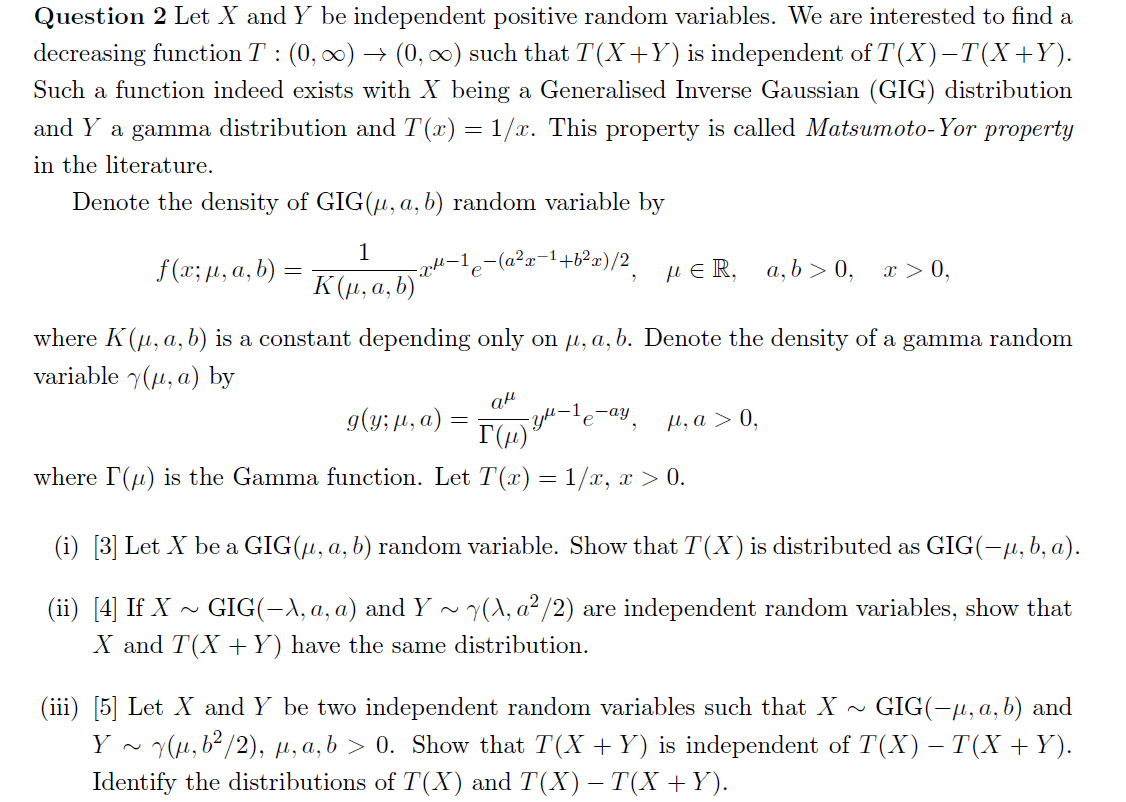
Question 2 Let X and Y be independent positive random variables. We are interested to nd a decreasing function T : (0, 00) > (0, 00) such that T(X +Y) is independent of T(X) T(X +Y). Such a function indeed exists with X being a Generalised Inverse Gaussian (GIG) distribution and Y a gamma distribution and T(:L') : 1/1; This property is called Mateumoto- Y0?" property in the literature. Denote the density of GIGQL, a, 3)) random variable by 1 pl (a2:z:_1+b2:r)'/2 f(x;p,a,b)=mx e pER, a,b>0, :L'>0, where K (p, a, b) is a constant depending only on p, a, b. Denote the density of a gamma random variable 70, a) by a\" gem, 0) = \"MW18'\"? a. a > 0, where Fur) is the Gamma function. Let T($) : 1/1:, x > O. (i) [3] Let X be a GIGQL, a, b) random variable. Show that T(X) is distributed as GIG(,u, b, (1.). (ii) [4] If X N GIG()\\, (1,0,) and Y N "YUM (12/ 2) are independent random variables, show that X and T(X + Y) have the same distribution. (iii) [5] Let X and Y be two independent random variables such that X N GIG(,u, a, b) and Y N 70;,52/2), mm?) > 0. Show that T(X + Y) is independent of T(X) T(X + Y). Identify the distributions of T(X) and T(X) T(X + Y)
Step by Step Solution
There are 3 Steps involved in it

Get step-by-step solutions from verified subject matter experts
 Study Help