







Question: I) II) Many damped physical systems found in engineering may have their behaviour expressed by second-order non-homogeneous ordinary differential equations (ODEs.) This type of
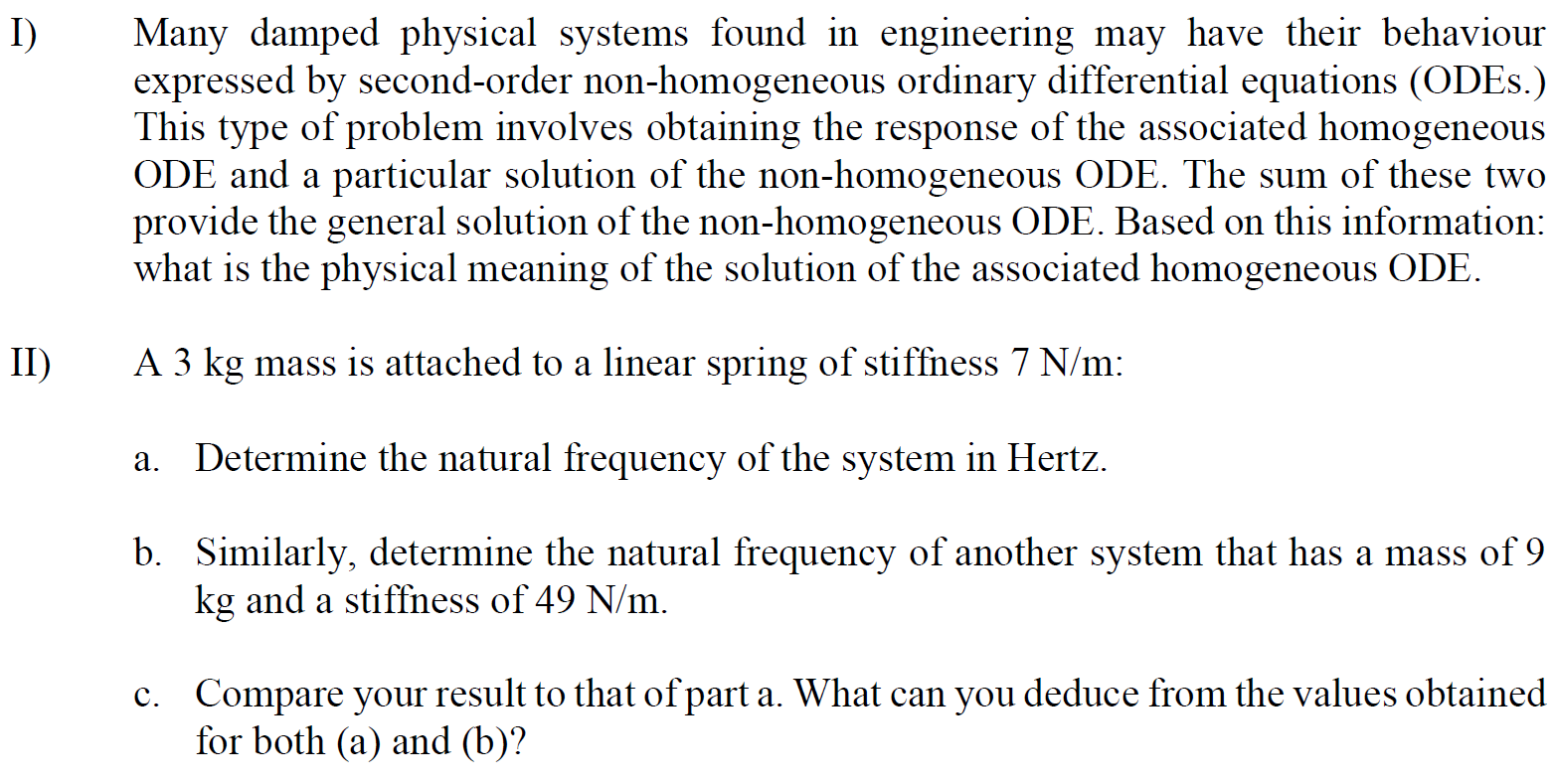
I) II) Many damped physical systems found in engineering may have their behaviour expressed by second-order non-homogeneous ordinary differential equations (ODEs.) This type of problem involves obtaining the response of the associated homogeneous ODE and a particular solution of the non-homogeneous ODE. The sum of these two provide the general solution of the non-homogeneous ODE. Based on this information: what is the physical meaning of the solution of the associated homogeneous ODE. A 3 kg mass is attached to a linear spring of stiffness 7 N/m: Determine the natural frequency of the system in Hertz. b. Similarly, determine the natural frequency of another system that has a mass of 9 kg and a stiffness of 49 N/m. a. c. Compare your result to that of part a. What can you deduce from the values obtained for both (a) and (b)?
Step by Step Solution
There are 3 Steps involved in it
Lets tackle the second part II of your question regarding the calculation of the natural frequency for two different massspring systems The natural fr... View full answer

Get step-by-step solutions from verified subject matter experts
 Study Help