



Question: I just need help with Part B, thanks! Income statement: Sales. Cost of goods sold Gross profit. Operating expenses. Net Income ........ 1,350,000 (810,000) 540,000
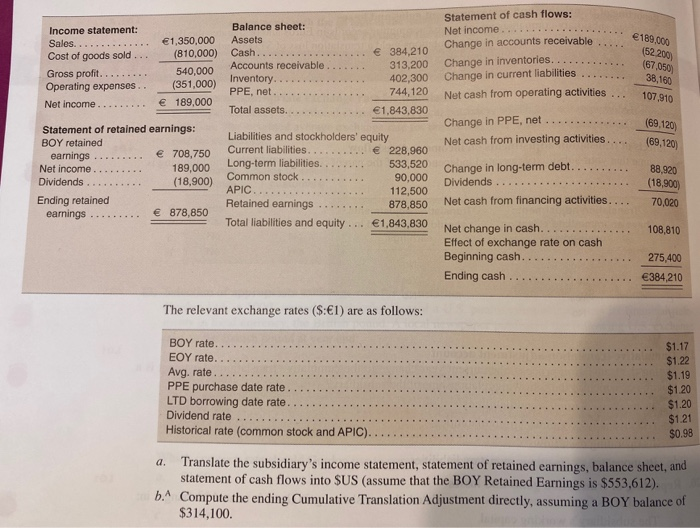
Income statement: Sales. Cost of goods sold Gross profit. Operating expenses. Net Income ........ 1,350,000 (810,000) 540,000 (351,000) 189,000 Balance sheet: Assets Cash.. Accounts receivable Inventory. PPE, net Total assets. Statement of cash flows: Net income Change in accounts receivable Change in inventories.. Change in current liabilities Net cash from operating activities 189.000 (52 200) (67.050) 38,160 384,210 313,200 402,300 744,120 1,843,830 107,910 Change in PPE, net Net cash from investing activities. (69.120) (69,120 Statement of retained earnings: BOY retained earnings 708,750 Net income 189,000 Dividends. (18,900) Ending retained earnings 878,850 Liabilities and stockholders' equity Current liabilities.. 228,960 Long-term liabilities. 533,520 Common stock 90,000 APIC.. 112,500 Retained earnings 878,850 Total liabilities and equity 1.843,830 Change in long-term debt. Dividends.. Net cash from financing activities. ... 88,920 (18,900 70.020 108,810 Net change in cash. Effect of exchange rate on cash Beginning cash Ending cash 275,400 384,210 The relevant exchange rates ($:1) are as follows: BOY rate. EOY rate. Avg. rate PPE purchase date rate LTD borrowing date rate. Dividend rate Historical rate (common stock and APIC). $1.17 $1.22 $1.19 $1.20 $1.20 $1.21 $0.98 a. Translate the subsidiary's income statement, statement of retained earnings, balance sheet, and statement of cash flows into $US (assume that the BOY Retained Earnings is $553,612). b. Compute the ending Cumulative Translation Adjustment directly, assuming a BOY balance of $314,100
Step by Step Solution
There are 3 Steps involved in it

Get step-by-step solutions from verified subject matter experts