







Question: I just need part C of this problem please. Problem 1: To work, or not to work A consumer has preferences described by the utility
I just need part C of this problem please.
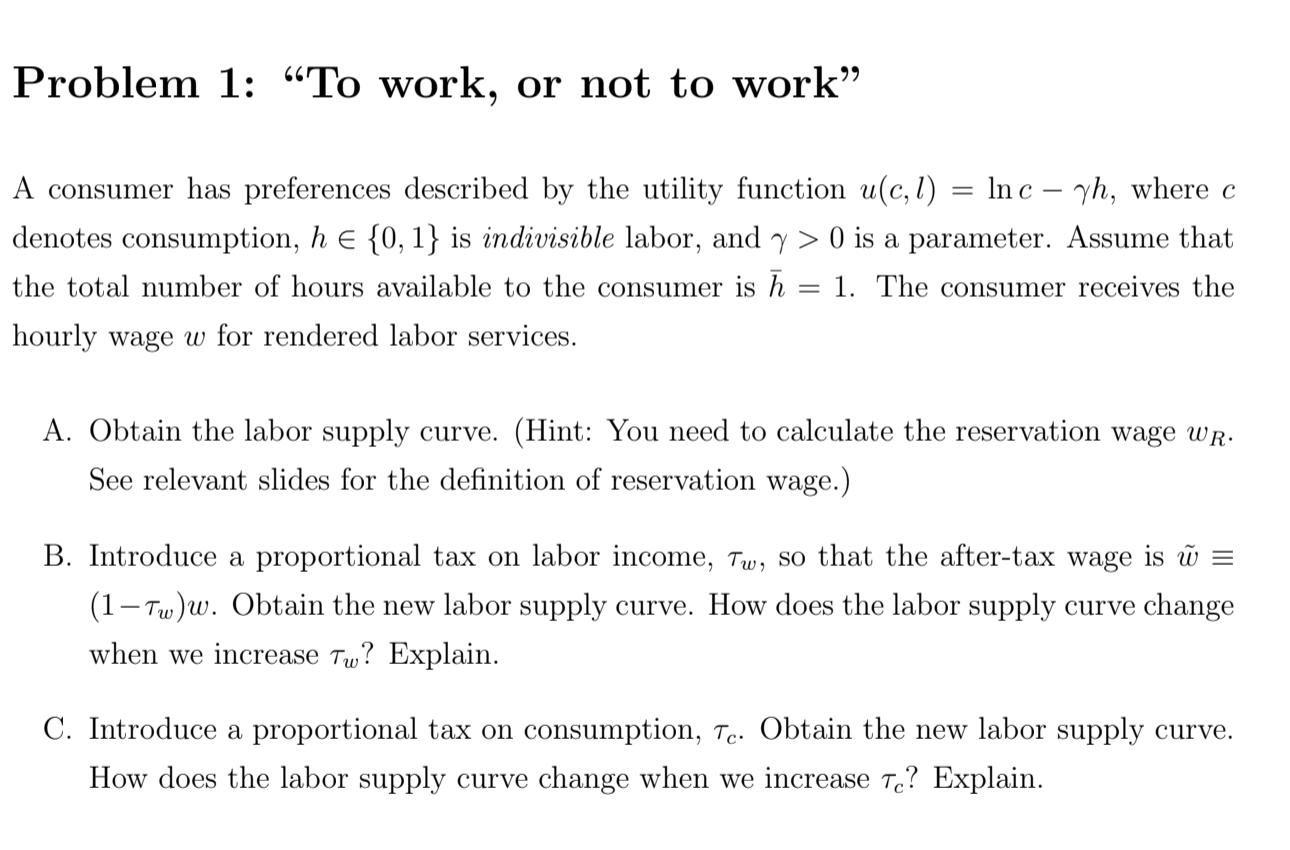
Problem 1: "To work, or not to work" A consumer has preferences described by the utility function u(c, () = Inc - yh, where c denotes consumption, h E {0, 1} is indivisible labor, and y > 0 is a parameter. Assume that the total number of hours available to the consumer is h = 1. The consumer receives the hourly wage w for rendered labor services. A. Obtain the labor supply curve. (Hint: You need to calculate the reservation wage WR. See relevant slides for the definition of reservation wage.) B. Introduce a proportional tax on labor income, Tw, so that the after-tax wage is w= (1-Tw)w. Obtain the new labor supply curve. How does the labor supply curve change when we increase Tw? Explain. C. Introduce a proportional tax on consumption, To. Obtain the new labor supply curve. How does the labor supply curve change when we increase T? Explain
Step by Step Solution
There are 3 Steps involved in it

Get step-by-step solutions from verified subject matter experts
 Study Help