







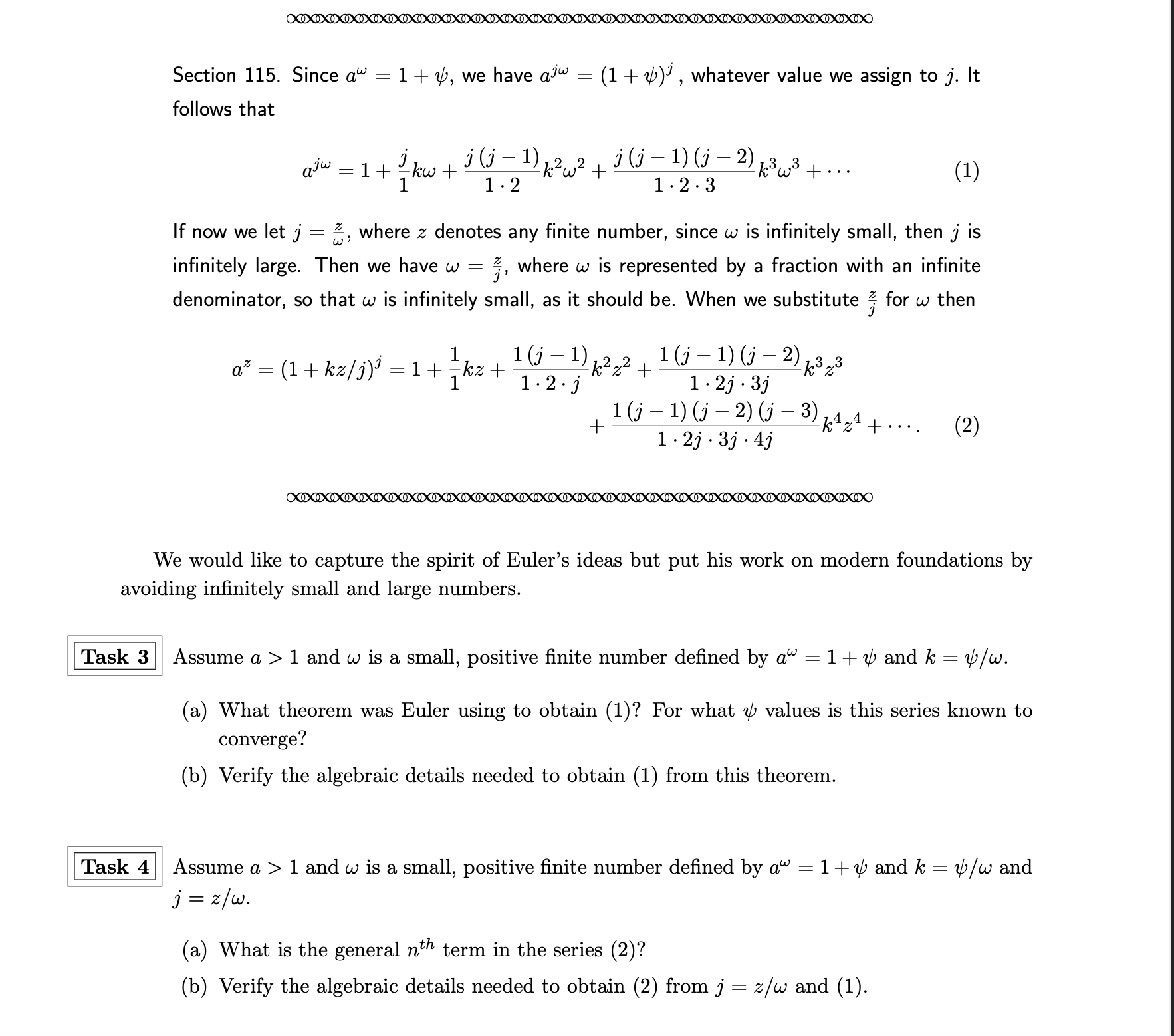
Question: I JUST NEED TASK 4 Section 115. Since aw = 1 + 1, we have aiw = (1 + 1)' , whatever value we assign
I JUST NEED TASK 4
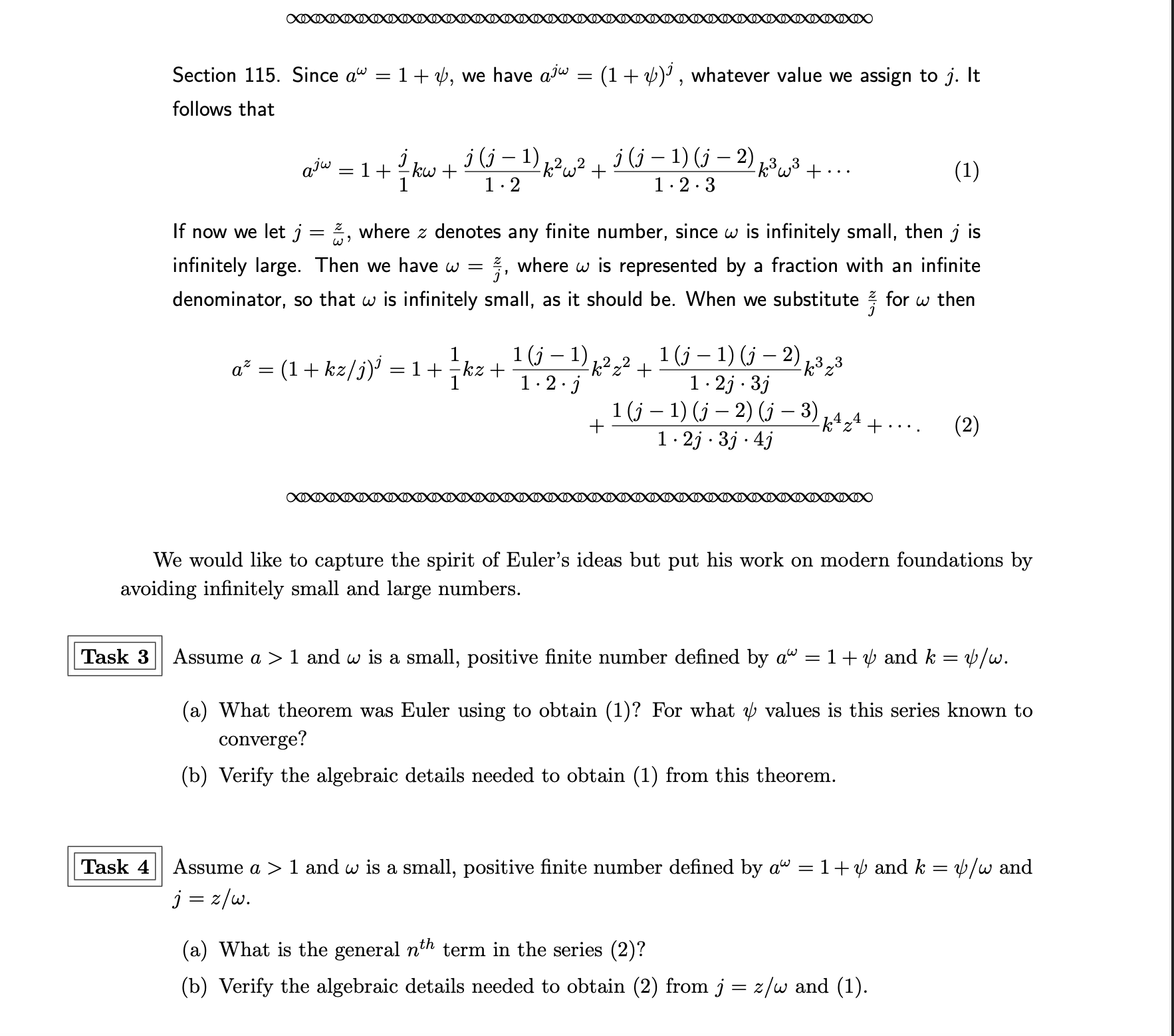
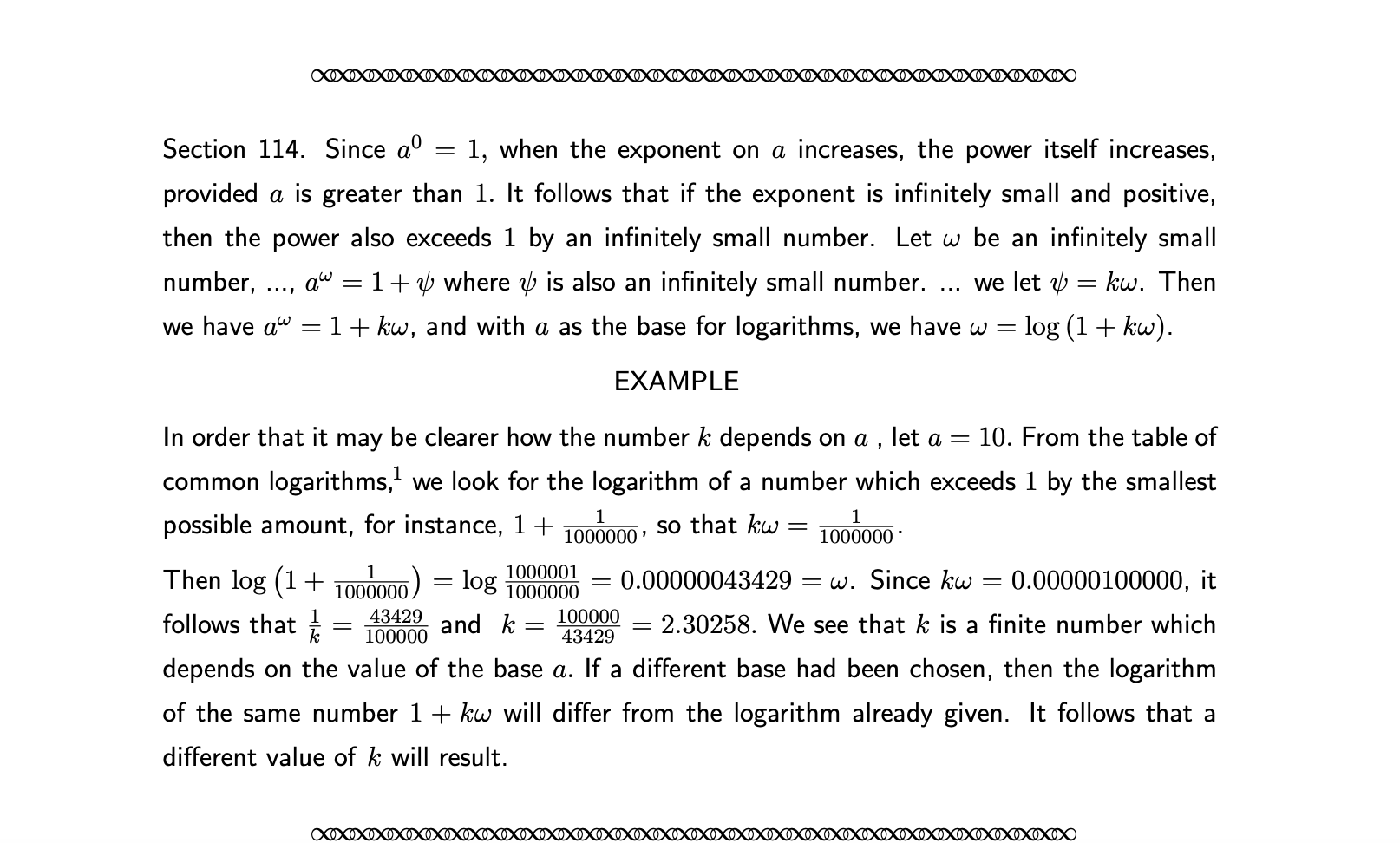
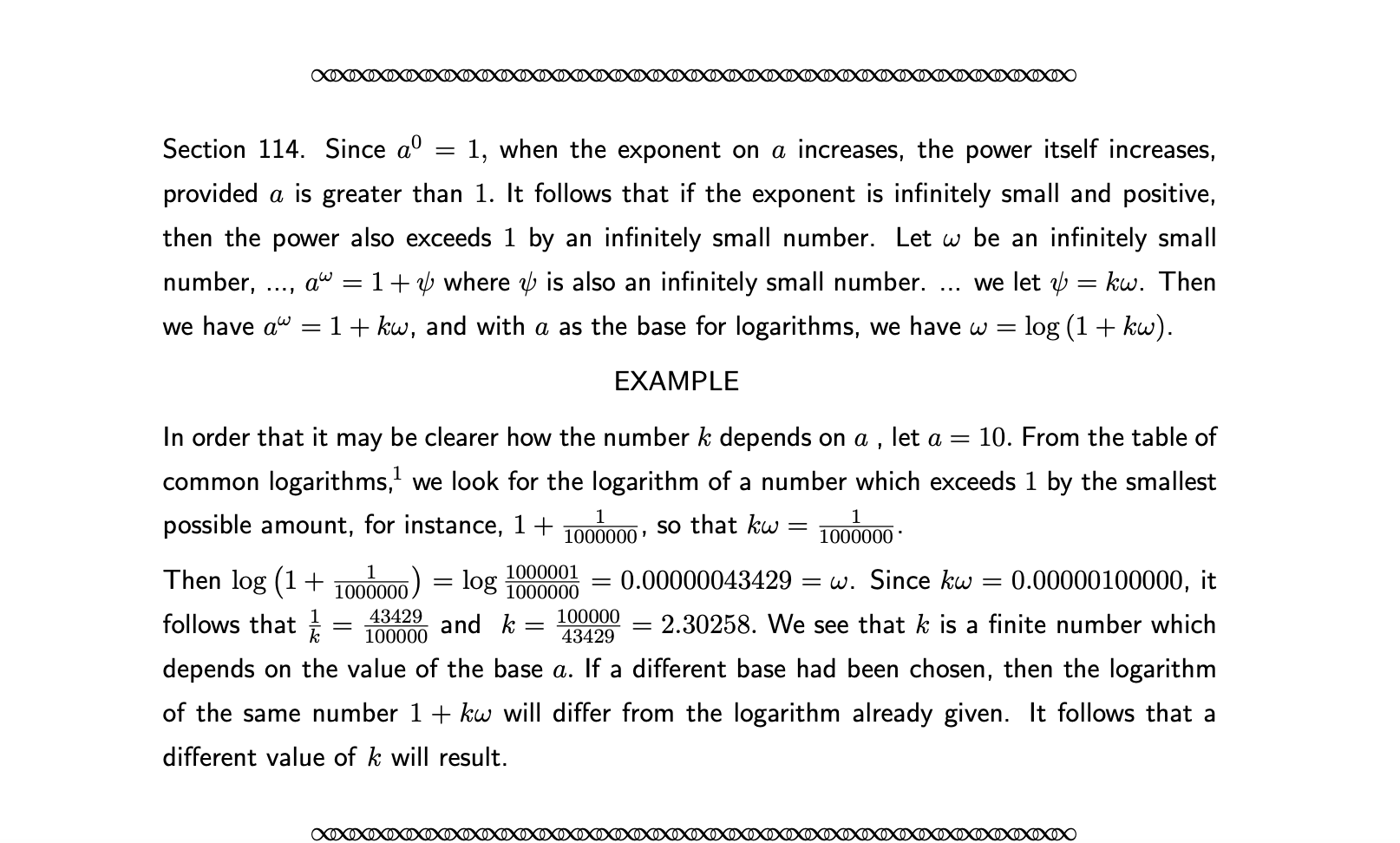
Section 115. Since aw = 1 + 1, we have aiw = (1 + 1)' , whatever value we assign to j. It follows that a jw = 1+ # kw + 3 (j - 12k2w2+ j ( j - 1) (j - 2k3W3 +... (1) 1 . 2 1 . 2 . 3 If now we let j = 2, where z denotes any finite number, since w is infinitely small, then j is infinitely large. Then we have w = , where w is represented by a fraction with an infinite denominator, so that w is infinitely small, as it should be. When we substitute = for w then a2 = (1+kz/j)j = 1+ -kz+1(3 -1x2,2 1(j-1) (j -2), 13 23 * 1 . 2 . j 1 . 2j . 3j + - 1 (3 - 1) (j - 2) (j - 3),4 ,4 +.... 1 . 2j . 3j . 4j (2 ) We would like to capture the spirit of Euler's ideas but put his work on modern foundations by avoiding infinitely small and large numbers. Task 3 Assume a > 1 and w is a small, positive finite number defined by a" = 1 + 1 and k = /w. (a) What theorem was Euler using to obtain (1)? For what y values is this series known to converge? (b) Verify the algebraic details needed to obtain (1) from this theorem. Task 4 Assume a > 1 and w is a small, positive finite number defined by a" = 1 + v and k = 1/w and j = z/W. (a) What is the general nth term in the series (2)? (b) Verify the algebraic details needed to obtain (2) from j = z/w and (1).Section 114. Since a" = 1, when the exponent on a increases, the power itself increases, provided a is greater than 1. It follows that if the exponent is infinitely small and positive, then the power also exceeds 1 by an infinitely small number. Let u; be an infinitely small number, a" = 1 +10 where 2,0 is also an infinitely small number. we let 1!; = kw. Then we have of" = 1 + km, and with a as the base for logarithms, we have m =10g(1 + kw). EXAMPLE In order that it may be clearer how the number k depends on a , let a = 10. From the table of common logarithms,1 we look for the logarithm of a number which exceeds 1 by the smallest 1 1000000 ' Then log (1 + W) =10g % = 000000043429 = w. Since kw = 000000100000, it 1 _ 43429 _ 100000 _ - - - - follows that k 100000 and k 43429 2.30258. We see that k 15 a finite number which depends on the value of the base a. If a different base had been chosen, then the logarithm possible amount, for instance, 1 | _ 1 so that kw 1000000. of the same number 1 + kw will differ from the logarithm already given. It follows that a different value of 19 will result
Step by Step Solution
There are 3 Steps involved in it

Get step-by-step solutions from verified subject matter experts
 Study Help