







Question: I JUST NEED TASK 6 Section 114. Since a = 1, when the exponent on a increases, the power itself increases, provided a is greater
I JUST NEED TASK 6
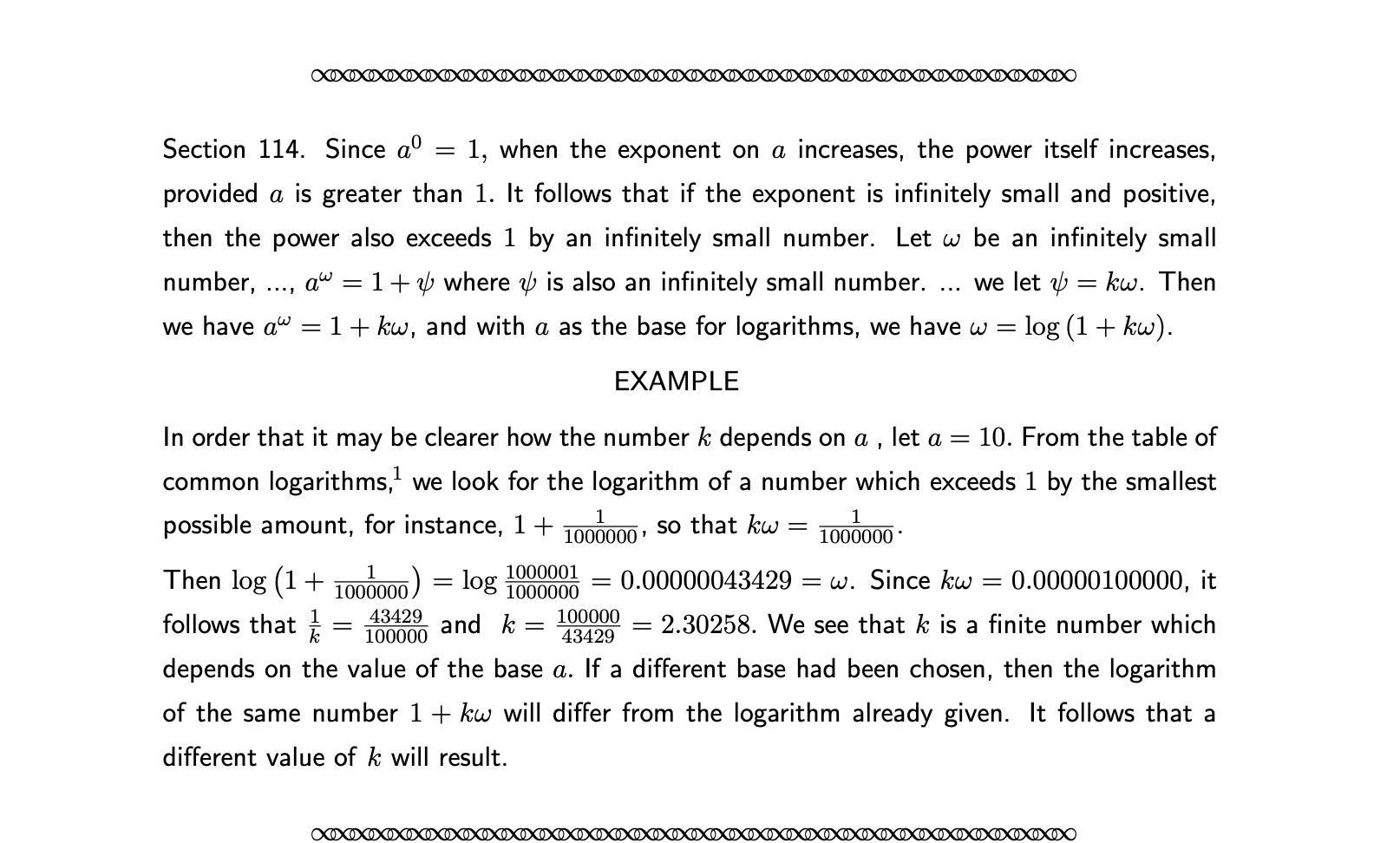
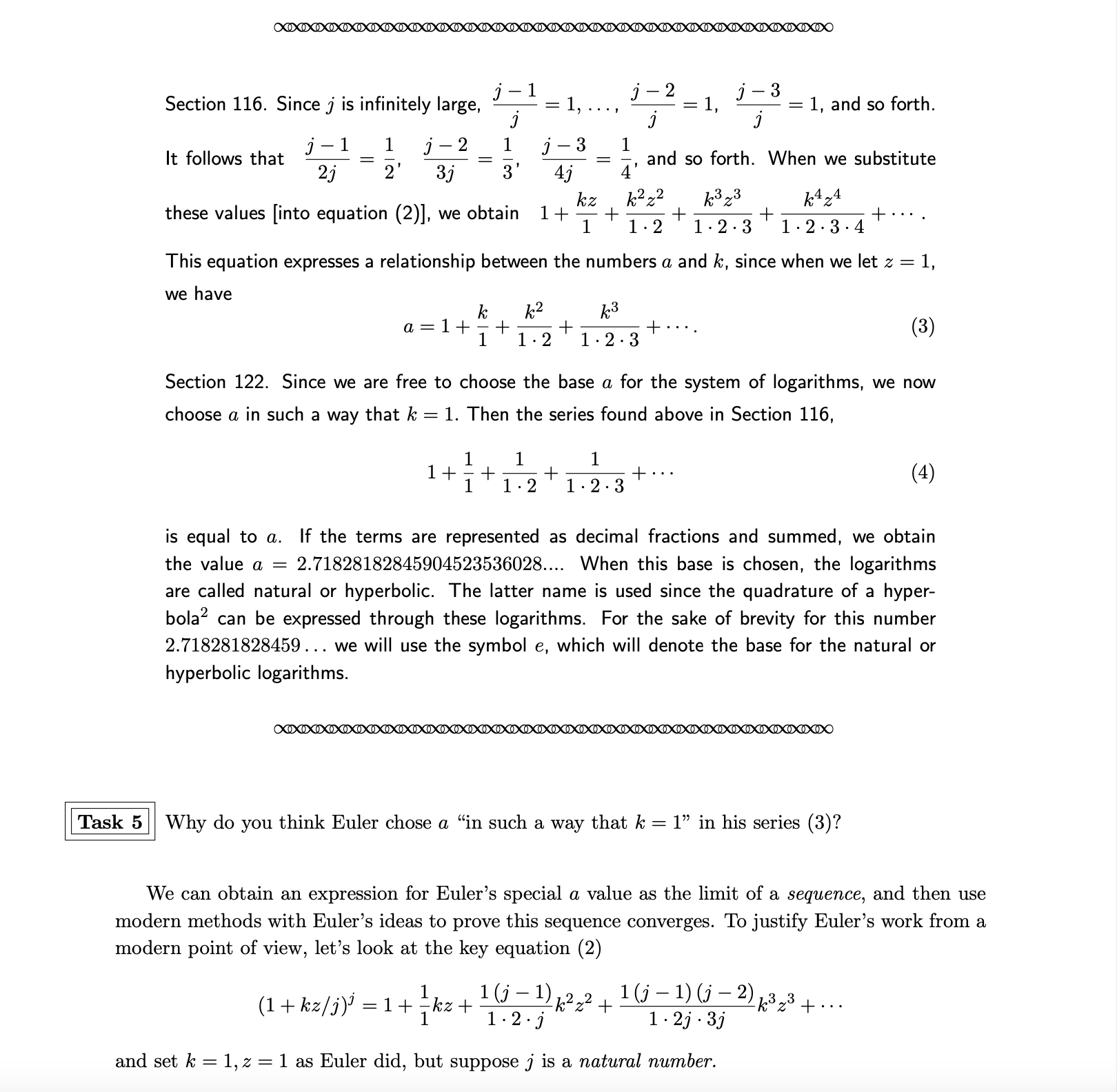
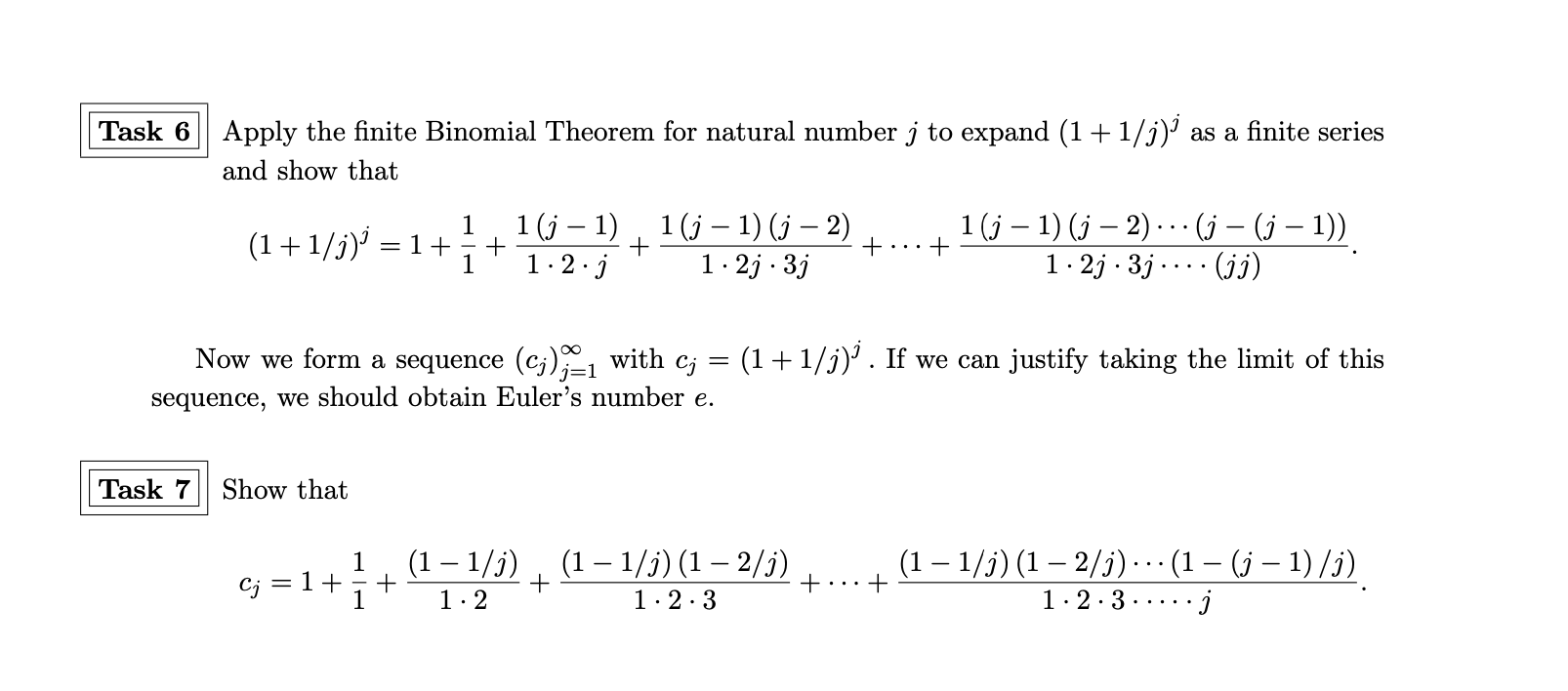
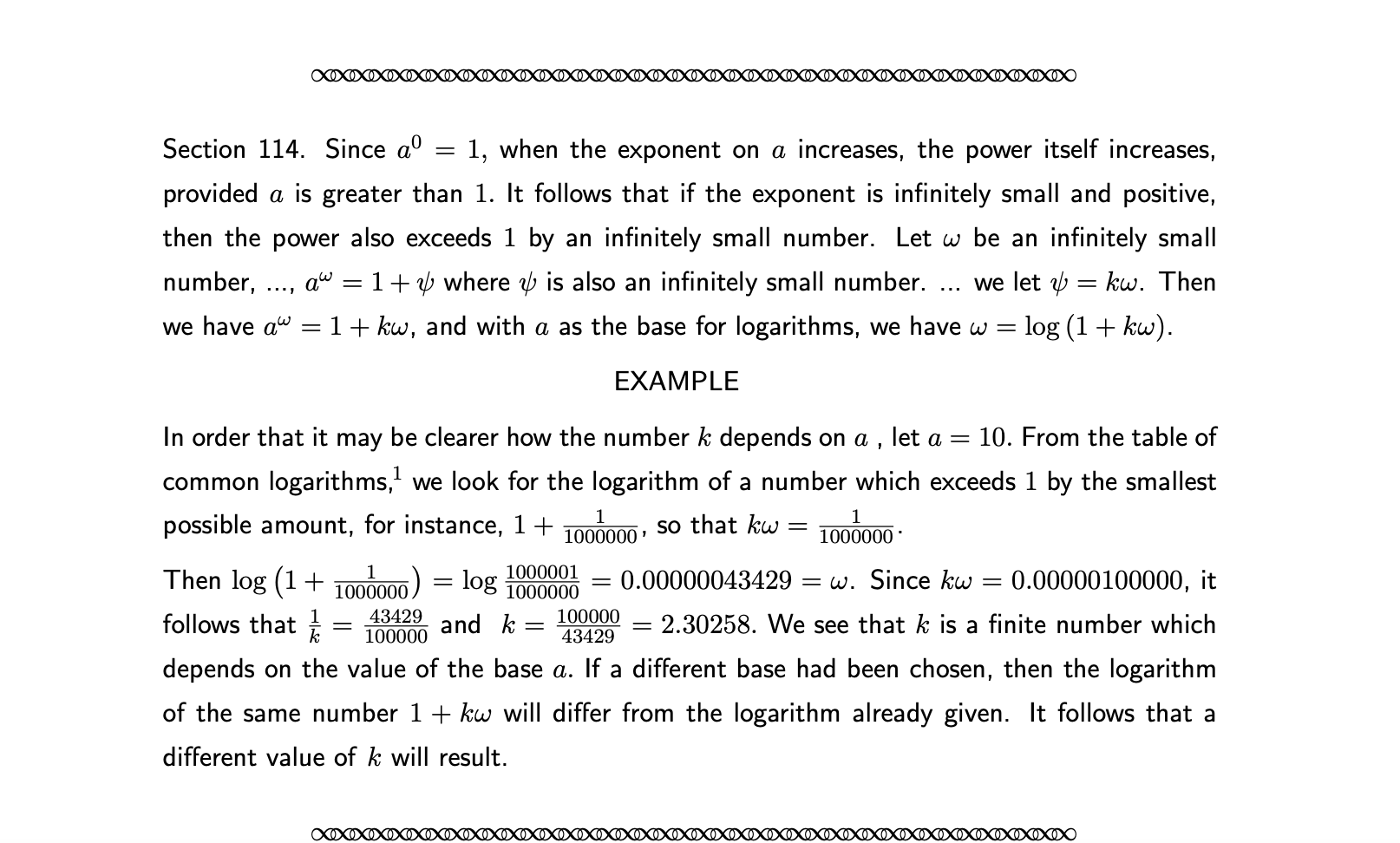
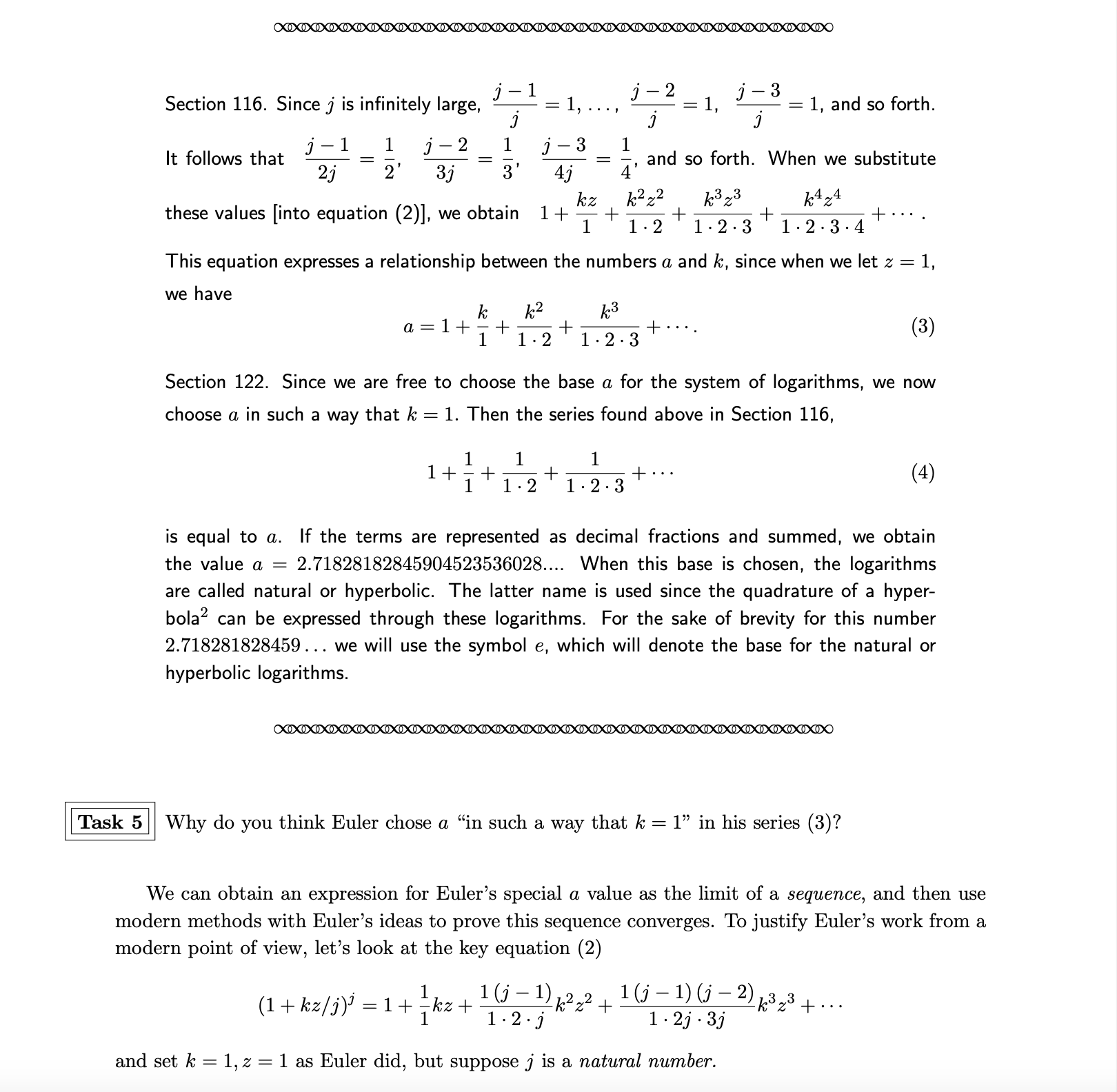
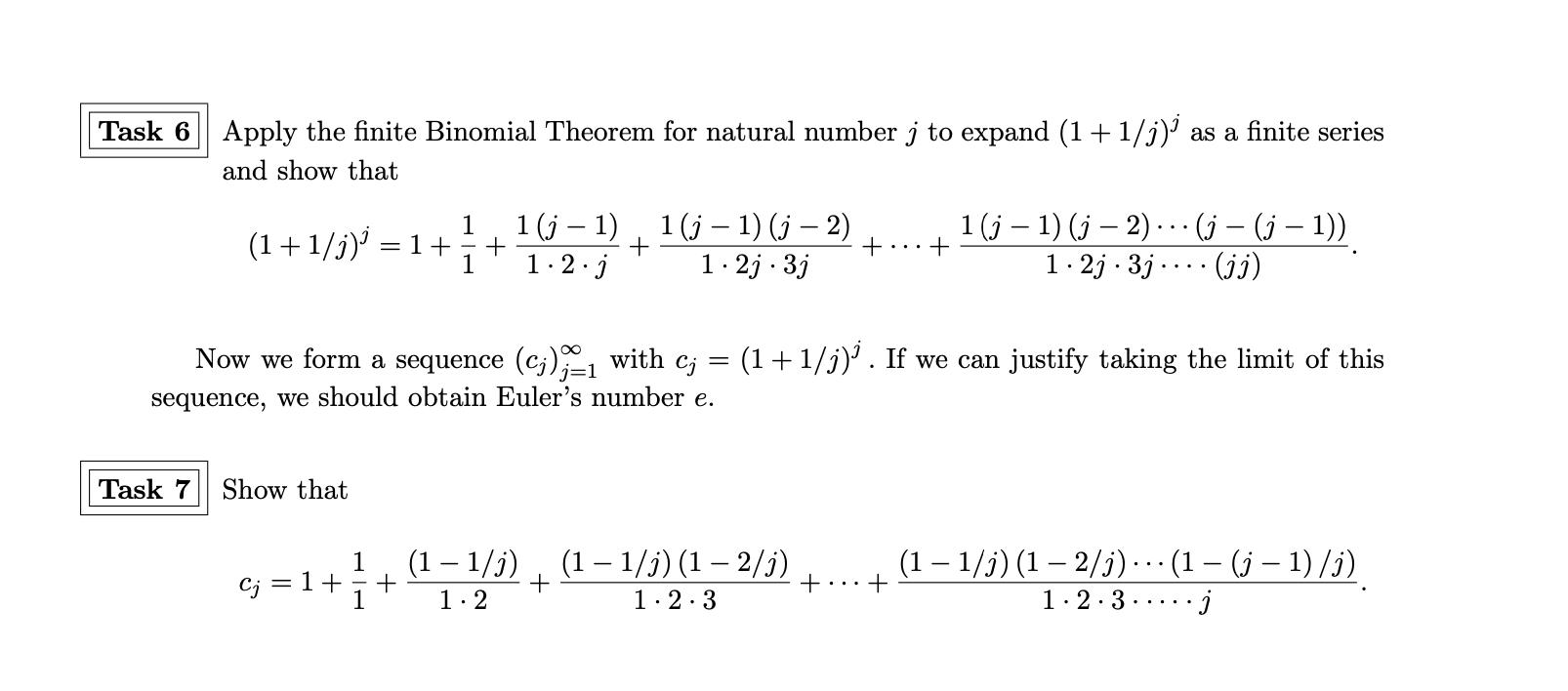
Section 114. Since a" = 1, when the exponent on a increases, the power itself increases, provided a is greater than 1. It follows that if the exponent is infinitely small and positive, then the power also exceeds 1 by an infinitely small number. Let u; be an infinitely small number, a" = 1 +10 where 2,0 is also an infinitely small number. we let 1!; = kw. Then we have of" = 1 + km, and with a as the base for logarithms, we have m =10g(1 + kw). EXAMPLE In order that it may be clearer how the number k depends on a , let a = 10. From the table of common logarithms,1 we look for the logarithm of a number which exceeds 1 by the smallest 1 1000000 ' Then log (1 + W) =10g % = 000000043429 = w. Since kw = 000000100000, it 1 _ 43429 _ 100000 _ - - - - follows that k 100000 and k 43429 2.30258. We see that k 15 a finite number which depends on the value of the base a. If a different base had been chosen, then the logarithm possible amount, for instance, 1 | _ 1 so that kw 1000000. of the same number 1 + kw will differ from the logarithm already given. It follows that a different value of 19 will result. Task 5 j1 j2 j3 Section 116. Sincej is infinitely large, _ = 1, ..., _ : 1, _ = 1, and so forth. 3 J J" ' i 1 1 ' i 2 1 ' i 1 It follows that J _ : , J , : , J _3 : , and so forth. When we substitute 2] 2 33 3 43 4 these values [into e uation (2)] we obtain 1 + kz + 1:222 + szB + #124 + . ~- q ' 1 L2 L23 1284 This equation expresses a relationship between the numbers a and is, since when we let 2 : 1, we have it 2 k3 k : 1 _ _ .. ._ a +1+1_2+1_2'3+ (3) Section 122. Since we are free to choose the base a for the system of logarithms. we now choose a in such a way that k : 1. Then the series found above in Section 116, 1+1+L+ 1 1 L2 L23 +--~ (4) is equal to a. If the terms are represented as decimal fractions and summed. we obtain the value a : 2.71828182845904523536028.... When this base is chosen. the logarithms are called natural or hyperbolic. The latter name is used since the quadrature of a hyper- bola2 can be expressed through these logarithms. For the sake of brevity for this number 2718281828459... we will use the symbol 6, which will denote the base for the natural or hyperbolic logarithms. Why do you think Euler chose a "in such a way that k. = 1" in his series (3)? We can obtain an expression for Euler's special a. value as the limit of a sequence, and then use modern methods with Euler's ideas to prove this sequence converges. To justify Euler's work from a modern point of view, let's look at the key equation (2) (l+k'z/j)j : 1+ %kz+ M19224. Wk323+~~ L23 ieyw and set R: = 1, z = 1 as Euler did, but suppose j is a natural number. Task 6 Apply the finite Binomial Theorem for natural number j to expand (1 + 1/j)' as a finite series and show that (1 + 1/j )' =1+ = 1 1 (j -1) + + 1 (j - 1) (j -2) + ...1(j -1) (j - 2) . . . (j -(j -1)) 1 . 2 . j 1 . 2j . 3j 1 . 23 . 3j . . . . (jj) Now we form a sequence (cj); ] with cj = (1 + 1/j)' . If we can justify taking the limit of this sequence, we should obtain Euler's number e. Task 7 Show that 1 + (1 - 1/j) + (1-1/j) (1 -2/j) Cj = 1+ - + ... + (1 - 1/j) (1 -2/j) . .. (1 -(3-1)/j) 1 . 2 1 . 2 .3 1 . 2 . 3 . . . . . j
Step by Step Solution
There are 3 Steps involved in it

Get step-by-step solutions from verified subject matter experts
 Study Help