







Question: I just need the answer for part (e) (c) Suppose (YA,t, YA,t+1) = (1, 0) and (YB,t, YB,t+1) = (0,1). Solve for the equilibrium interest
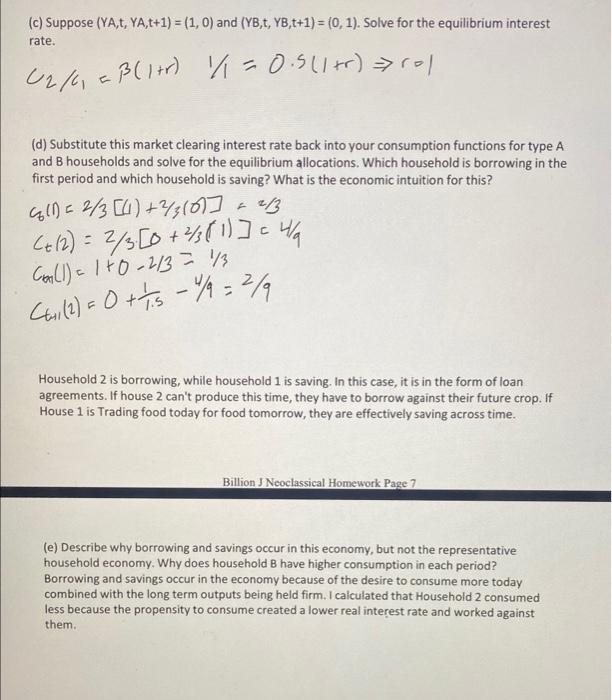
(c) Suppose (YA,t, YA,t+1) = (1, 0) and (YB,t, YB,t+1) = (0,1). Solve for the equilibrium interest rate. (2/6, =B (1+r) /=0.5 (1+r) rol (d) Substitute this market clearing interest rate back into your consumption functions for type A and B households and solve for the equilibrium allocations. Which household is borrowing in the first period and which household is saving? What is the economic intuition for this? GID= 2/3 [0) +2101] (+12) = 2/3[0 + 2/3(1)] c Wa Coll) = 1 to 213= 1/3 Cai (2) = 0 + 1/5 - 1/4 = 2/9 Household 2 is borrowing, while household 1 is saving. In this case, it is in the form of loan agreements. If house 2 can't produce this time, they have to borrow against their future crop. If House 1 is Trading food today for food tomorrow, they are effectively saving across time. Billion J Neoclassical Homework Page 7 (e) Describe why borrowing and savings occur in this economy, but not the representative household economy. Why does household B have higher consumption in each period? Borrowing and savings occur in the economy because of the desire to consume more today combined with the long term outputs being held firm. I calculated that Household 2 consumed less because the propensity to consume created a lower real interest rate and worked against them. (c) Suppose (YA,t, YA,t+1) = (1, 0) and (YB,t, YB,t+1) = (0,1). Solve for the equilibrium interest rate. (2/6, =B (1+r) /=0.5 (1+r) rol (d) Substitute this market clearing interest rate back into your consumption functions for type A and B households and solve for the equilibrium allocations. Which household is borrowing in the first period and which household is saving? What is the economic intuition for this? GID= 2/3 [0) +2101] (+12) = 2/3[0 + 2/3(1)] c Wa Coll) = 1 to 213= 1/3 Cai (2) = 0 + 1/5 - 1/4 = 2/9 Household 2 is borrowing, while household 1 is saving. In this case, it is in the form of loan agreements. If house 2 can't produce this time, they have to borrow against their future crop. If House 1 is Trading food today for food tomorrow, they are effectively saving across time. Billion J Neoclassical Homework Page 7 (e) Describe why borrowing and savings occur in this economy, but not the representative household economy. Why does household B have higher consumption in each period? Borrowing and savings occur in the economy because of the desire to consume more today combined with the long term outputs being held firm. I calculated that Household 2 consumed less because the propensity to consume created a lower real interest rate and worked against them
Step by Step Solution
There are 3 Steps involved in it

Get step-by-step solutions from verified subject matter experts
 Study Help