



Question: I just need the answer to Required 1 Proposal B. Kent Tessman, manager of a Dairy Products Division, was pleased with his division's performance over
I just need the answer to Required 1 Proposal B.
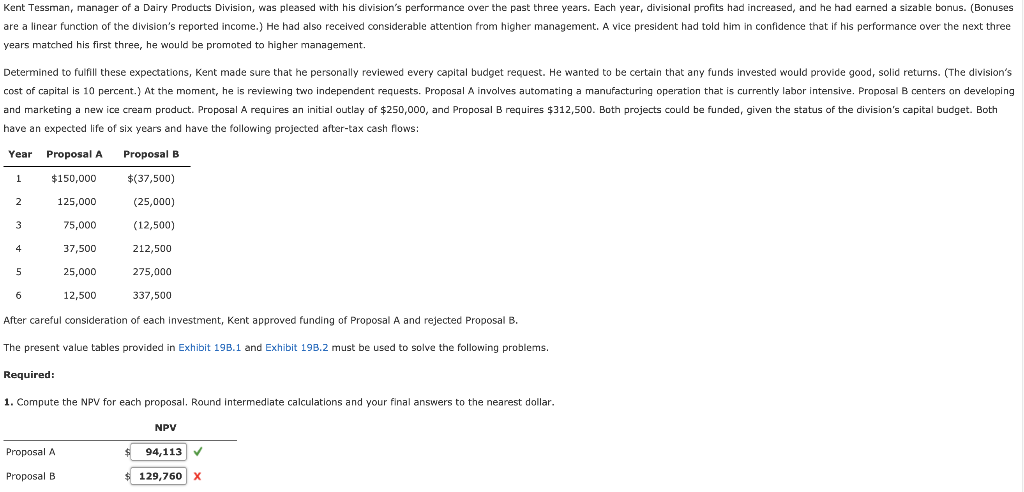
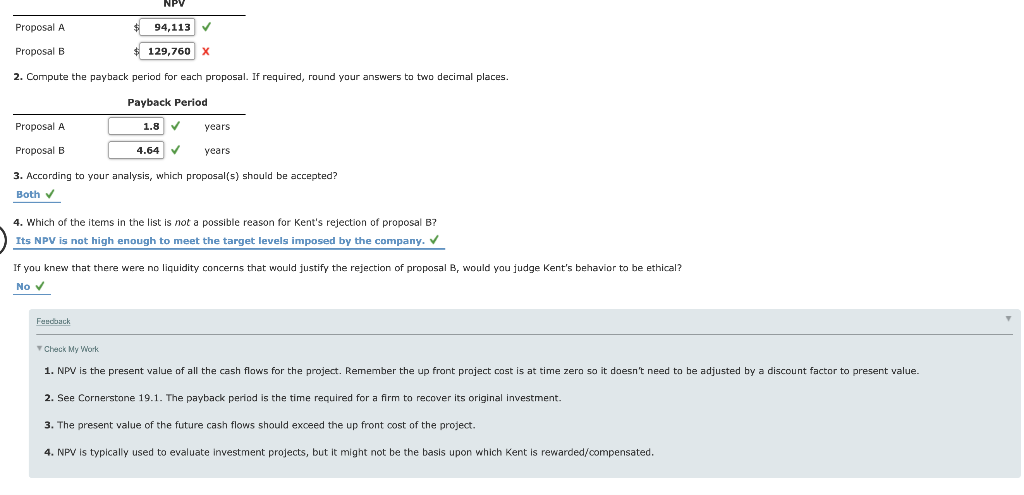
Kent Tessman, manager of a Dairy Products Division, was pleased with his division's performance over the past three years. Each year, divisional profits had increased, and he had earned a sizable bonus. (Bonuses are a linear function of the division's reported income.) He had also received considerable attention from higher management. A vice president had told him in confidence that if his performance over the next three years matched his first three, he would be promoted to higher management. Determined to fulfill these expectations, Kent made sure that he personally reviewed every capital budget request. He wanted to be certain that any funds invested would provide good, solid returns. (The division's cost of capital is 10 percent.) At the moment, he is reviewing two independent requests. Proposal A involves automating a manufacturing operation that is currently labor intensive. Proposal B centers on developing and marketing a new ice cream product. Proposal A requires an initial outlay of $250,000, and Proposal B requires $312,500. Both projects could be funded, given the status of the division's capital budget. Both have an expected life of six years and have the following projected after-tax cash flows: Year Proposal A Proposal B 1 $150,000 $(37,500) 2 125,000 (25,000) 3 75,000 (12,500) 4 37,500 212,500 5 25,000 275,000 6 12,500 337,500 After careful consideration of each investment, Kent approved funding of Proposal A and rejected Proposal B. The present value tables provided in Exhibit 19B.1 and Exhibit 198.2 must be used to solve the following problems. Required: 1. Compute the NPV for each proposal. Round intermediate calculations and your final answers to the nearest dollar. NPV Proposal A 94,113 Proposal B $ 129,760 X Proposal A $ 94,113 Proposal B $ 129,760 X 2. Compute the payback period for each proposal. If required, round your answers to two decimal places. Payback Period Proposal A 1.8 years Proposal B 4.64 years 3. According to your analysis, which proposal(s) should be accepted? Both 4. Which of the items in the list is not a possible reason for Kent's rejection of proposal B? Its NPV is not high enough to meet the target levels imposed by the company. If you knew that there were no liquidity concerns that would justify the rejection of proposal B, would you judge Kent's behavior to be ethical? No Feedback Check My Work 1. NPV is the present value of all the cash flows for the project. Remember the up front project cost is at time zero so it doesn't need to be adjusted by a discount factor to present value. 2. See Cornerstone 19.1. The payback period is the time required for a firm to recover its original investment. 3. The present value of the future cash flows should exceed the up front cost of the project 4. NPV is typically used to evaluate investment projects, but it might not be the basis upon which Kent is rewarded/compensated
Step by Step Solution
There are 3 Steps involved in it

Get step-by-step solutions from verified subject matter experts