



Question: I need 3 good questions that I can ask a group that is presenting this problem tomorrow, so literally just 3 questions based on the
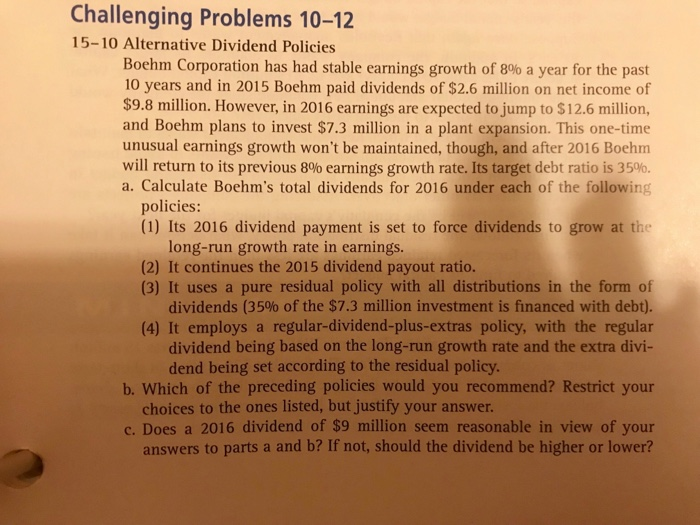
Challenging Problems 10-12 15-10 Alternative Dividend Policies Boehm Corporation has had stable earnings growth of 8% a year for the past 10 years and in 2015 Boehm paid dividends of $2.6 million on net income of $9.8 million. However, in 2016 earnings are expected to jump to $12.6 million, and Boehm plans to invest $7.3 million in a plant expansion. This one-time unusual earnings growth won't be maintained, though, and after 2016 Boehm will return to its previous 8% earnings growth rate. Its target debt ratio is 35%. a. Calculate Boehm's total dividends for 2016 under each of the following policies: (1) Its 2016 dividend payment is set to force dividends to grow at the long-run growth rate in earnings. (2) It continues the 2015 dividend payout ratio. (3) It uses a pure residual policy with all distributions in the form of dividends (35% of the $7.3 million investment is financed with debt). (4) It employs a regular-dividend-plus-extras policy, with the regular dividend being based on the long-run growth rate and the extra divi- dend being set according to the residual policy. b. Which of the preceding policies would you recommend? Restrict your choices to the ones listed, but justify your answer. c. Does a 2016 dividend of $9 million seem reasonable in view of your answers to parts a and b? If not, should the dividend be higher or lower? Challenging Problems 10-12 15-10 Alternative Dividend Policies Boehm Corporation has had stable earnings growth of 8% a year for the past 10 years and in 2015 Boehm paid dividends of $2.6 million on net income of $9.8 million. However, in 2016 earnings are expected to jump to $12.6 million, and Boehm plans to invest $7.3 million in a plant expansion. This one-time unusual earnings growth won't be maintained, though, and after 2016 Boehm will return to its previous 8% earnings growth rate. Its target debt ratio is 35%. a. Calculate Boehm's total dividends for 2016 under each of the following policies: (1) Its 2016 dividend payment is set to force dividends to grow at the long-run growth rate in earnings. (2) It continues the 2015 dividend payout ratio. (3) It uses a pure residual policy with all distributions in the form of dividends (35% of the $7.3 million investment is financed with debt). (4) It employs a regular-dividend-plus-extras policy, with the regular dividend being based on the long-run growth rate and the extra divi- dend being set according to the residual policy. b. Which of the preceding policies would you recommend? Restrict your choices to the ones listed, but justify your answer. c. Does a 2016 dividend of $9 million seem reasonable in view of your answers to parts a and b? If not, should the dividend be higher or lower
Step by Step Solution
There are 3 Steps involved in it

Get step-by-step solutions from verified subject matter experts