







Question: I need 5 questions to ask, based on this article. it's an article we have to come up with questions from this article. could be
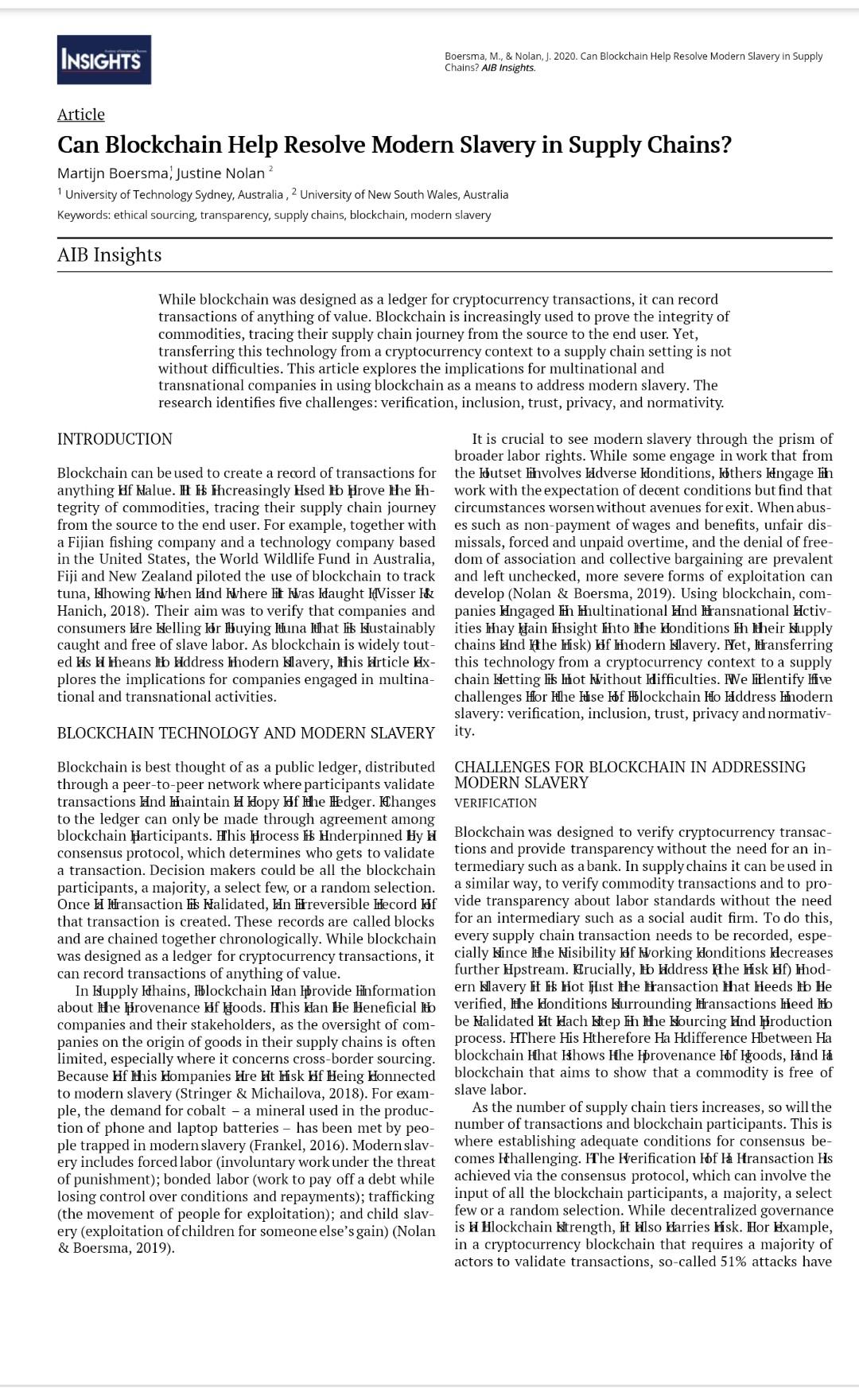
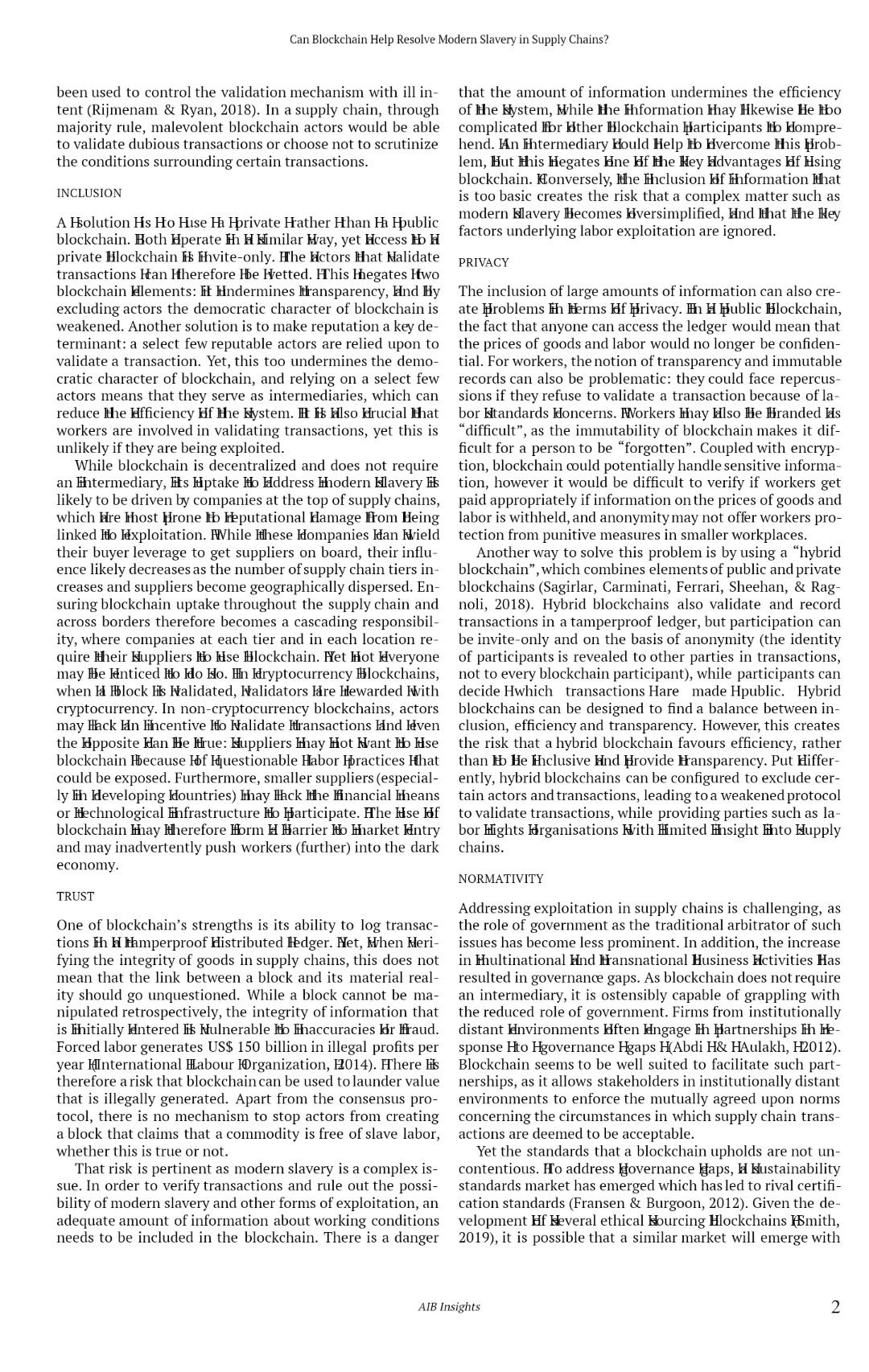
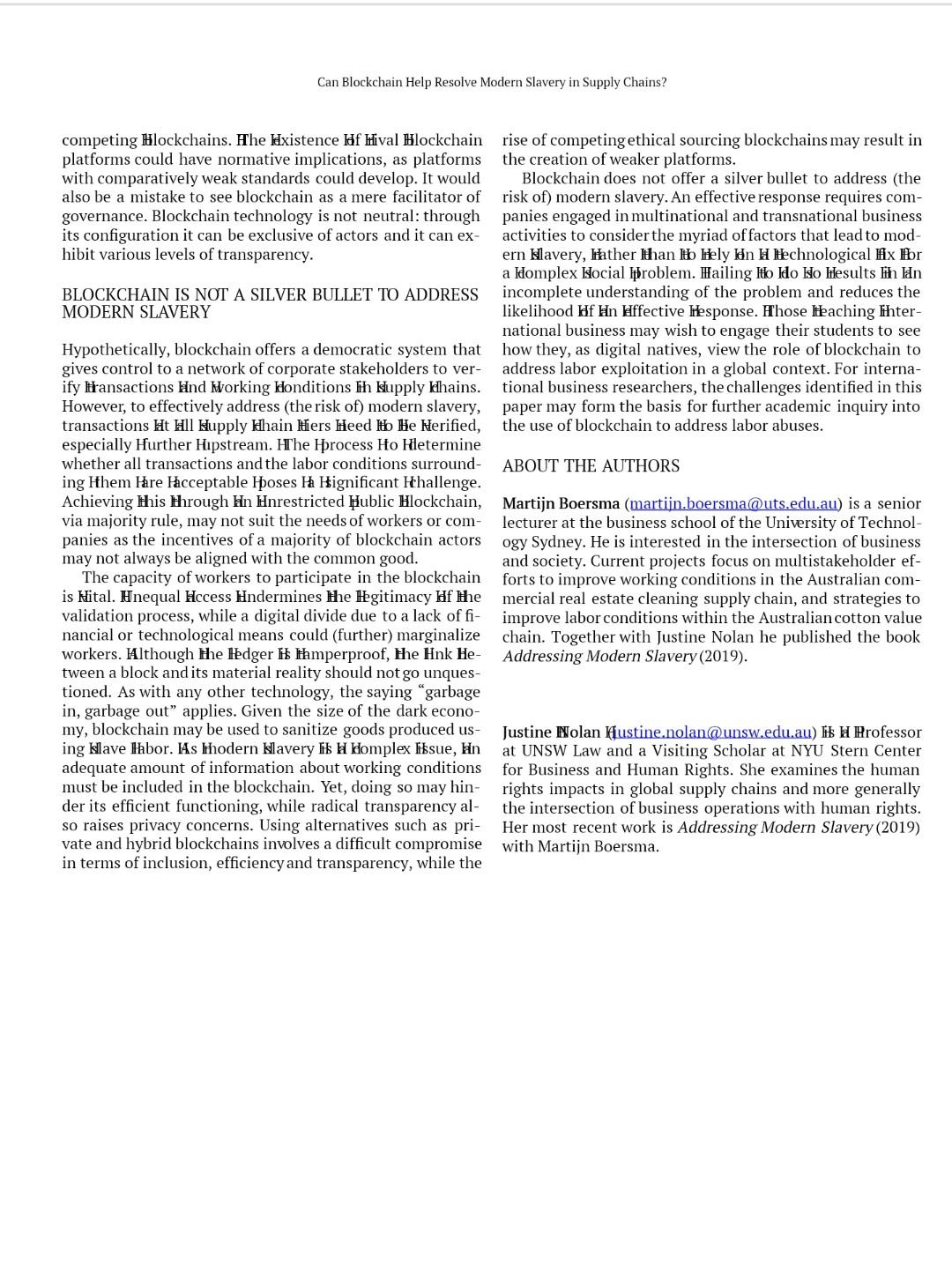
I need 5 questions to ask, based on this article.
it's an article we have to come up with questions from this article. could be any question related the topic.
Article Can Blockchain Help Resolve Modern Slavery in Supply Chains? Martijn Boersma,' Justine Nolan 2 1 University of Technology Sydney, Australia, 2 University of New South Wales, Australia Keywords: ethical sourcing, transparency, supply chains, blockchain, modern slavery AIB Insights While blockchain was designed as a ledger for cryptocurrency transactions, it can record transactions of anything of value. Blockchain is increasingly used to prove the integrity of commodities, tracing their supply chain journey from the source to the end user. Yet, transferring this technology from a cryptocurrency context to a supply chain setting is not without difficulties. This article explores the implications for multinational and transnational companies in using blockchain as a means to address modern slavery. The research identifies five challenges: verification, inclusion, trust, privacy, and normativity. INTRODUCTION It is crucial to see modern slavery through the prism of broader labor rights. While some engage in work that from Blockchain can be used to create a record of transactions for the lutset finvolves idverse Ifonditions, ltthers Ingage th anything Hf Halue. It It is ihcreasingly Hsed tb Hrove the lih- work with the expectation of decent conditions but find that tegrity of commodities, tracing their supply chain journey circumstances worsen without avenues for exit. When abusfrom the source to the end user. For example, together with es such as non-payment of wages and benefits, unfair disa Fijian fishing company and a technology company based missals, forced and unpaid overtime, and the denial of freein the United States, the World Wildlife Fund in Australia, dom of association and collective bargaining are prevalent Fiji and New Zealand piloted the use of blockchain to track and left unchecked, more severe forms of exploitation can tuna, Jhowing then Hand khere Hit Has Iaught HVisser I\& develop (Nolan \& Boersma, 2019). Using blockchain, comHanich, 2018). Their aim was to verify that companies and panies ingaged th thultinational fnd Hransnational Hctivconsumers Hre kelling Ir \#uying ttuna that tik kustainably ities thay fain thsight thto the donditions the their kupply caught and free of slave labor. As blockchain is widely tout- chains ind (the Hisk) Iff thodern Elavery. Het, Hfransferring ed ls k theans ltb Hddress ihodern klavery, this krticle kx- this technology from a cryptocurrency context to a supply plores the implications for companies engaged in multina- chain Ietting tik thot kithout ldifficulties. FNe liflentify iffive tional and transnational activities. challenges Hfor the Hise Wf Hlockchain Ho Hddress thnodern slavery: verification, inclusion, trust, privacy and normativBLOCKCHAIN TECHNOLOGY AND MODERN SLAVERY ity. Blockchain is best thought of as a public ledger, distributed CHALLENGES FOR BLOCKCHAIN IN ADDRESSING through a peer-to-peer network where participants validate MODERN SLAVERY transactions find hhaintain H Idopy Iff the \#redger. Whanges VERIFICATION to the ledger can only be made through agreement among consensus protocol, which determines who gets to validate tions and provide transparency without the need for an ina transaction. Decision makers could be all the blockchain termediary such as abank. In supply chains it can be used in participants, a majority, a select few, or a random selection. a similar way, to verify commodity transactions and to proOnce Hi Hransaction Hir Halidated, Hn Hrreversible Hecord ldf vide transparency about labor standards without the need that transaction is created. These records are called blocks for an intermediary such as a social audit firm. To do this, and are chained together chronologically. While blockchain every supply chain transaction needs to be recorded, espewas designed as a ledger for cryptocurrency transactions, it cially since the kisibility ldf krorking Idonditions Idecreases can record transactions of anything of value. further Hpstream. ICrucially, Hb iddress (the Ifisk iff) Ithodabout the Hrovenance If goods. This Ifan He Heneficial to verified, the Idonditions Gurrounding tfransactions Heed to companies and their stakeholders, as the oversight of com- be Halidated Ht Hach Ktep th the Hourcing Hnd Hroduction panies on the origin of goods in their supply chains is often process. HThere His Htherefore Ha Hdifference Hbetween Ha Because Hf this kompanies Hre Ht Hisk Hf Heing Honnected blockchain that aims to show that a commodity is free of to modern slavery (Stringer \& Michailova, 2018). For exam- slave labor. ple, the demand for cobalt - a mineral used in the produc- As the number of supply chain tiers increases, so will the tion of phone and laptop batteries - has been met by peo- number of transactions and blockchain participants. This is ple trapped in modern slavery (Frankel, 2016). Modern slav- where establishing adequate conditions for consensus beery includes forced labor (involuntary work under the threat comes Hhallenging. Hhe Herification f Hl Iransaction Hs of punishment); bonded labor (work to pay off a debt while achieved via the consensus protocol, which can involve the losing control over conditions and repayments); trafficking input of all the blockchain participants, a majority, a select (the movement of people for exploitation); and child slav- few or a random selection. While decentralized governance ery (exploitation of children for someone else's gain) (Nolan is H Hlockchain ktrength, lit klso karries Hisk. Hor kxample, \& Boersma, 2019). in a cryptocurrency blockchain that requires a majority of actors to validate transactions, so-called 51% attacks have Can Blockchain Help Resolve Modern Slavery in Supply Chains? been used to control the validation mechanism with ill in- that the amount of information undermines the efficiency tent (Rijmenam \& Ryan, 2018). In a supply chain, through of the slystem, While the lihformation Ihay H ikewise He Ibo majority rule, malevolent blockchain actors would be able complicated \#br kther Hlockchain Harticipants Ho kompreto validate dubious transactions or choose not to scrutinize hend. An lihtermediary Hould Help th Ivercome Ihis $ Hrobthe conditions surrounding certain transactions. Iem, Hut Hhis Hegates Hne If He Hey Hdvantages Iff Hsing INCLUSION blockchain. Konversely, the thclusion If thformation Ithat ss HbH factors underlying labor exploitatior private Hlockchain lit ihvite-only. Hhe kctors that Halidate PRIVACY transactions Han Hherefore He Hetted. Hhis Hegates Iwo blockchain kelements: Hndermines Hiransparency, Hnd Hy The inclusion of large amounts of information can also creexcluding actors the democratic character of blockchain is ate Hroblems th Herms Iff Hrivacy. Hin Hublic Hlockchain, weakened. Another solution is to make reputation a key de- the fact that anyone can access the ledger would mean that terminant: a select few reputable actors are relied upon to the prices of goods and labor would no longer be confidenvalidate a transaction. Yet, this too undermines the demo- tial. For workers, the notion of transparency and immutable cratic character of blockchain, and relying on a select few records can also be problematic: they could face repercusactors means that they serve as intermediaries, which can sions if they refuse to validate a transaction because of laworkers are involved in validating transactions, yet this is "difficult", as the immutability of blockchain makes it difunlikely if they are being exploited. ficult for a person to be "forgotten". Coupled with encrypWhile blockchain is decentralized and does not require tion, blockchain could potentially handle sensitive informaan tihtermediary, lifs Hptake tho Hddress Hhodern Hllavery iri tion, however it would be difficult to verify if workers get likely to be driven by companies at the top of supply chains, paid appropriately if information on the prices of goods and which kre Ifost Hrone tb Ifeputational Hamage lffom Heing labor is witheld, and anonymity may not offer workers prolinked tio lexploitation. Whhile Ithese Idompanies Itan tield tection from punitive measures in smaller workplaces. their buyer leverage to get suppliers on board, their influ- Another way to solve this problem is by using a "hybrid ence likely decreases as the number of supply chain tiers in- blockchain", which combines elements of public and private creases and suppliers become geographically dispersed. En- blockchains (Sagirlar, Carminati, Ferrari, Sheehan, \& Ragsuring blockchain uptake throughout the supply chain and noli, 2018). Hybrid blockchains also validate and record across borders therefore becomes a cascading responsibil- transactions in a tamperproof ledger, but participation can ity, where companies at each tier and in each location re- be invite-only and on the basis of anonymity (the identity quire their Kuppliers tho Hse Hlockchain. Het Hot kveryone of participants is revealed to other parties in transactions, may He Enticed tto Ido Ho. Hn Eryptocurrency Hlockchains, not to every blockchain participant), while participants can when H Hlock Hils Kalidated, Halidators Hre Hewarded Hith decide Hwhich transactions Hare made Hpublic. Hybrid cryptocurrency. In non-cryptocurrency blockchains, actors blockchains can be designed to find a balance between inmay Hlhack In tifcentive tho Halidate Hransactions Hnd liven clusion, efficiency and transparency. However, this creates the Idpposite Ian He Hrue: Huppliers Hhay Hot Kant Ho Hse the risk that a hybrid blockchain favours efficiency, rather blockchain Hecause Wf Hjuestionable Habor Hractices Hhat than H He Hhclusive Knd Hrovide Hansparency. Put kiffercould be exposed. Furthermore, smaller suppliers (especial- ently, hybrid blockchains can be configured to exclude cerly thin Ifeveloping Idountries) Hhay Hick Hithe Hinancial theans tain actors and transactions, leading to a weakened protocol or Hechnological thfrastructure Ho Harticipate. Hhe Hse Iff to validate transactions, while providing parties such as laand may inadvertently push workers (further) into the dark chains. economy. NORMATIVITY TRUST Addressing exploitation in supply chains is challenging, as One of blockchain's strengths is its ability to log transac- the role of government as the traditional arbitrator of such tions tih H Hhmperproof Histributed Hedger. Het, Hhen Heri- issues has become less prominent. In addition, the increase fying the integrity of goods in supply chains, this does not in Hhultinational Hnd Hransnational Husiness Hctivities Has mean that the link between a block and its material real- resulted in governance gaps. As blockchain does not require ity should go unquestioned. While a block cannot be ma- an intermediary, it is ostensibly capable of grappling with nipulated retrospectively, the integrity of information that the reduced role of government. Firms from institutionally is thitially Intered tib Hulnerable to thaccuracies Kr Hiraud. distant knvironments Kften Ingage Hhartnerships tih HeForced labor generates US\$ 150 billion in illegal profits per sponse Hto Hgovernance Hgaps H(Abdi H\& HAulakh, H2012). year FIInternational mlabour rganization, H014). Hhere itis Blockchain seems to be well suited to facilitate such parttherefore a risk that blockchain can be used to launder value nerships, as it allows stakeholders in institutionally distant that is illegally generated. Apart from the consensus pro- environments to enforce the mutually agreed upon norms tocol, there is no mechanism to stop actors from creating concerning the circumstances in which supply chain transa block that claims that a commodity is free of slave labor, actions are deemed to be acceptable. whether this is true or not. Yet the standards that a blockchain upholds are not un- That risk is pertinent as modern slavery is a complex is- contentious. Ho address fovernance faps, H klustainability sue. In order to verify transactions and rule out the possi- standards market has emerged which has led to rival certifibility of modern slavery and other forms of exploitation, an cation standards (Fransen \& Burgoon, 2012). Given the deadequate amount of information about working conditions velopment Hf Heveral ethical klourcing Hlockchains (5mith, needs to be included in the blockchain. There is a danger 2019), it is possible that a similar market will emerge with AIB Insights 2 Can Blockchain Help Resolve Modern Slavery in Supply Chains? competing Hlockchains. Hhe lexistence If Hival Hlockchain rise of competing ethical sourcing blockchains may result in platforms could have normative implications, as platforms the creation of weaker platforms. with comparatively weak standards could develop. It would Blockchain does not offer a silver bullet to address (the also be a mistake to see blockchain as a mere facilitator of risk of) modern slavery. An effective response requires comgovernance. Blockchain technology is not neutral: through panies engaged in multinational and transnational business its configuration it can be exclusive of actors and it can ex- activities to consider the myriad of factors that lead to moda tomplex Isocial \#roblem. \#railing tifo ldo Ko Hesults tinh Hn BLOCKCHAIN IS NOT A SILVER BULLET TO ADDRESS incomplete understanding of the problem and reduces the MODERN SLAVERY likelihood Hf Hn Hffective Hesponse. Hhose theaching Hhternational business may wish to engage their students to see Hypothetically, blockchain offers a democratic system that how they, as digital natives, view the role of blockchain to gives control to a network of corporate stakeholders to ver- address labor exploitation in a global context. For internaify ltransactions knd korking donditions lih klupply khains. tional business researchers, the challenges identified in this However, to effectively address (the risk of) modern slavery, paper may form the basis for further academic inquiry into transactions Ht Hll kupply khain Hiliers Heed to He Herified, the use of blockchain to address labor abuses. especially Hurther Hipstream. HThe Hrocess Ho Hetermine whether all transactions and the labor conditions surround- ABOUT THE AUTHORS ing Hhem Hare Hacceptable Hoses Ha Hignificant Hhallenge. Achieving this Hhrough Hn Hnrestricted Hublic Hlockchain, Martijn Boersma (martijn.boersma@uts.edu.au) is a senior via majority rule, may not suit the needs of workers or com- lecturer at the business school of the University of Technolpanies as the incentives of a majority of blockchain actors ogy Sydney. He is interested in the intersection of business may not always be aligned with the common good. and society. Current projects focus on multistakeholder efThe capacity of workers to participate in the blockchain forts to improve working conditions in the Australian comis kital. Hnequal Hccess Hndermines the H fitimacy Hf the mercial real estate cleaning supply chain, and strategies to validation process, while a digital divide due to a lack of fi- improve labor conditions within the Australian cotton value nancial or technological means could (further) marginalize chain. Together with Justine Nolan he published the book workers. IAlthough the 1edger fib thmperproof, the Hnk He- Addressing Modern Slavery (2019). tween a block and its material reality should not go unquestioned. As with any other technology, the saying "garbage in, garbage out" applies. Given the size of the dark econoing kllave Ihbor. Hs thodern klavery lik H k komplex lissue, kn at UNSW Law and a Visiting Scholar at NYU Stern Center adequate amount of information about working conditions for Business and Human Rights. She examines the human must be included in the blockchain. Yet, doing so may hin- rights impacts in global supply chains and more generally der its efficient functioning, while radical transparency al- the intersection of business operations with human rights. so raises privacy concerns. Using alternatives such as pri- Her most recent work is Addressing Modern Slavery (2019) vate and hybrid blockchains involves a difficult compromise with Martijn Boersma. in terms of inclusion, efficiency and transparency, while the
Step by Step Solution
There are 3 Steps involved in it

Get step-by-step solutions from verified subject matter experts
 Study Help