







Question: I need a little help for my projecte. Objective: Comparative study of Dimensionality Reduction Techniques and their Impact on Regression and Visualization. Dataset: The dataset
I need a little help for my projecte. Objective: Comparative study of Dimensionality Reduction Techniques and their Impact on
Regression and Visualization.
Dataset:
The dataset is stored in a CSV file named 'diabetescsv which has been provided to you.
The dataset consists of observations on patients, with the response of interest being a
quantitative measure of disease progression one year after baseline. There are ten
baseline input variables, age, sex, bodymass index, average blood pressure, and six blood
serum measurements. The last variable is the output.
Task:
Load the dataset from the CSV file into a DataFrame named diabetesdf using the Pandas
library.
Data Preprocessing:
a Preprocess the diabetesdf by scaling all the variables to the range using
MinMaxScaler.
b Convert the scaled data back to a DataFrame named diabetesdfs for easier
visualization.
Compute the variance of each input variable.
Plot the bar chart showing the variances computed in step
Generate a heatmap to visualize the pairwise correlation between the variables input and
output variables
Rank the input variables in descending order based on their correlation with the output
variable. The higher the variance, the more important the input variable is
Using the first two important input variables, generate a scatter to display the data
distribution.
Apply Lasso regression to the entire dataset using all variables
a Lasso regression involves a regularization parameter, denoted as alpha prop in the Scikit
learn ML tool. A higher value of alpha also known as lambda leads to more
regularization, which in turn shrinks the coefficients towards zero, effectively reducing
the complexity of the model and selecting only the most important variables.
b Using Mean Squared Error MSE to calculate the average squared difference between
the predicted and actual values. Lower MSE values indicate better model performance.
Scikitlearn provides a function for calculating MSE.
c Compute the MSE of Lasso regression for different values of alpha:
and
d Plot the curve showing the variation of MSE with respect to alpha.
Display the best MSE and the corresponding alpha value.
f Plot the evolution of Lasso coefficients against alpha to observe how they change and
how they are Shrunk as alpha varies.
Reduce the data dimensionality using PCA Principal Component Analysis
a Utilize PC and PC and visualize the data scatter.
b Plot the loadings to examine how the variables contribute to PC and PC
c Perform normal linear regression, using PC only.
d Plot the regression line on the scatter.
e Perform normal linear regression, using PC and PC
f Plot the regression hyperline on the scatter.
g Using bar chart, calculate, and display the MSE for both cases c and d
Reduce the data dimensionality with tSNE.
a Utilize the st and nd tSNE dimensions to visualize the data scatter, with different
perplexity values: and
b Perform normal linear regression, using only the st dimension of tSNE.
c Plot the regression line on the scatter.
d Perform normal linear regression, using the st and nd dimensions of tSNE.
e Plot the regression hyperline on the scatter.
f Using bar chart, calculate, and display the MSE for both cases b and d
Reduce the data dimensionality with UMAP.
a Utilize the st and nd UMAP dimensions to visualize the data scatter, with different
nneighbors number of neighbors values: and
b Perform normal linear regression, using only the st dimension of UMAP.
c Plot the regression line on the scatter.
d Perform normal linear regression, using the st and nd dimensions of UMAP.
e Plot the regression hyperline on the scatter.
f Using bar chart, calculate, and display the MSE for both cases b and d
g Provide a comparative table to compare Linear Regression applied to PCA, tSNE, and
UMAP data, utilizing the first three dimensions for each dimensionality reduction
method.
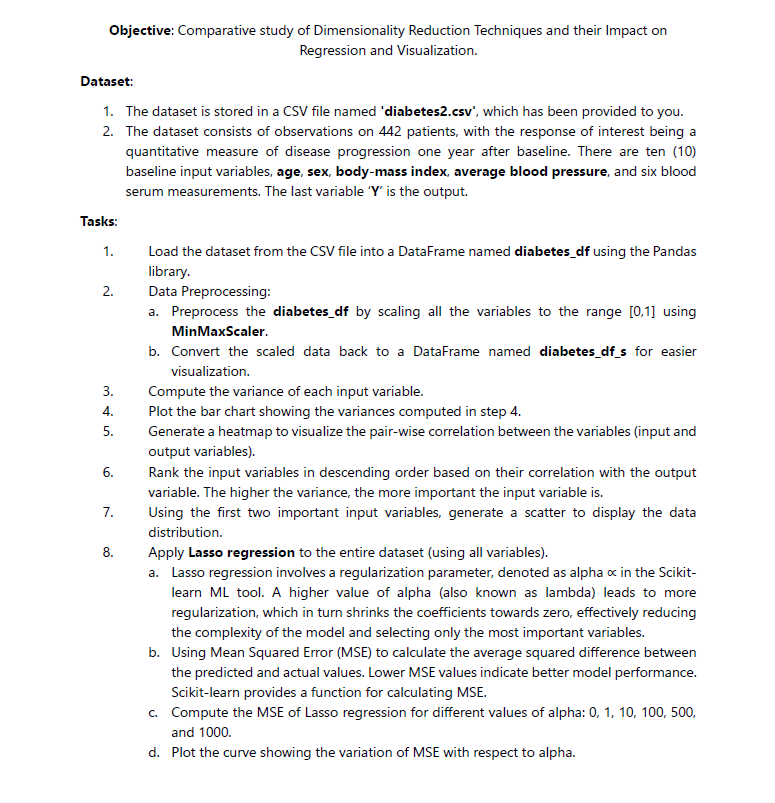
Objective: Comparative study of Dimensionality Reduction Techniques and their Impact on
Regression and Visualization.
Dataset:
The dataset is stored in a CSV file named 'diabetescsv which has been provided to you.
The dataset consists of observations on patients, with the response of interest being a
quantitative measure of disease progression one year after baseline. There are ten
baseline input variables, age, sex, bodymass index, average blood pressure, and six blood
serum measurements. The last variable Y is the output.
Task:
Load the dataset from the CSV file into a DataFrame named diabetesdf using the Pandas
library.
Data Preprocessing:
a Preprocess the diabetesdf by scaling all the variables to the range using
MinMaxScaler.
Step by Step Solution
There are 3 Steps involved in it
1 Expert Approved Answer
Step: 1 Unlock

Question Has Been Solved by an Expert!
Get step-by-step solutions from verified subject matter experts
Step: 2 Unlock
Step: 3 Unlock
 Study Help