







Question: i need a solution step 1 and 2 and 3 PROBLEM-SOLVING APPLICATION CASE Zappos CEO Asks Employees to Commit to Teal, or Leave A BIT
 i need a solution step 1 and 2 and 3
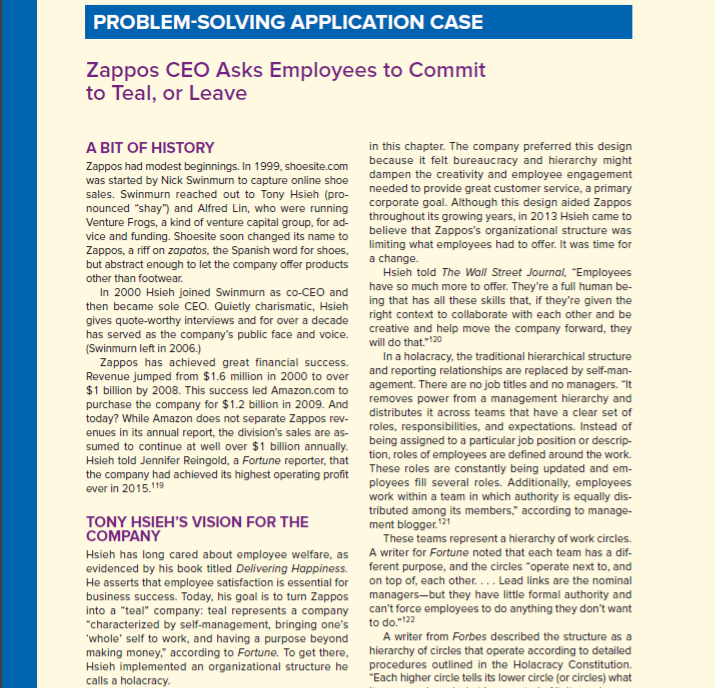
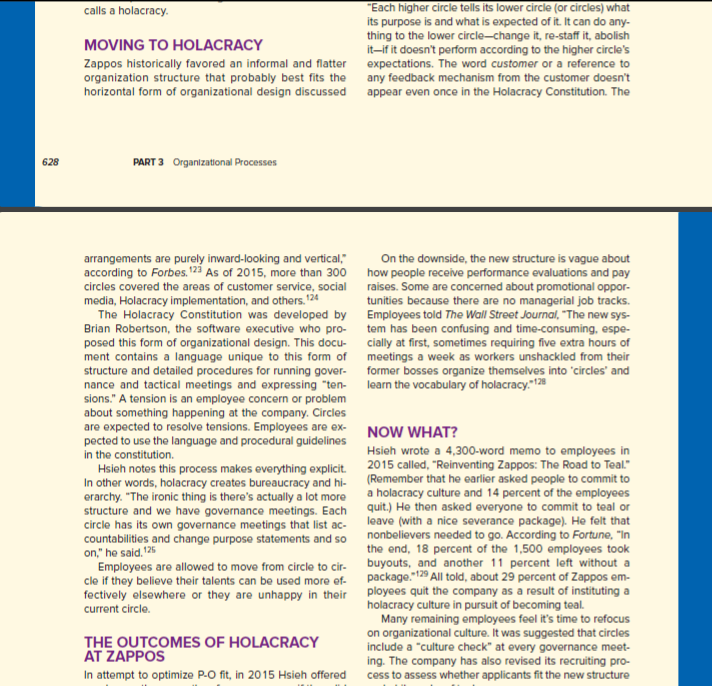
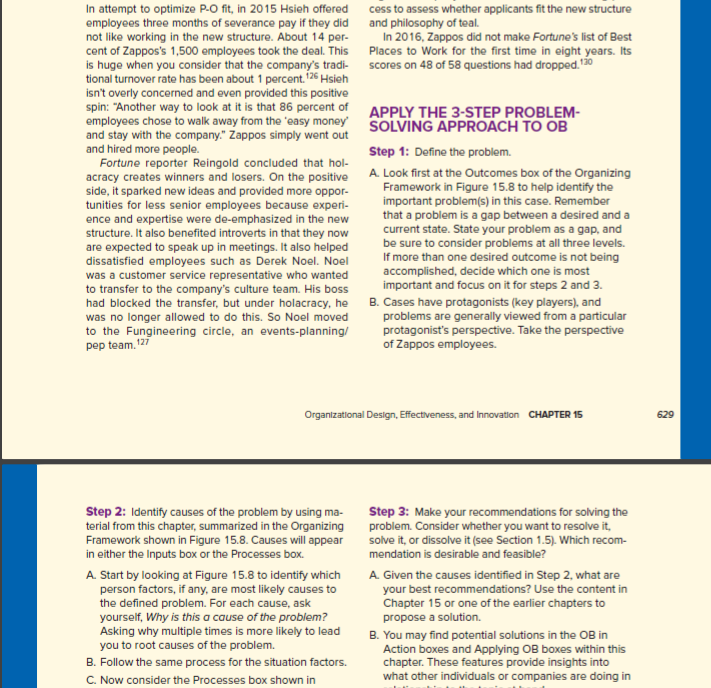
PROBLEM-SOLVING APPLICATION CASE Zappos CEO Asks Employees to Commit to Teal, or Leave A BIT OF HISTORY in this chapter. The company preferred this design Zappos had modest beginnings. In 1999, shoesite.com because it felt bureaucracy and hierarchy might was started by Nick Swinmurn to capture online shoe dampen the creativity and employee engagement sales. Swinmurn reached out to Tony Hsieh (pro- needed to provide great customer service, a primary nounced "shay") and Alfred Lin, who were running corporate goal. Although this design aided Zappos Venture Frogs, a kind of venture capital group, for ad- throughout its growing years, in 2013 Hsieh came to vice and funding. Shoesite soon changed its name to believe that Zappos's organizational structure was Zappos, a riff on zapatos, the Spanish word for shoes limiting what employees had to offer. It was time for but abstract enough to let the company offer products a change. other than footwear Hsieh told The Wall Street Journal, "Employees In 2000 Hsieh joined Swinmurn as Co-CEO and have so much more to offer. They're a full human be then became sole CEO. Quietly charismatic, Hsieh ing that has all these skills that, if they're given the gives quote-worthy interviews and for over a decade right context to collaborate with each other and be has served as the company's public face and voice. creative and help move the company forward, they (Swinmurn left in 2006.) will do that."120 Zappos has achieved great financial success. In a holacracy, the traditional hierarchical structure Revenue jumped from $1.6 million in 2000 to over and reporting relationships are replaced by self-man- $1 billion by 2008. This success led Amazon.com to agement. There are no job titles and no managers. "It purchase the company for $1.2 billion in 2009. And removes power from a management hierarchy and today? While Amazon does not separate Zappos rev- distributes it across teams that have a clear set of enues in its annual report, the division's sales are as- roles, responsibilities, and expectations. Instead of sumed to continue at well over $1 billion annually. being assigned to a particular job position or descrip- Hsieh told Jennifer Reingold, a Fortune reporter, that tion, roles of employees are defined around the work. the company had achieved its highest operating profit These roles are constantly being updated and em- ever in 2015.119 ployees fill several roles. Additionally, employees work within a team in which authority is equally dis- TONY HSIEH'S VISION FOR THE tributed among its members, according to manage ment blogger 121 COMPANY These teams represent a hierarchy of work circles. Hsieh has long cared about employee welfare, as A writer for Fortune noted that each team has a dif- evidenced by his book titled Delivering Happiness.ferent purpose, and the circles "operate next to, and He asserts that employee satisfaction is essential for on top of each other.... Lead links are the nominal business success. Today, his goal is to turn Zappos managers, but they have little formal authority and into a "teal" company: teal represents a company can't force employees to do anything they don't want "characterized by self-management, bringing one's to do."122 'whole' self to work, and having a purpose beyond A writer from Forbes described the structure as a making money." according to Fortune. To get there, hierarchy of circles that operate according to detailed Hsieh implemented an organizational structure he procedures outlined in the Holacracy Constitution. calls a holacracy. "Each higher circle tells its lower circle (or circles) what calls a holacracy. "Each higher circle tells its lower circle (or circles) what its purpose is and what is expected of it. It can do any- MOVING TO HOLACRACY thing to the lower circle-change it, re-staff it, abolish it-if it doesn't perform according to the higher circle's Zappos historically favored an informal and flatter expectations. The word customer or a reference to organization structure that probably best fits the any feedback mechanism from the customer doesn't horizontal form of organizational design discussed appear even once in the Holacracy Constitution. The 628 PART 3 Organizational Processes arrangements are purely inward-looking and vertical." On the downside, the new structure is vague about according to Forbes.123 As of 2015, more than 300 how people receive performance evaluations and pay circles covered the areas of customer service, social raises. Some are concerned about promotional oppor- media, Holacracy implementation, and others. 124 tunities because there are no managerial job tracks. The Holacracy Constitution was developed by Employees told The Wall Street Journal, "The new sys- Brian Robertson, the software executive who pro- tem has been confusing and time-consuming, espe- posed this form of organizational design. This docu- cially at first, sometimes requiring five extra hours of ment contains a language unique to this form of meetings a week as workers unshackled from their structure and detailed procedures for running gover- former bosses organize themselves into circles' and nance and tactical meetings and expressing "ten- learn the vocabulary of holacracy."128 sions." A tension is an employee concern or problem about something happening at the company. Circles are expected to resolve tensions. Employees are ex- NOW WHAT? pected to use the language and procedural guidelines Hsieh wrote a 4,300-word memo to employees in in the constitution Hsieh notes this process makes everything explicit 2015 called, "Reinventing Zappos: The Road to Teal." In other words, holacracy creates bureaucracy and hi- (Remember that he earlier asked people to commit to erarchy. "The ironic thing is there's actually a lot more a holacracy culture and 14 percent of the employees structure and we have governance meetings. Each quit.) He then asked everyone to commit to teal or circle has its own governance meetings that list ac leave (with a nice severance package). He felt that countabilities and change purpose statements and so nonbelievers needed to go. According to Fortune, "In on," he said. 125 the end, 18 percent of the 1,500 employees took Employees are allowed to move from circle to cir. buyouts, and another 11 percent left without a cle if they believe their talents can be used more of package." 129 All told, about 29 percent of Zappos em- fectively elsewhere or they are unhappy in their ployees quit the company as a result of instituting a current circle holacracy culture in pursuit of becoming teal. Many remaining employees feel it's time to refocus on organizational culture. It was suggested that circles THE OUTCOMES OF HOLACRACY AT ZAPPOS include a "culture check" at every governance meet- ing. The company has also revised its recruiting pro- In attempt to optimize P-O fit, in 2015 Hsieh offered cess to assess whether applicants fit the new structure In attempt to optimize P-O fit, in 2015 Hsieh offered cess to assess whether applicants fit the new structure employees three months of severance pay if they did and philosophy of teal. not like working in the new structure. About 14 per- In 2016, Zappos did not make Fortune's list of Best cent of Zappos's 1,500 employees took the deal. This Places to Work for the first time in eight years. Its is huge when you consider that the company's tradi- scores on 48 of 58 questions had dropped to tional turnover rate has been about 1 percent. 126 Hsieh isn't overly concerned and even provided this positive spin: "Another way to look at it is that 86 percent of APPLY THE 3-STEP PROBLEM- employees chose to walk away from the 'easy money SOLVING APPROACH TO OB and stay with the company." Zappos simply went out and hired more people. Step 1: Define the problem. Fortune reporter Reingold concluded that hol- acracy creates winners and losers. On the positive A. Look first at the Outcomes box of the Organizing side, it sparked new ideas and provided more oppor- Framework in Figure 15.8 to help identify the tunities for less senior employees because experi- important problem(s) in this case. Remember ence and expertise were de-emphasized in the new that a problem is a gap between a desired and a structure. It also benefited introverts in that they now current state. State your problem as a gap, and are expected to speak up in meetings. It also helped be sure to consider problems at all three levels. dissatisfied employees such as Derek Noel. Noel If more than one desired outcome is not being was a customer service representative who wanted accomplished, decide which one is most to transfer to the company's culture team. His boss important and focus on it for steps 2 and 3. had blocked the transfer, but under holacracy, he B. Cases have protagonists (key players), and was no longer allowed to do this. So Noel moved problems are generally viewed from a particular to the Fungineering circle, an events-planning/ protagonist's perspective. Take the perspective of Zappos employees. pep team 127 Organizational Design, Effectiveness, and Innovation CHAPTER 15 629 Step 2: Identify causes of the problem by using ma- terial from this chapter, summarized in the Organizing Framework shown in Figure 15.8. Causes will appear in either the Inputs box or the Processes box. A. Start by looking at Figure 15.8 to identify which person factors, if any, are most likely causes to the defined problem. For each cause, ask yourself, Why is this a cause of the problem? Asking why multiple times is more likely to lead you to root causes of the problem. B. Follow the same process for the situation factors. C. Now consider the Processes box shown in Step 3: Make your recommendations for solving the problem. Consider whether you want to resolve it, solve it, or dissolve it (see Section 1.5). Which recom- mendation is desirable and feasible? A Given the causes identified in Step 2, what are your best recommendations? Use the content in Chapter 15 or one of the earlier chapters to propose a solution B. You may find potential solutions in the OB in Action boxes and Applying OB boxes within this chapter. These features provide insights into what other individuals or companies are doing in C. Now consider the Processes box shown in Figure 15.8. Consider concepts listed at all three levels. For any concept that might be a cause, ask yourself, Why is this a cause? Again, do this for several iterations to arrive at root causes. D. To check the accuracy or appropriateness of the causes, map them onto the defined problem. what other individuals or companies are doing in relationship to the topic at hand. C. Create an action plan for implementing your recommendations
Step by Step Solution
There are 3 Steps involved in it
1 Expert Approved Answer
Step: 1 Unlock

Question Has Been Solved by an Expert!
Get step-by-step solutions from verified subject matter experts
Step: 2 Unlock
Step: 3 Unlock
 Study Help