







Question: Please help with this. There are 3 steps problem solving approah listed on the book. Please review them as you help. Thank you 1) Define
Please help with this.
There are 3 steps problem solving approah listed on the book. Please review them as you help. Thank you
1) Define the problem
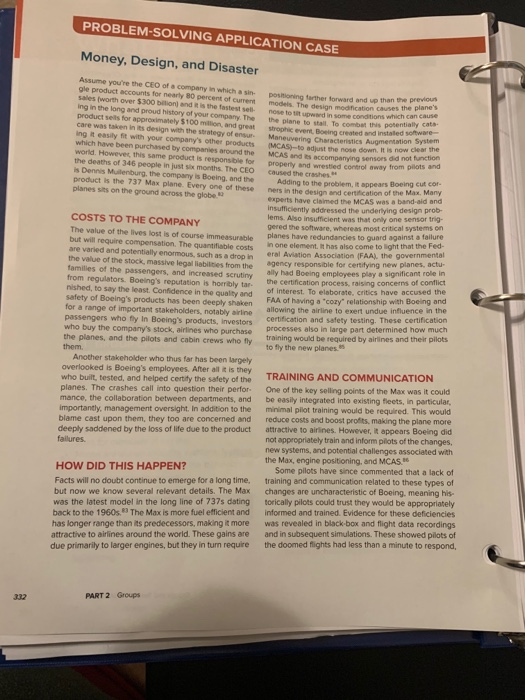
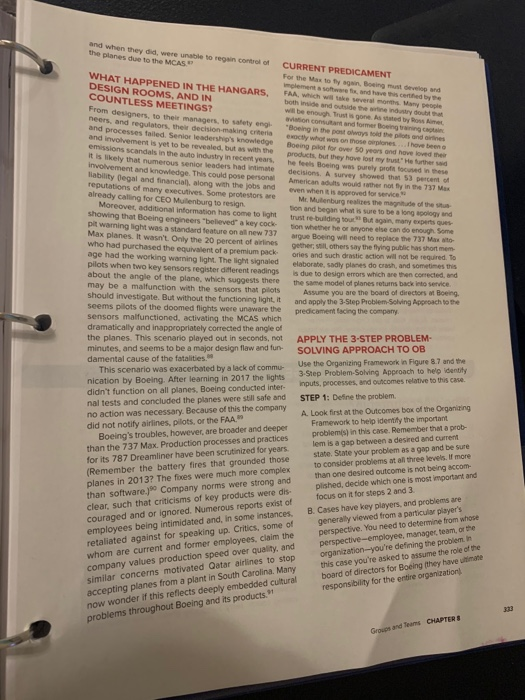
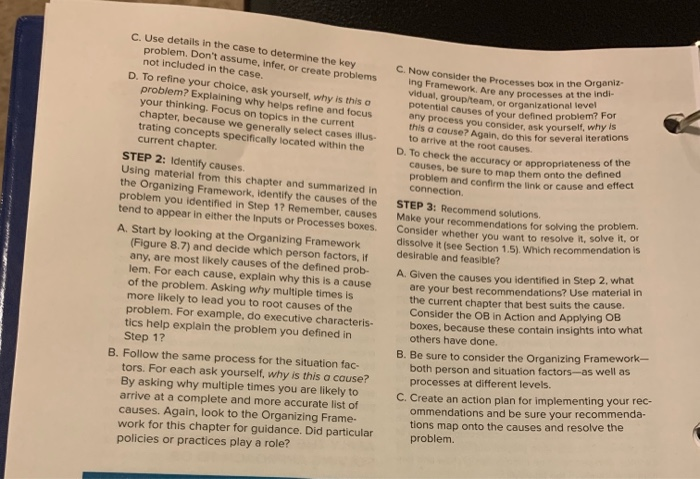
PROBLEM-SOLVING APPLICATION CASE Money, Design, and Disaster Assume you're the CEO of a company in which a sin gle product accounts for nearly 80 percent of current sales worth over $300 on and is the fastest ing in the long and proud history of your company. The products for approximately $100 million, and great care was taken in its design with the strategy of ensu Ing it easily it with your company's other products which have been purchased by companies around the world. However, this same product is responsible for the deaths of 346 people in just six months. The CEO is Dennis Muilenburg, the company is Boeing, and the product is the 737 Max plane. Every one of these planes sits on the ground across the globe COSTS TO THE COMPANY The value of the lives lost is of course immeasurable but will require compensation. The quantifiable costs are varied and potentially enormous, such as a drop in the value of the stock, massive legal liabilities from the families of the passengers, and increased scrutiny from regulators. Boeing's reputation is horribly tar nished, to say the least Confidence in the quality and safety of Boeing's products has been deeply shaken for a range of important stakeholders, notably airline passengers who fly In Boeing's products, investors who buy the company's stock, airlines who purchase the planes, and the pilots and cabin crews who fly them. Another stakeholder who thus far has been largely overlooked is Boeing's employees. After all it is they who built, tested, and helped certify the safety of the planes. The crashes call into question their perfor mance, the collaboration between departments, and importantly, management oversight. In addition to the blame cast upon them, they too are concerned and deeply saddened by the loss of life due to the product failures. positioning further forward and up than the previous models. The design modification causes the plane's nose to tuwd in some conditions which can cause the plane to stall To combat this potentially cats strophic event, Boeing created and instated software- Maneuvering Characteristics Augmentation System IMCAS)--to adjust the nose down. It is now clear the MCAS and its accompanying sensors did not function properly and wrestled control away from pilots and caused the crashes Adding to the problem, it appears Boeing cut cor- ners in the design and certification of the Max. Many experts have claimed the MCAS was a band-aid and Insufficiently addressed the underlying design prob- lems. Also insufficient was that only one sensor trig. gered the software, whereas most critical systems on planes have redundancies to guard against a failure in one element. It has also come to light that the Fed- eral Aviation Association (FAA), the governmental agency responsible for certifying new planes, actu- ally had Boeing employees play a significant role in the certification process, raising concerns of conflict of interest. To elaborate, critics have accused the FAA of having a 'correlationship with Boeing and allowing the airline to exert undue influence in the certification and safety testing. These certification processes also in large part determined how much training would be required by airlines and their pilots to fly the new planes HOW DID THIS HAPPEN? Facts will no doubt continue to emerge for a long time. but now we know several relevant details. The Max was the latest model in the long line of 737s dating back to the 1960s. The Max is more fuel efficient and has longer range than its predecessors, making it more attractive to airlines around the world. These gains are due primarily to larger engines, but they in turn require TRAINING AND COMMUNICATION One of the key selling points of the Max was it could be easily integrated into existing fleets, in particular, minimal pilot training would be required. This would reduce costs and boost profits, making the plane more attractive to airlines. However, it appears Boeing did not appropriately train and inform pilots of the changes. new systems, and potential challenges associated with the Max, engine positioning, and MCAS." Some pilots have since commented that a lack of training and communication related to these types of changes are uncharacteristic of Boeing, meaning his torically pilots could trust they would be appropriately informed and trained. Evidence for these deficiencies was revealed in black box and flight data recordings and in subsequent simulations. These showed pilots of the doomed fights had less than a minute to respond, PART 2 Groups And when they did, were unable to regain control of the planes due to the MCAS." CURRENT PREDICAMENT For the Max to ty wgwin, Boeing must develop and WHAT HAPPENED IN THE HANGARS, mentowwe, nave certified by the DESIGN ROOMS, AND IN FAA, which wie several month. Many people COUNTLESS MEETINGS? both inside and the wind will be enou Trust is gone. As by Rose From designers, to their managers, to safety engl. cond former Boeing neers, and regulators, the decision-making creria Boeing in the post oposandories C and processes talled. Senior leadership's knowledge actly what was on those ones Thove been and involvement is yet to be revealed, but as with the Boeing plot for over 50 years and have loved emissions scandals in the auto industry in recent years. products, but they have lost myster It is likely that numerous senior leaders had tomate he feels Boeing was purely focused in these Involvement and knowledge. This could pose personal decisions. A survey showed that 53 percent liability Degal and financial, along with the jobs and American adults would rather notty in the 737 Max reputations of many executives. Some protestors are even when it is proved for service Mr. Multenburg realizes the magte of the already calling for CEO Muilenburg to resign son and began what is sure to be a long logy and Moreover, additional information has come to light trustre-building tour But in many experts showing that Boeing engineers believed a keycode tion whether he or anyone else can do enough some pit warning light was a standard feature on all new 737 argue Boeing will need to replace the 737 Maxto Max planes. It wasn't. Only the 20 percent of lines getherill others say the flying public has short mem who had purchased the equivalent of a premium pack ories and such drastic action will not be required. To age had the working warning light. The light signaled elaborate, sadly planes do crash, and sometimes this pilots when two key sensors register different readings is due to design errors which are the corrected, and about the angle of the plane, which suggests there the same model of planes returns back into service may be a malfunction with the sensors that pilots Assume you are the board of directors of Boeing should investigate. But without the functioning light, it and apply the 3-Step Problem Solving Approach to the seems pilots of the doomed flights were unaware the predicament facing the company sensors malfunctioned, activating the MCAS which dramatically and inappropriately corrected the angle of APPLY THE 3-STEP PROBLEM- the planes. This scenario played out in seconds, not SOLVING APPROACH TO OB minutes, and seems to be a major design flaw and fun damental cause of the fatalities. This scenario was exacerbated by a lack of commu- nication by Boeing. After learning in 2017 the lights didn't function on all planes, Boeing conducted inter- nal tests and concluded the planes were still safe and no action was necessary. Because of this the company did not notify airlines, pilots, or the FAA Boeing's troubles, however, are broader and deeper than the 737 Max. Production processes and practices for its 787 Dreamliner have been scrutinized for years (Remember the battery fires that grounded those planes in 2013? The foxes were much more complex than software.) Company norms were strong and clear, such that criticisms of key products were dis- couraged and or ignored. Numerous reports exist of employees being intimidated and, in some instances, retaliated against for speaking up. Critics, some of whom are current and former employees, claim the company values production speed over quality, and similar concerns motivated Qatar airlines to stop Use the Organizing Framework in Figure 8.7 and the 3-Step Problem Solving Approach to help identity inputs, processes, and outcomes relative to this case. STEP 1: Define the problem A. Look first at the outcomes box of the Organizing Framework to help identify the important problems in this case. Remember that a prob- lem is a gap between a desired and current state. State your problem as a gap and be sure to consider problems at all three levels. If more than one desired outcome is not being accom- plished, decide which one is most important and focus on it for steps 2 and 3 B. Cases have key players, and problems are generally viewed from a particular player's perspective. You need to determine from whose perspective-employee, manager, team, or the organization-you're defining the problem. In this case you're asked to assume the role of the board of directors for Boeing (they have time responsibility for the entire organization accepting planes from a plant in South Carolina. Many now wonder if this reflects deeply embedded cultural problems throughout Boeing and its products Groups and Teams CHAPTER C. Now consider the Processes box in the Organiz Ing Framework. Are any processes at the indi- vidual, group/team, or organizational level potential causes of your defined problem? For this couse? Again, do this for several iterations C. Use details in the case to determine the key problem. Don't assume, infer, or create problems not included in the case. D. To refine your choice, ask yourself, why is this a problem? Explaining why helps refine and focus your thinking. Focus on topics in the current chapter, because we generally select cases illus trating concepts specifically located within the current chapter. STEP 2: Identify causes. Using material from this chapter and summarized in the Organizing Framework, identify the causes of the problem you identified in Step 1? Remember, causes tend to appear in either the inputs or Processes boxes. A. Start by looking at the Organizing Framework (Figure 8.7) and decide which person factors, if any, are most likely causes of the defined prob. lem. For each cause, explain why this is a cause of the problem. Asking why multiple times is more likely to lead you to root causes of the problem. For example, do executive characteris- tics help explain the problem you defined in Step 1? B. Follow the same process for the situation fac- tors. For each ask yourself, why is this a couse? By asking why multiple times you are likely to arrive at a complete and more accurate list of causes. Again, look to the Organizing Frame. work for this chapter for guidance. Did particular policies or practices play a role? any process you consider, ask yourself, why is to arrive at the root causes D. To check the accuracy or appropriateness of the causes, be sure to map them onto the defined problem and confirm the link or cause and effect connection. STEP 3: Recommend solutions. Make your recommendations for solving the problem. Consider whether you want to resolve it, solve it, or dissolve it (see Section 1,5). Which recommendation is desirable and feasible? A. Given the causes you identified in Step 2. what are your best recommendations? Use material in the current chapter that best suits the cause. Consider the OB in Action and Applying OB boxes, because these contain insights into what others have done. B. Be sure to consider the Organizing Framework- both person and situation factors-as well as processes at different levels. C. Create an action plan for implementing your rec- ommendations and be sure your recommenda- tions map onto the causes and resolve the problem. PROBLEM-SOLVING APPLICATION CASE Money, Design, and Disaster Assume you're the CEO of a company in which a sin gle product accounts for nearly 80 percent of current sales worth over $300 on and is the fastest ing in the long and proud history of your company. The products for approximately $100 million, and great care was taken in its design with the strategy of ensu Ing it easily it with your company's other products which have been purchased by companies around the world. However, this same product is responsible for the deaths of 346 people in just six months. The CEO is Dennis Muilenburg, the company is Boeing, and the product is the 737 Max plane. Every one of these planes sits on the ground across the globe COSTS TO THE COMPANY The value of the lives lost is of course immeasurable but will require compensation. The quantifiable costs are varied and potentially enormous, such as a drop in the value of the stock, massive legal liabilities from the families of the passengers, and increased scrutiny from regulators. Boeing's reputation is horribly tar nished, to say the least Confidence in the quality and safety of Boeing's products has been deeply shaken for a range of important stakeholders, notably airline passengers who fly In Boeing's products, investors who buy the company's stock, airlines who purchase the planes, and the pilots and cabin crews who fly them. Another stakeholder who thus far has been largely overlooked is Boeing's employees. After all it is they who built, tested, and helped certify the safety of the planes. The crashes call into question their perfor mance, the collaboration between departments, and importantly, management oversight. In addition to the blame cast upon them, they too are concerned and deeply saddened by the loss of life due to the product failures. positioning further forward and up than the previous models. The design modification causes the plane's nose to tuwd in some conditions which can cause the plane to stall To combat this potentially cats strophic event, Boeing created and instated software- Maneuvering Characteristics Augmentation System IMCAS)--to adjust the nose down. It is now clear the MCAS and its accompanying sensors did not function properly and wrestled control away from pilots and caused the crashes Adding to the problem, it appears Boeing cut cor- ners in the design and certification of the Max. Many experts have claimed the MCAS was a band-aid and Insufficiently addressed the underlying design prob- lems. Also insufficient was that only one sensor trig. gered the software, whereas most critical systems on planes have redundancies to guard against a failure in one element. It has also come to light that the Fed- eral Aviation Association (FAA), the governmental agency responsible for certifying new planes, actu- ally had Boeing employees play a significant role in the certification process, raising concerns of conflict of interest. To elaborate, critics have accused the FAA of having a 'correlationship with Boeing and allowing the airline to exert undue influence in the certification and safety testing. These certification processes also in large part determined how much training would be required by airlines and their pilots to fly the new planes HOW DID THIS HAPPEN? Facts will no doubt continue to emerge for a long time. but now we know several relevant details. The Max was the latest model in the long line of 737s dating back to the 1960s. The Max is more fuel efficient and has longer range than its predecessors, making it more attractive to airlines around the world. These gains are due primarily to larger engines, but they in turn require TRAINING AND COMMUNICATION One of the key selling points of the Max was it could be easily integrated into existing fleets, in particular, minimal pilot training would be required. This would reduce costs and boost profits, making the plane more attractive to airlines. However, it appears Boeing did not appropriately train and inform pilots of the changes. new systems, and potential challenges associated with the Max, engine positioning, and MCAS." Some pilots have since commented that a lack of training and communication related to these types of changes are uncharacteristic of Boeing, meaning his torically pilots could trust they would be appropriately informed and trained. Evidence for these deficiencies was revealed in black box and flight data recordings and in subsequent simulations. These showed pilots of the doomed fights had less than a minute to respond, PART 2 Groups And when they did, were unable to regain control of the planes due to the MCAS." CURRENT PREDICAMENT For the Max to ty wgwin, Boeing must develop and WHAT HAPPENED IN THE HANGARS, mentowwe, nave certified by the DESIGN ROOMS, AND IN FAA, which wie several month. Many people COUNTLESS MEETINGS? both inside and the wind will be enou Trust is gone. As by Rose From designers, to their managers, to safety engl. cond former Boeing neers, and regulators, the decision-making creria Boeing in the post oposandories C and processes talled. Senior leadership's knowledge actly what was on those ones Thove been and involvement is yet to be revealed, but as with the Boeing plot for over 50 years and have loved emissions scandals in the auto industry in recent years. products, but they have lost myster It is likely that numerous senior leaders had tomate he feels Boeing was purely focused in these Involvement and knowledge. This could pose personal decisions. A survey showed that 53 percent liability Degal and financial, along with the jobs and American adults would rather notty in the 737 Max reputations of many executives. Some protestors are even when it is proved for service Mr. Multenburg realizes the magte of the already calling for CEO Muilenburg to resign son and began what is sure to be a long logy and Moreover, additional information has come to light trustre-building tour But in many experts showing that Boeing engineers believed a keycode tion whether he or anyone else can do enough some pit warning light was a standard feature on all new 737 argue Boeing will need to replace the 737 Maxto Max planes. It wasn't. Only the 20 percent of lines getherill others say the flying public has short mem who had purchased the equivalent of a premium pack ories and such drastic action will not be required. To age had the working warning light. The light signaled elaborate, sadly planes do crash, and sometimes this pilots when two key sensors register different readings is due to design errors which are the corrected, and about the angle of the plane, which suggests there the same model of planes returns back into service may be a malfunction with the sensors that pilots Assume you are the board of directors of Boeing should investigate. But without the functioning light, it and apply the 3-Step Problem Solving Approach to the seems pilots of the doomed flights were unaware the predicament facing the company sensors malfunctioned, activating the MCAS which dramatically and inappropriately corrected the angle of APPLY THE 3-STEP PROBLEM- the planes. This scenario played out in seconds, not SOLVING APPROACH TO OB minutes, and seems to be a major design flaw and fun damental cause of the fatalities. This scenario was exacerbated by a lack of commu- nication by Boeing. After learning in 2017 the lights didn't function on all planes, Boeing conducted inter- nal tests and concluded the planes were still safe and no action was necessary. Because of this the company did not notify airlines, pilots, or the FAA Boeing's troubles, however, are broader and deeper than the 737 Max. Production processes and practices for its 787 Dreamliner have been scrutinized for years (Remember the battery fires that grounded those planes in 2013? The foxes were much more complex than software.) Company norms were strong and clear, such that criticisms of key products were dis- couraged and or ignored. Numerous reports exist of employees being intimidated and, in some instances, retaliated against for speaking up. Critics, some of whom are current and former employees, claim the company values production speed over quality, and similar concerns motivated Qatar airlines to stop Use the Organizing Framework in Figure 8.7 and the 3-Step Problem Solving Approach to help identity inputs, processes, and outcomes relative to this case. STEP 1: Define the problem A. Look first at the outcomes box of the Organizing Framework to help identify the important problems in this case. Remember that a prob- lem is a gap between a desired and current state. State your problem as a gap and be sure to consider problems at all three levels. If more than one desired outcome is not being accom- plished, decide which one is most important and focus on it for steps 2 and 3 B. Cases have key players, and problems are generally viewed from a particular player's perspective. You need to determine from whose perspective-employee, manager, team, or the organization-you're defining the problem. In this case you're asked to assume the role of the board of directors for Boeing (they have time responsibility for the entire organization accepting planes from a plant in South Carolina. Many now wonder if this reflects deeply embedded cultural problems throughout Boeing and its products Groups and Teams CHAPTER C. Now consider the Processes box in the Organiz Ing Framework. Are any processes at the indi- vidual, group/team, or organizational level potential causes of your defined problem? For this couse? Again, do this for several iterations C. Use details in the case to determine the key problem. Don't assume, infer, or create problems not included in the case. D. To refine your choice, ask yourself, why is this a problem? Explaining why helps refine and focus your thinking. Focus on topics in the current chapter, because we generally select cases illus trating concepts specifically located within the current chapter. STEP 2: Identify causes. Using material from this chapter and summarized in the Organizing Framework, identify the causes of the problem you identified in Step 1? Remember, causes tend to appear in either the inputs or Processes boxes. A. Start by looking at the Organizing Framework (Figure 8.7) and decide which person factors, if any, are most likely causes of the defined prob. lem. For each cause, explain why this is a cause of the problem. Asking why multiple times is more likely to lead you to root causes of the problem. For example, do executive characteris- tics help explain the problem you defined in Step 1? B. Follow the same process for the situation fac- tors. For each ask yourself, why is this a couse? By asking why multiple times you are likely to arrive at a complete and more accurate list of causes. Again, look to the Organizing Frame. work for this chapter for guidance. Did particular policies or practices play a role? any process you consider, ask yourself, why is to arrive at the root causes D. To check the accuracy or appropriateness of the causes, be sure to map them onto the defined problem and confirm the link or cause and effect connection. STEP 3: Recommend solutions. Make your recommendations for solving the problem. Consider whether you want to resolve it, solve it, or dissolve it (see Section 1,5). Which recommendation is desirable and feasible? A. Given the causes you identified in Step 2. what are your best recommendations? Use material in the current chapter that best suits the cause. Consider the OB in Action and Applying OB boxes, because these contain insights into what others have done. B. Be sure to consider the Organizing Framework- both person and situation factors-as well as processes at different levels. C. Create an action plan for implementing your rec- ommendations and be sure your recommenda- tions map onto the causes and resolve the 2) Identify the cause of the problem
3) recommendation for solving the problem.
up to one page if posible.
Step by Step Solution
There are 3 Steps involved in it
1 Expert Approved Answer
Step: 1 Unlock

Question Has Been Solved by an Expert!
Get step-by-step solutions from verified subject matter experts
Step: 2 Unlock
Step: 3 Unlock
 Study Help