Question: i need answer for fourth one The Need for Project Management Metrics (B) WHERE DO WE BEGIN? The weekly executive staff meeting concluded, and everyone
i need answer for fourth one
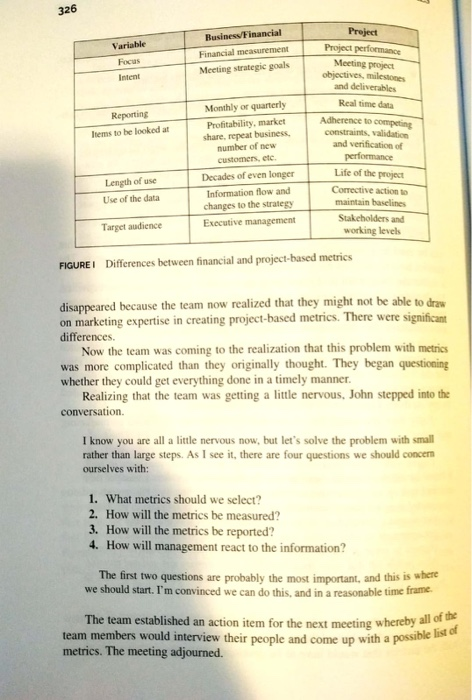
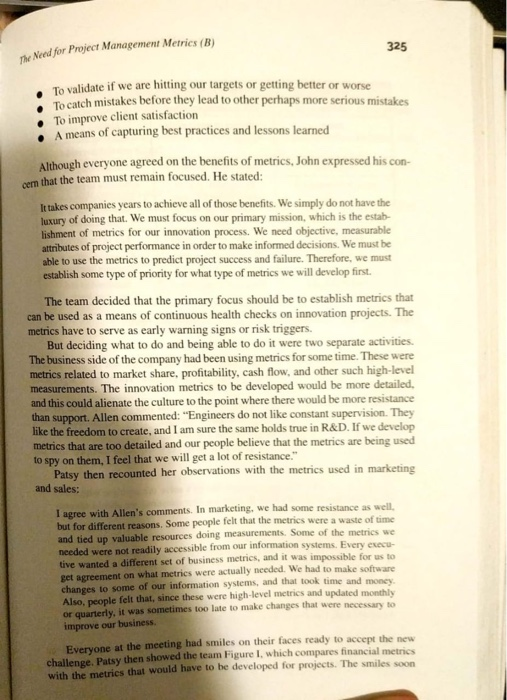
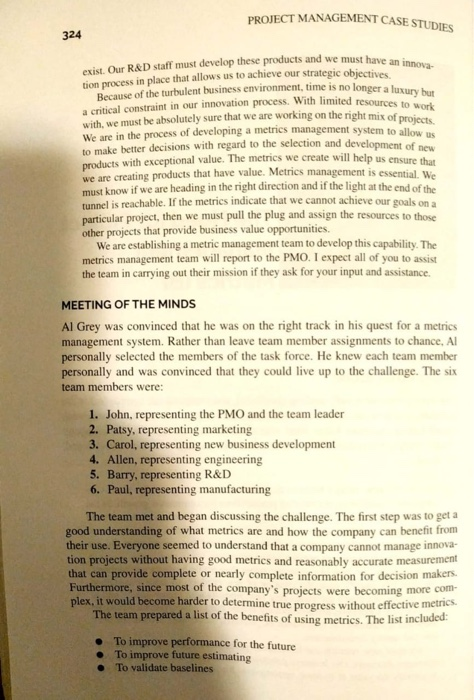
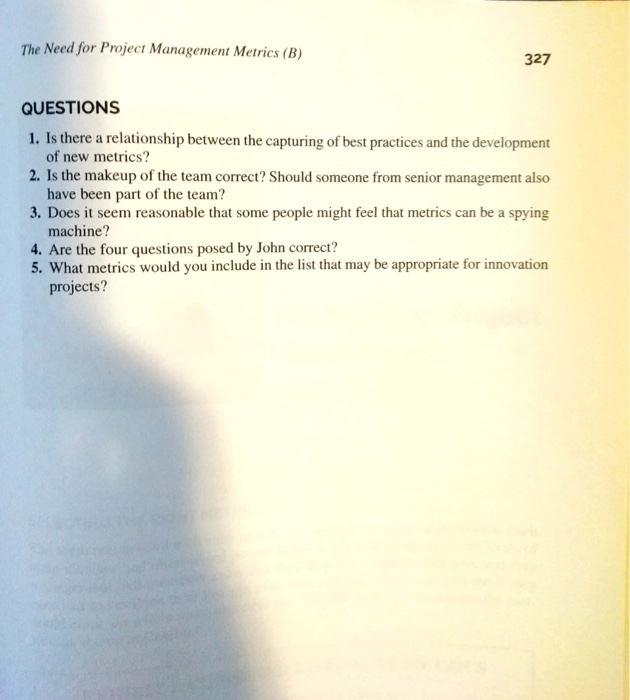
The Need for Project Management Metrics (B) WHERE DO WE BEGIN? The weekly executive staff meeting concluded, and everyone felt confident that the company was now heading in the right direction. Al Grey sent out a companywide e-mail letting everyone know what was about to happen and that the company needed everyone's cooperation to make this metrics management initiative succeed. Al stated: As you all know, today's business environment is changing rapidly. We can no longer rely solely upon our existing product lines for continuous growth. In the past, we have captured best practices and lesson leared, and this has improved the efficiency and effectiveness of our operations which then added to profits. Unfortunately, the best practices and lessons learned that we captured did not directly provide benefits to our innovation processes. Because we are now in a dynamic rather than stable business environment, we must rely heavily upon the creation of new products to achieve sustained growth. Our customers are demanding new products with higher quality and at a lower cost. Customers are now looking at how our products provided value to them and sometimes the importance of perceived value takes precedence over cost and quality considerations. We must now redefine our innovations processes to meet rapidly changing consumer demands. Our business development managers are being challenged to identify the value of business opportunities for new products that do not yet 326 Variable Focus Intent Business Financial Financial measurement Meeting strategic goals Reporting lems to be looked at Monthly or quarterly Profitability, market share, repeat business, number of new customers, etc. Decades of even longer Information flow and changes to the strategy Executive management Project Project performance Meeting project objectives, milestones and deliverables Realtime data Adherence to competing constraints, validation and verification of performance Life of the project Corrective action to maintain baselines Stakeholders and working levels Length of use Use of the data Target audience FIGURE I Differences between financial and project-based metrics disappeared because the team now realized that they might not be able to draw on marketing expertise in creating project-based metrics. There were significant differences. Now the team was coming to the realization that this problem with metrics was more complicated than they originally thought. They began questioning whether they could get everything done in a timely manner. Realizing that the team was getting a little nervous, John stepped into the conversation I know you are all a little nervous now, but let's solve the problem with small rather than large steps. As I see it, there are four questions we should concen ourselves with: 1. What metrics should we select? 2. How will the metrics be measured? 3. How will the metrics be reported? 4. How will management react to the information? The first two questions are probably the most important, and this is where we should start. I'm convinced we can do this, and in a reasonable time frame. The team established an action item for the next meeting whereby all of the team members would interview their people and come up with a possible list of metrics. The meeting adjourned. The Need for Project Management Metrics (B) 325 To validate if we are hitting our targets or getting better or worse To catch mistakes before they lead to other perhaps more serious mistakes To improve client satisfaction A means of capturing best practices and lessons learned Although everyone agreed on the benefits of metrics, John expressed his con- cern that the team must remain focused. He stated: It takes companies years to achieve all of those benefits. We simply do not have the luxury of doing that. We must focus on our primary mission, which is the estab lishment of metrics for our innovation process. We need objective measurable attributes of project performance in order to make informed decisions. We must be able to use the metrics to predict project success and failure. Therefore, we must establish some type of priority for what type of metrics we will develop first. The team decided that the primary focus should be to establish metrics that can be used as a means of continuous health checks on innovation projects. The metrics have to serve as early warning signs or risk triggers. But deciding what to do and being able to do it were two separate activities. The business side of the company had been using metrics for some time. These were metrics related to market share, profitability, cash flow, and other such high-level measurements. The innovation metrics to be developed would be more detailed, and this could alienate the culture to the point where there would be more resistance than support. Allen commented: "Engineers do not like constant supervision. They like the freedom to create, and I am sure the same holds true in R&D. If we develop metrics that are too detailed and our people believe that the metrics are being used to spy on them, I feel that we will get a lot of resistance." Patsy then recounted her observations with the metrics used in marketing and sales: I agree with Allen's comments. In marketing, we had some resistance as well but for different reasons. Some people felt that the metrics were a waste of time and tied up valuable resources doing measurements. Some of the metrics we needed were not readily accessible from our information systems. Every execu- tive wanted a different set of business metrics, and it was impossible for us to get agreement on what metrics were actually needed. We had to make software changes to some of our information systems, and that took time and money Also, people felt that, since these were high-level metrics and updated monthly or quarterly, it was sometimes too late to make changes that were necessary to improve our business Everyone at the meeting hud smiles on their faces ready to accept the new challenge. Patsy then showed the team Figure I, which compares financial metrics with the metries that would have to be developed for projects. The smiles soon PROJECT MANAGEMENT CASE STUDIES exist. Our R&D staff must develop these products and we must have an innova Because of the turbulent business environment, time is no longer a luxury but 324 tion process in place that allows us to achieve our strategic objectives a critical constraint in our innovation process. With limited resources to work with, we must be absolutely sure that we are working on the right mix of projects to make better decisions with regard to the selection and development of new products with exceptional value. The metrics we create will help us ensure that we are creating products that have value. Metrics management is essential. We must know if we are heading in the right direction and if the light at the end of the tunnel is reachable. If the metrics indicate that we cannot achieve our goals on a particular project, then we must pull the plug and assign the resources to those other projects that provide business value opportunities. We are establishing a metric management team to develop this capability. The metrics management team will report to the PMO. I expect all of you to assist the team in carrying out their mission if they ask for your input and assistance. MEETING OF THE MINDS Al Grey was convinced that he was on the right track in his quest for a metrics management system. Rather than leave team member assignments to chance, AI personally selected the members of the task force. He knew each team member personally and was convinced that they could live up to the challenge. The six team members were: 1. John, representing the PMO and the team leader 2. Patsy, representing marketing 3. Carol, representing new business development 4. Allen, representing engineering 5. Barry, representing R&D 6. Paul, representing manufacturing The team met and began discussing the challenge. The first step was to get a good understanding of what metrics are and how the company can benefit from their use. Everyone seemed to understand that a company cannot manage innova- tion projects without having good metrics and reasonably accurate measurement that can provide complete or nearly complete information for decision makers. Furthermore, since most of the company's projects were becoming more com plex, it would become harder to determine true progress without effective metrics. The team prepared a list of the benefits of using metrics. The list included: To improve performance for the future To improve future estimating To validate baselines The Need for Project Management Metrics (B) 327 QUESTIONS 1. Is there a relationship between the capturing of best practices and the development of new metrics? 2. Is the makeup of the team correct? Should someone from senior management also have been part of the team? 3. Does it seem reasonable that some people might feel that metrics can be a spying machine? 4. Are the four questions posed by John correct? 5. What metrics would you include in the list that may be appropriate for innovation projects









 Study Help