







Question: I need full answer with implementation by MATLAB PLZ THNX Mission statement: 3GPP group standardized Long Term Evolution (LTE) and it is designed to have
I need full answer with implementation by MATLAB PLZ THNX
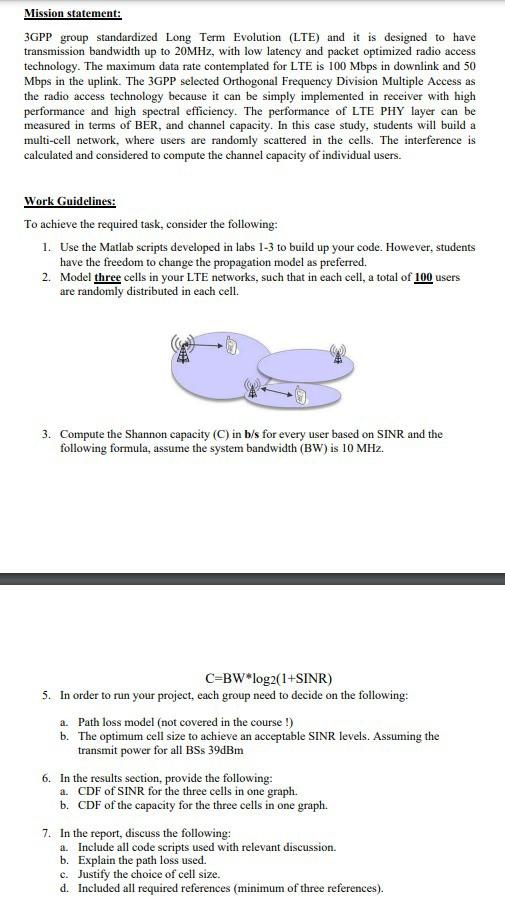
Mission statement: 3GPP group standardized Long Term Evolution (LTE) and it is designed to have transmission bandwidth up to 20MHz, with low latency and packet optimized radio access technology. The maximum data rate contemplated for LTE is 100 Mbps in downlink and 50 Mbps in the uplink. The 3GPP selected Orthogonal Frequency Division Multiple Access as the radio access technology because it can be simply implemented in receiver with high performance and high spectral efficiency. The performance of LTE PHY layer can be measured in terms of BER, and channel capacity. In this case study, students will build a multi-cell network, where users are randomly scattered in the cells. The interference is calculated and considered to compute the channel capacity of individual users. Work Guidelines: To achieve the required task, consider the following: 1. Use the Matlab scripts developed in labs 1-3 to build up your code. However, students have the freedom to change the propagation model as preferred. 2. Model three cells in your LTE networks, such that in each cell, a total of 100 users are randomly distributed in each cell. 3. Compute the Shannon capacity (C) in b/s for every user based on SINR and the following formula, assume the system bandwidth (BW) is 10MHz. C=BWlog2(1+SINR) 5. In order to run your project, each group need to decide on the following: a. Path loss model (not covered in the course !) b. The optimum cell size to achieve an acceptable SINR levels. Assuming the transmit power for all BSs 39dBm 6. In the results section, provide the following: a. CDF of SINR for the three cells in one graph. b. CDF of the capacity for the three cells in one graph. 7. In the report, discuss the following: a. Include all code scripts used with relevant discussion. b. Explain the path loss used. c. Justify the choice of cell size. d. Included all required references (minimum of three references)
Step by Step Solution
There are 3 Steps involved in it

Get step-by-step solutions from verified subject matter experts
 Study Help