



Question: I need help...... 5-26 ABC, activity area cost-driver rates, product cross-subsidization. Idaho Potatoes (IP) operates at capacity and processes potatoes into potato cuts at its
I need help......
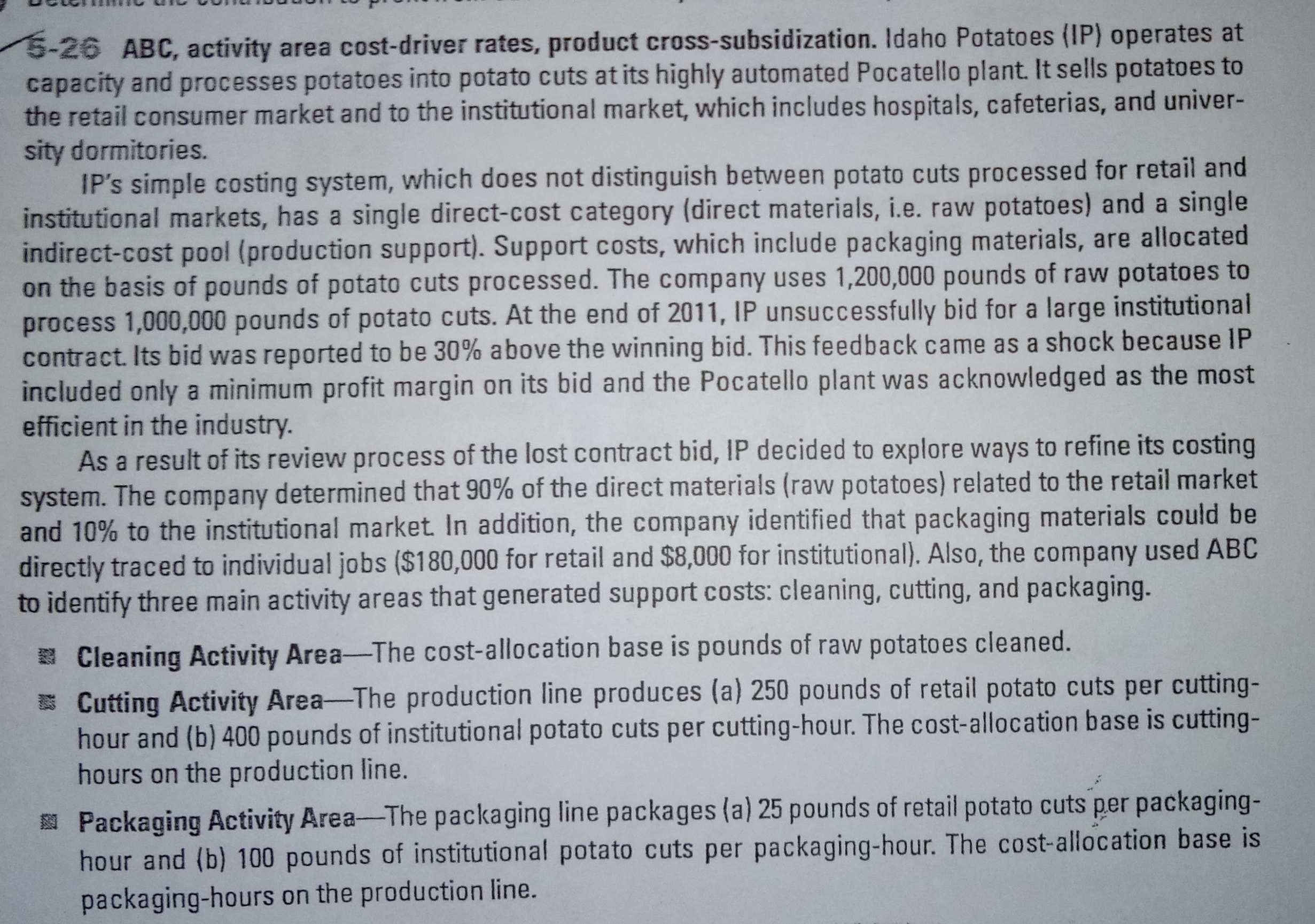
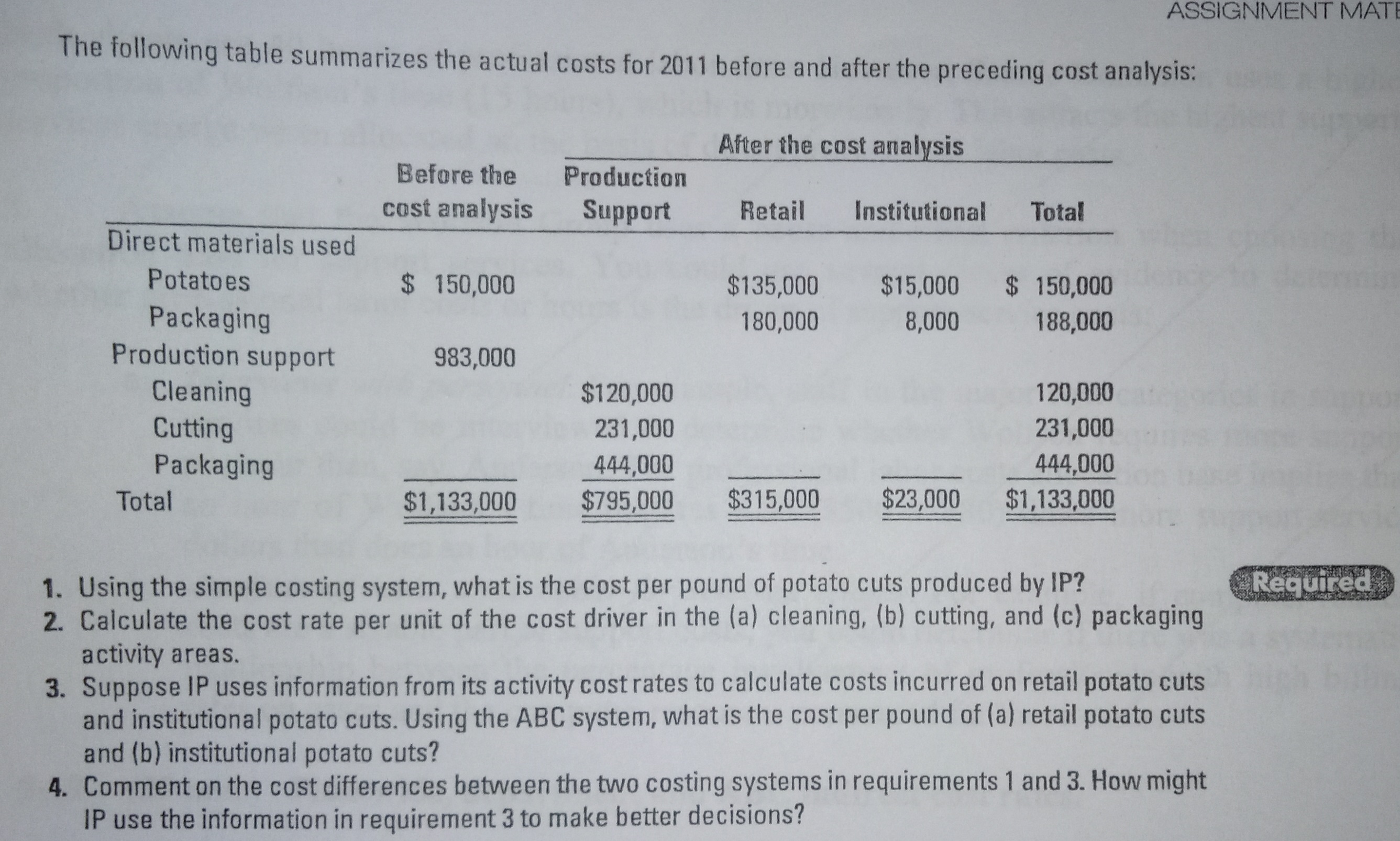
5-26 ABC, activity area cost-driver rates, product cross-subsidization. Idaho Potatoes (IP) operates at capacity and processes potatoes into potato cuts at its highly automated Pocatello plant. It sells potatoes to the retail consumer market and to the institutional market, which includes hospitals, cafeterias, and univer- sity dormitories. IP's simple costing system, which does not distinguish between potato cuts processed for retail and institutional markets, has a single direct-cost category (direct materials, i.e. raw potatoes) and a single indirect-cost pool (production support). Support costs, which include packaging materials, are allocated on the basis of pounds of potato cuts processed. The company uses 1,200,000 pounds of raw potatoes to process 1,000,000 pounds of potato cuts. At the end of 2011, IP unsuccessfully bid for a large institutional contract. Its bid was reported to be 30% above the winning bid. This feedback came as a shock because IP included only a minimum profit margin on its bid and the Pocatello plant was acknowledged as the most efficient in the industry. As a result of its review process of the lost contract bid, IP decided to explore ways to refine its costing system. The company determined that 90% of the direct materials (raw potatoes) related to the retail market and 10% to the institutional market. In addition, the company identified that packaging materials could be directly traced to individual jobs ($180,000 for retail and $8,000 for institutional). Also, the company used ABC to identify three main activity areas that generated support costs: cleaning, cutting, and packaging. Cleaning Activity Area-The cost-allocation base is pounds of raw potatoes cleaned. Cutting Activity Area-The production line produces (a) 250 pounds of retail potato cuts per cutting- hour and (b) 400 pounds of institutional potato cuts per cutting-hour. The cost-allocation base is cutting- hours on the production line. Packaging Activity Area-The packaging line packages (a) 25 pounds of retail potato cuts per packaging- hour and (b) 100 pounds of institutional potato cuts per packaging-hour. The cost-allocation base is packaging-hours on the production line.ASSIGNMENT MATE The following table summarizes the actual costs for 2011 before and after the preceding cost analysis: After the cost analysis Before the Production cost analysis Support Retail Institutional Total Direct materials used Potatoes $ 150,000 $135,000 $15,000 $ 150,000 Packaging 180,000 8,000 188,000 Production support 983,000 Cleaning $120,000 120,000 Cutting 231,000 231,000 Packaging 444,000 444,000 Total $1,133,000 $795,000 $315,000 $23,000 $1,133,000 1. Using the simple costing system, what is the cost per pound of potato cuts produced by IP? Required 2. Calculate the cost rate per unit of the cost driver in the (a) cleaning, (b) cutting, and (c) packaging activity areas. 3. Suppose IP uses information from its activity cost rates to calculate costs incurred on retail potato cuts and institutional potato cuts. Using the ABC system, what is the cost per pound of (a) retail potato cuts and (b) institutional potato cuts? 4. Comment on the cost differences between the two costing systems in requirements 1 and 3. How might IP use the information in requirement 3 to make better decisions
Step by Step Solution
There are 3 Steps involved in it

Get step-by-step solutions from verified subject matter experts