







Question: I need help coding this in C++. 1.The two roots of a quadratic equation ax+ bx+c-0 can be obtained using the following formula: and r2
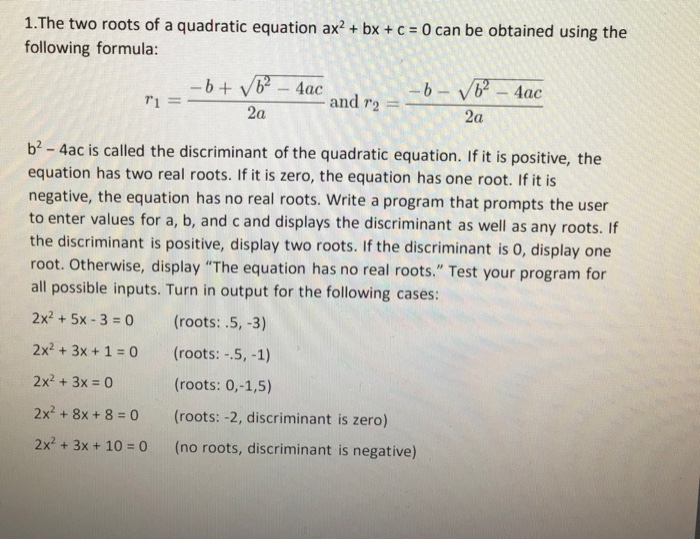
1.The two roots of a quadratic equation ax+ bx+c-0 can be obtained using the following formula: and r2 2a 2a b' - 4ac is called the discriminant of the quadratic equation. If it is positive, the equation has two real roots. If it is zero, the equation has one root. If it is negative, the equation has no real roots. Write a program that prompts the user to enter values for a, b, and c and displays the discriminant as well as any roots. If the discriminant is positive, display two roots. If the discriminant is O, display one root. Otherwise, display "The equation has no real roots." Test your program for all possible inputs. Turn in output for the following cases: 2x2+5x-3 0 (roots: .5,-3) 2x2 +3x+1-0 (roots: -5, -1) (roots: 0,-1,5) 2x2+8x + 8 0 (roots: -2, discriminant is zero) 2x +3x + 10 0 (no roots, discriminant is negative)
Step by Step Solution
There are 3 Steps involved in it

Get step-by-step solutions from verified subject matter experts
 Study Help