



Question: I need help filling out the decision sheet for this business game. Help on how to complete the decision sheet COMPANY: Choose a name for
I need help filling out the decision sheet for this business game.
Help on how to complete the decision sheet
COMPANY: Choose a name for your company Think of a strategy you want for your business. Following are the two extremes pricing strategies:
- cheap product (low margin) and sell more. Ex: Conair
- expensive product (high margin) and sell small quantity. Ex: Dyson
1 Production 1.1 Quantity produced: how many hairdryers are you going to produce ?
As stated in the game, at January 1st 2020, you have 9 assembly lines that can produce in total 90,000 hair dryers (10,000 units per line).
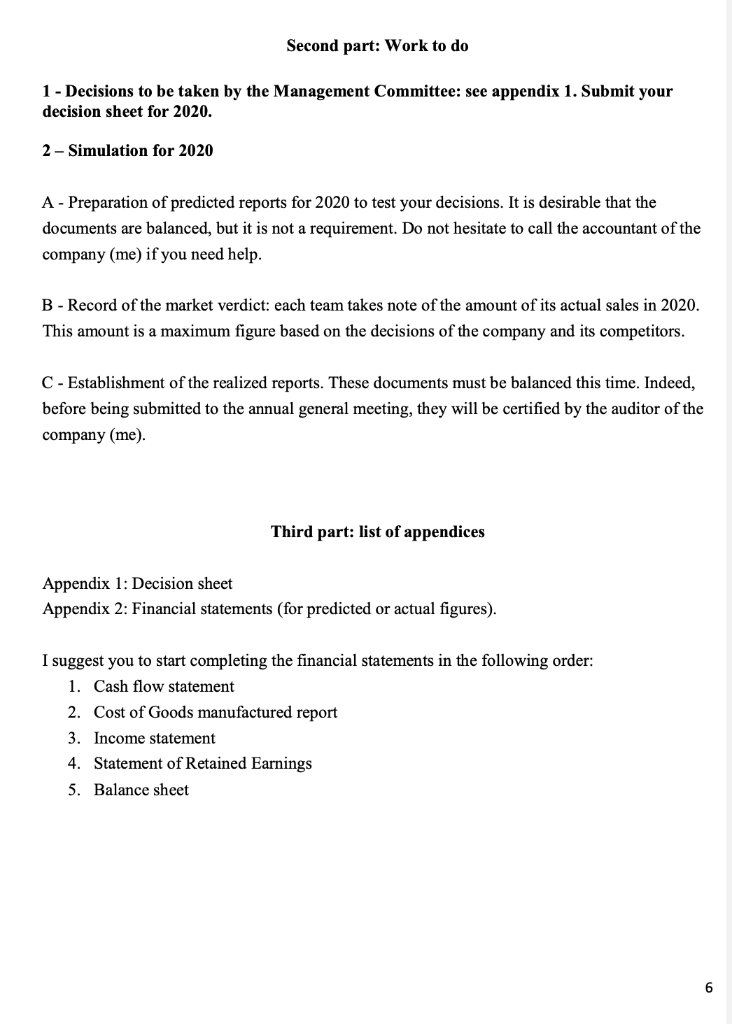
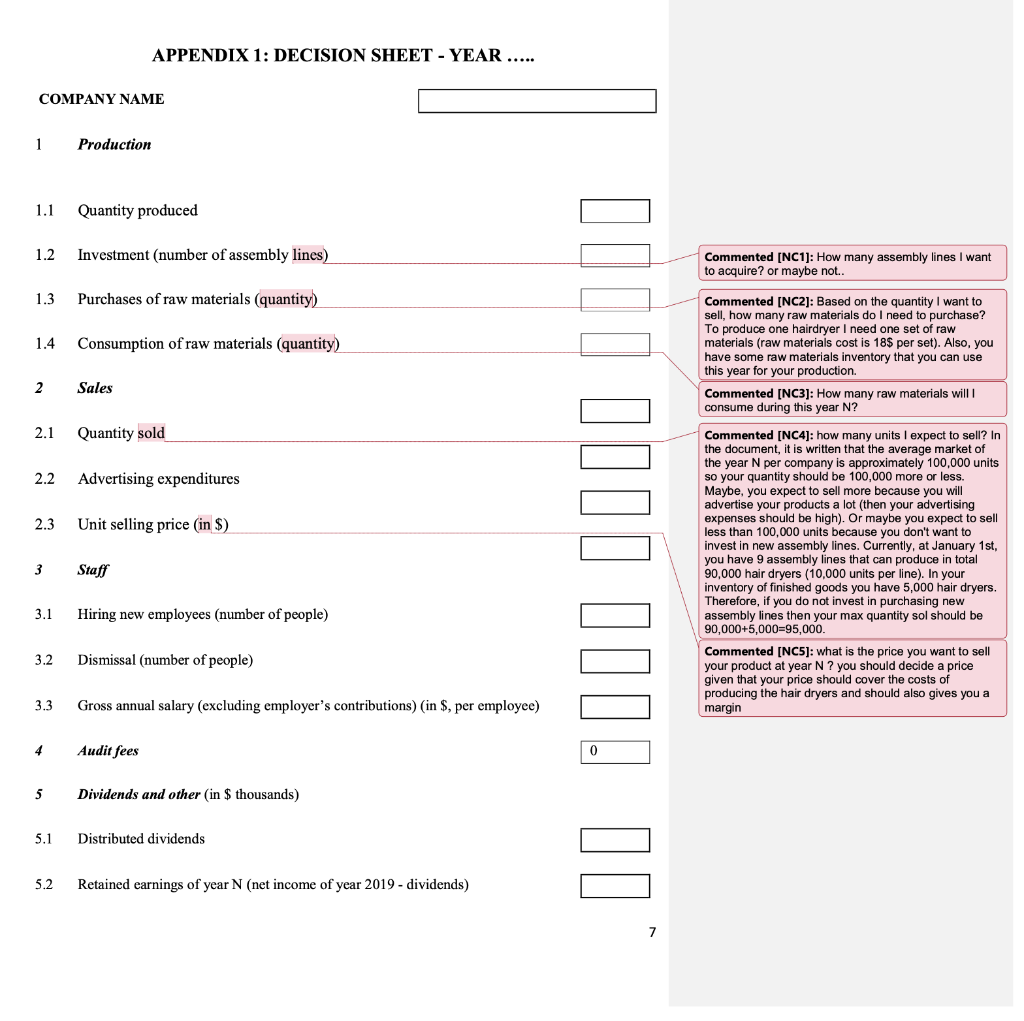
It is also written that the average market of the year 2020 per company is approximately 100,000 units, so you can expect to sell 100,000 more or less. Maybe, you expect to sell more because you will advertise your products a lot (then your advertising expenses should be high). Or maybe you expect to sell less than 100,000 units because you don't want to invest in new assembly lines (needed to produce more).
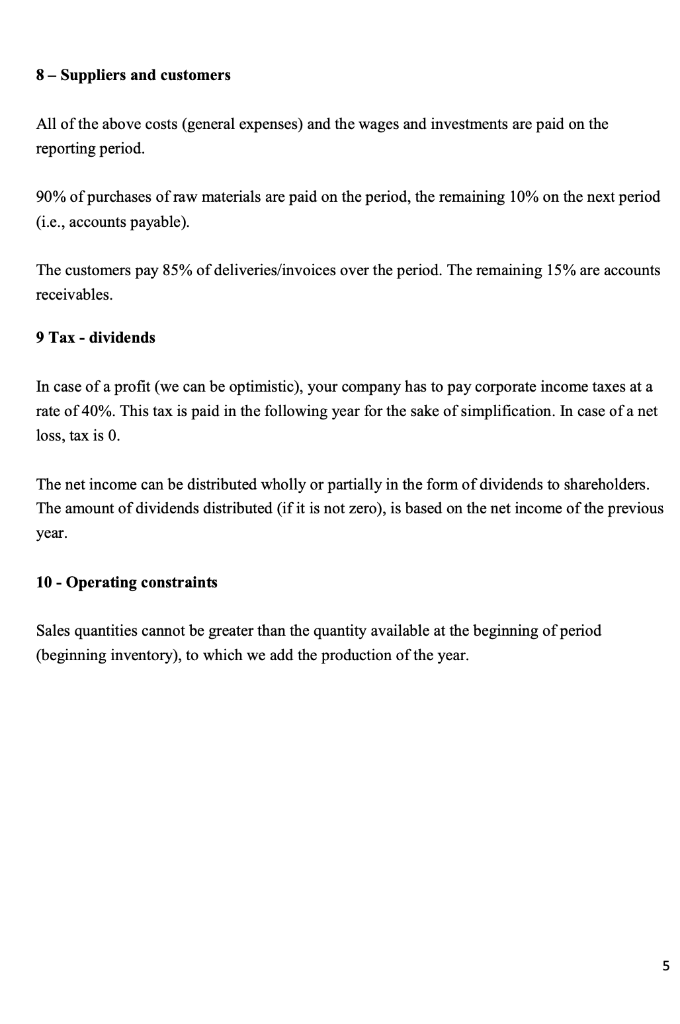
In your inventory of finished goods, you have 5,000 hair dryers. Therefore, if you do not invest in purchasing new assembly lines, you can sell your inventory of 5,000 goods + the max quantity produced with 9 lines being 90,000 95,000 units.
Notice that you can expect to produce more than sell. Therefore, your decision in 2.1 can be lower than 1.1 if you want to have inventories of finished products in 2021. It is your decision !
1.2 Investments (number of new assembly lines): how many assembly lines do you want to acquire?
This should be consistent with your decision for the quantity produced (1.1).
If you want to produce more than 90,000 units, you need to invest in a new line. You can increase your production capacity by 10,000 units per new line. For instance, if you invest in one line, you increase your production capacity by 10,000, so that your total production capacity is 100,000. If you invest in two line, your production capacity is 110,000....
Moreover, to simplify, we assume that we use our equipment at their maximum (i.e., if you have the capacity to produce 100,000, you produce 100,000 units). But you need to understand that sometimes, companies that do not want to have finished goods inventories in the next years, they prefer to produce only 40 units even if they have the capacity to produce 100 units.
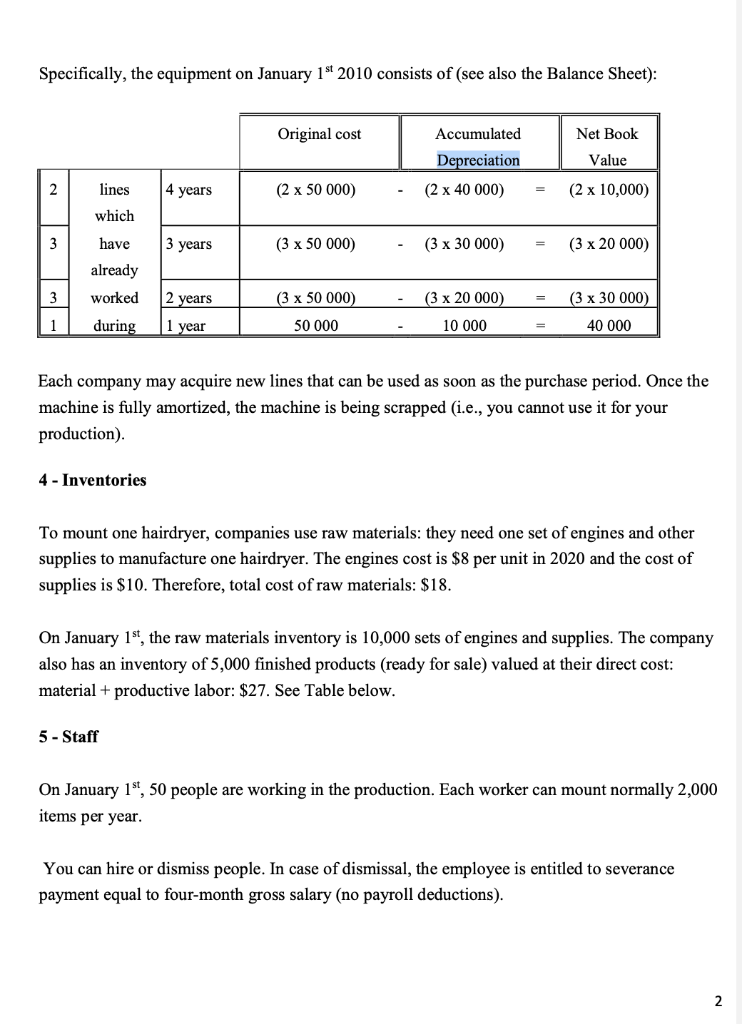
Maybe, you prefer not to invest in new lines but think of your next years production when two of your assembly lines will be scrapped (i.e., fully depreciated). See depreciation table: page 2 of the game instructions.
1.3 Purchases of raw materials (quantity): Based on the quantity you want to produce, how many raw materials do you need to purchase?
To produce one hairdryer, you need one set of raw materials. Raw materials cost is 18$ per set.
Also, you have some raw materials inventory that you can use in 2020 for your production. On January 1st 2020, the raw materials inventory is 10,000 sets.
You can also purchase more raw materials than needed for your 2020 production in order to have inventories of raw materials for 2021.
1.4 Consumption of raw materials (quantity): How many raw materials will I consume during this year 2020?
2 Sales 2.1 Quantity sold: how many units I expect to sell? First, you need to calculate the number of units available for sale which comprises of:
- Number of units available in our inventory: 5,000 hairdryers.
- Number of units produced (1.1) You can expect to sell less units than the number of units available in order to have inventories for
next year. 2.2 Advertising expenditures (in $ thousands): What is my advertising budget for the year 2020?
List the total costs of manufacturing:
- Direct cost (raw materials + direct labor)*
- Indirect labor: administrative staff
- Rental cost of office
- Taxes (see Balance sheet Liabilities)
- Depreciation
* To simplify, we assume that the finished products are always valued at $27 per unit (direct cost in 2020). This cost does not change during the game even if the components of the cost change (employers salaries for instance). You multiply this unit direct cost by the number of units produced (1.1).
Add up all these costs. Advertising expenses usually represent 5% more or less of the costs of products. If you decide to have a large advertising budget you can expect to sell more than your competitors
2.3 Unit Selling price in $: how to determine your selling price? Price = Costs + Margin List the total costs of manufacturing one hairdryer:
-
-
-
-
-
-
You Add -
-
Direct cost (raw materials + direct labor) ($27 per unit produced) Indirect labor: administrative staff Rental cost of office taxes (see Balance sheet Liabilities)
Depreciation (this increase if you invested in new assembly lines) Advertising expenditures (4.1: usually represent more or less 5% of the previous total cost)
will get a cost per unit by adding up all these unit costs and divide by the produced quantity. your margin to the unit cost: between 10-50% of the costs.
cheap product (low margin) and sell more. Ex: Conair expensive product (high margin) and sell small quantity. Ex: Dyson
3 Staff
3.1 Hiring new employees (number of people): Do you want to hire new employees?
It is written in the game that Each worker can mount normally 2,000 items per year. Currently, the company employs 50 workers. So, the maximum number of hairdryers that your company can produce is 100,000 units per year (2,000 * 50). If the quantity produced (1.1) is lower than 100,000 units then it is not necessary to hire new employees. But, you can still do it.
3.2 Dismissal (number of people): do you want to dismiss employees? 3.3 Gross annual salary (excluding employers payroll taxes) (in $, per employee): Do you
want to increase the salary of your employee? I do not recommend to decrease it.
4. Audit fees
In 2020, audit fees are 0.
5. Dividends and other 5.1 distributed dividends: How much dividends you want to distribute to your shareholders?
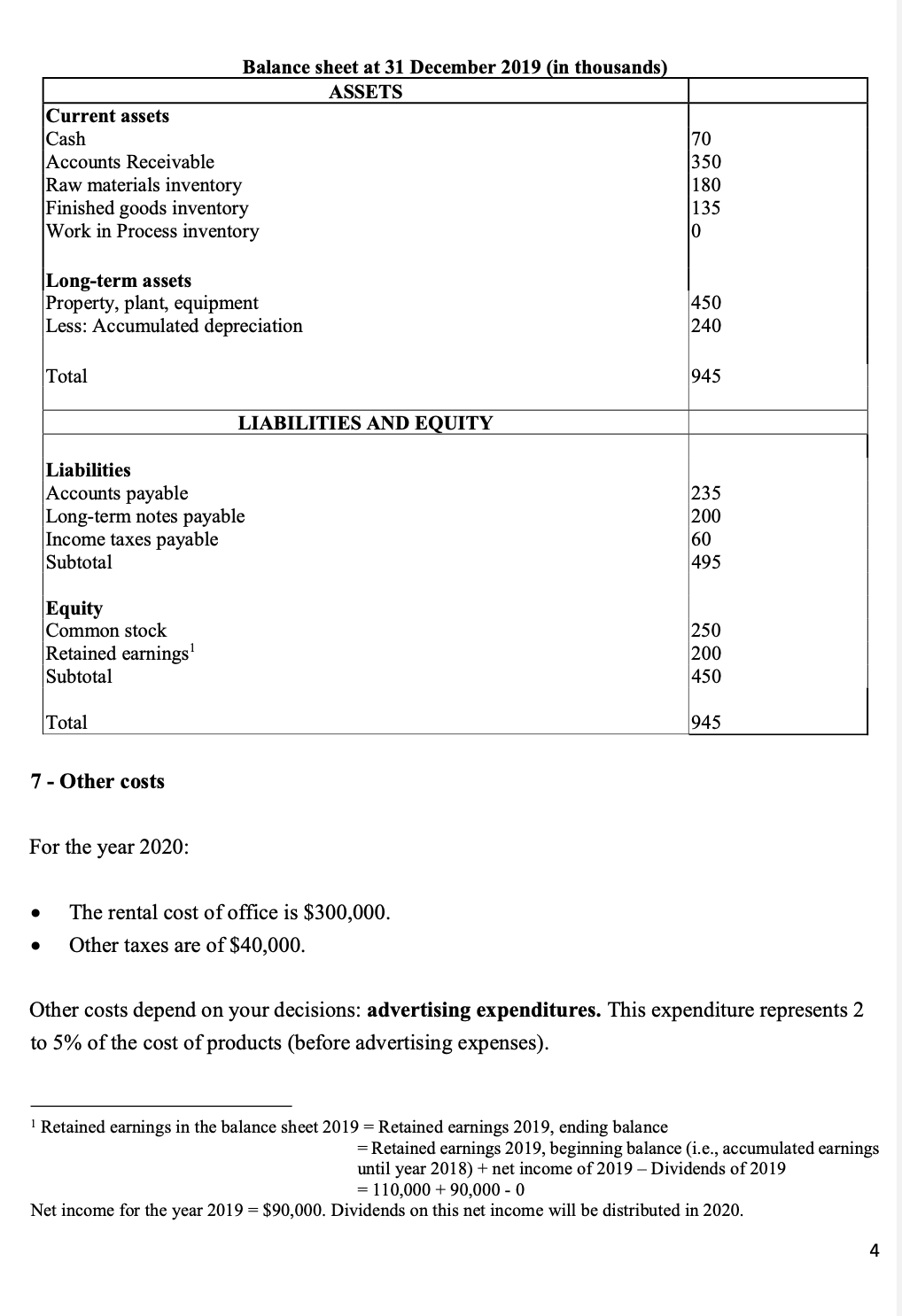
Your net income (profit) at Dec 31, 2019 was $90,000 (see income statement 2019).
You can distribute part of this net income to your shareholders: usually between 20% and 45% of net income is distributed to shareholders as dividends.
The other part should be reinvested in the company (the "retained earnings).
5.2 Retained earnings of year 2020 (net income of year 2019 - dividends)
The retained earnings is the other part. So, it should be equal to 90,000 dividends (5.1).
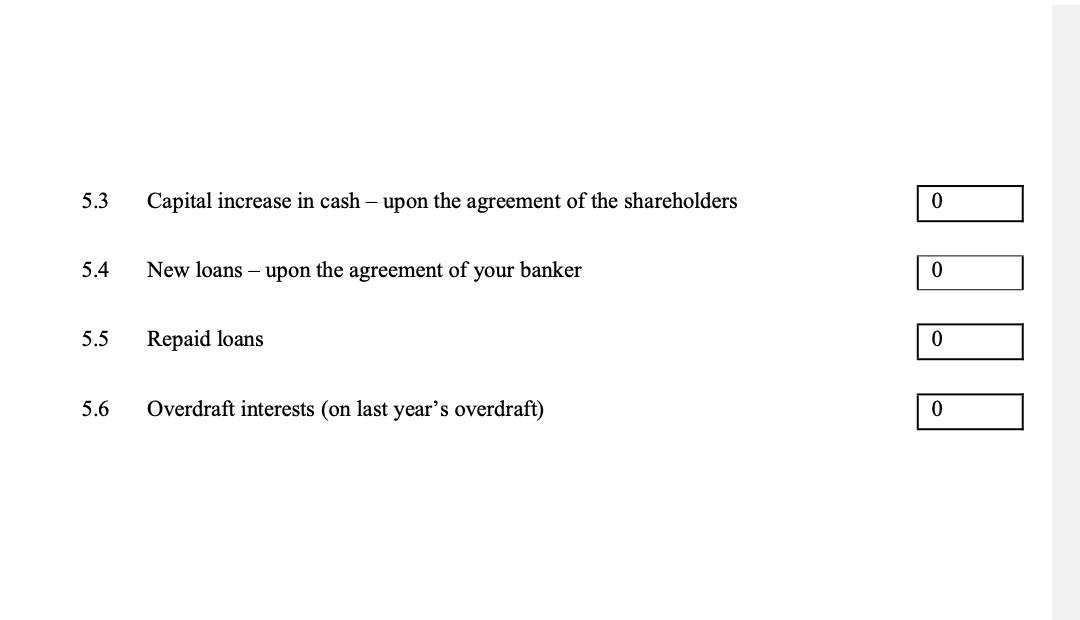
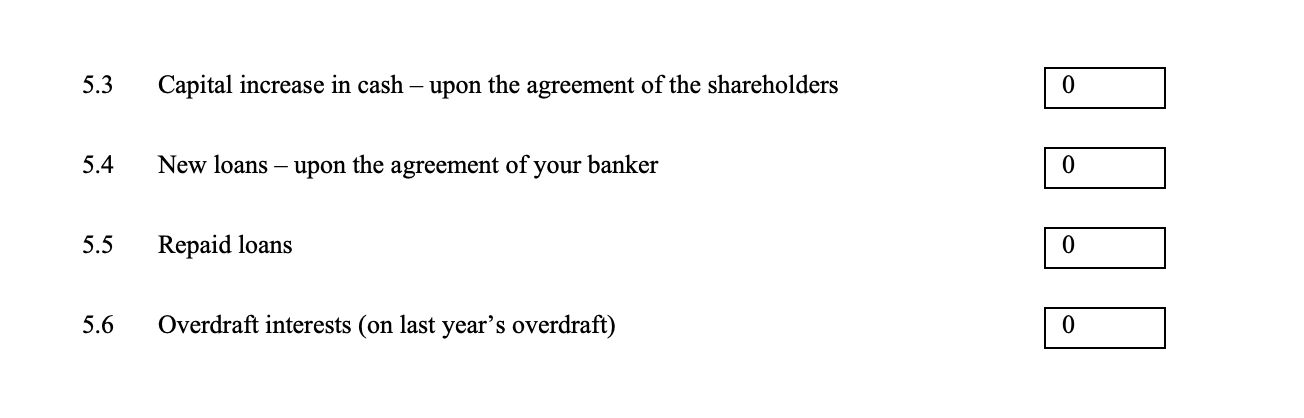
5.3 Capital increase in cash upon the agreement of the shareholders
There is no capital increase in 2020. This is 0.
5.4 New loans
There is no new loans in 2020. This is 0.
5.5 Repaid loans
Your company has no loan to repaid in 2020. It will repay its loan next year in 2021. But, notice that interests have to be paid every year.
5.6 Overdraft interests
The game assumes that you pay your interests in 2020 on your overdraft of 2019. There is an overdraft when your cash is negative (see balance sheet of 2019). In 2019, Cash is 70 so you have 0 overdraft interest.
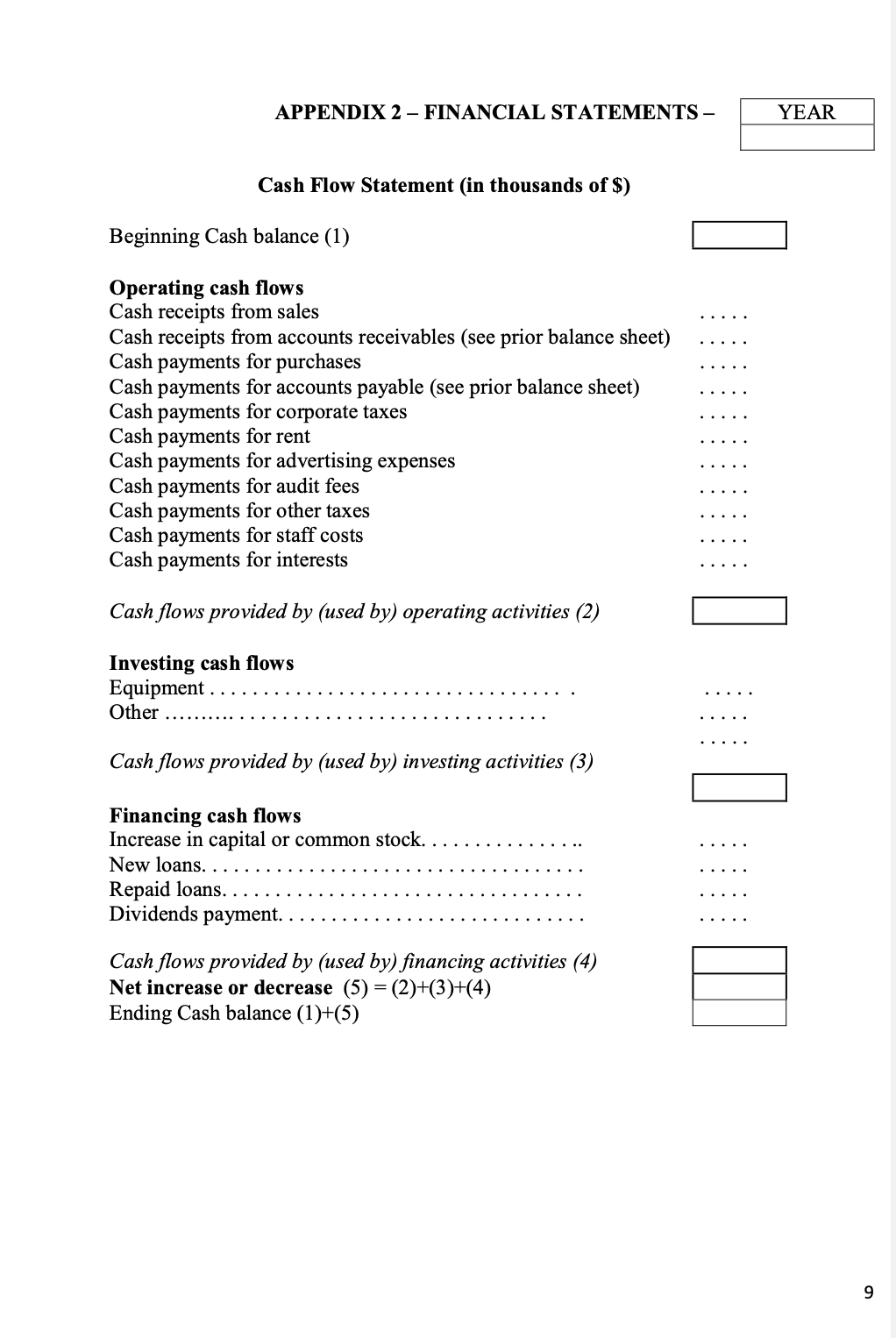
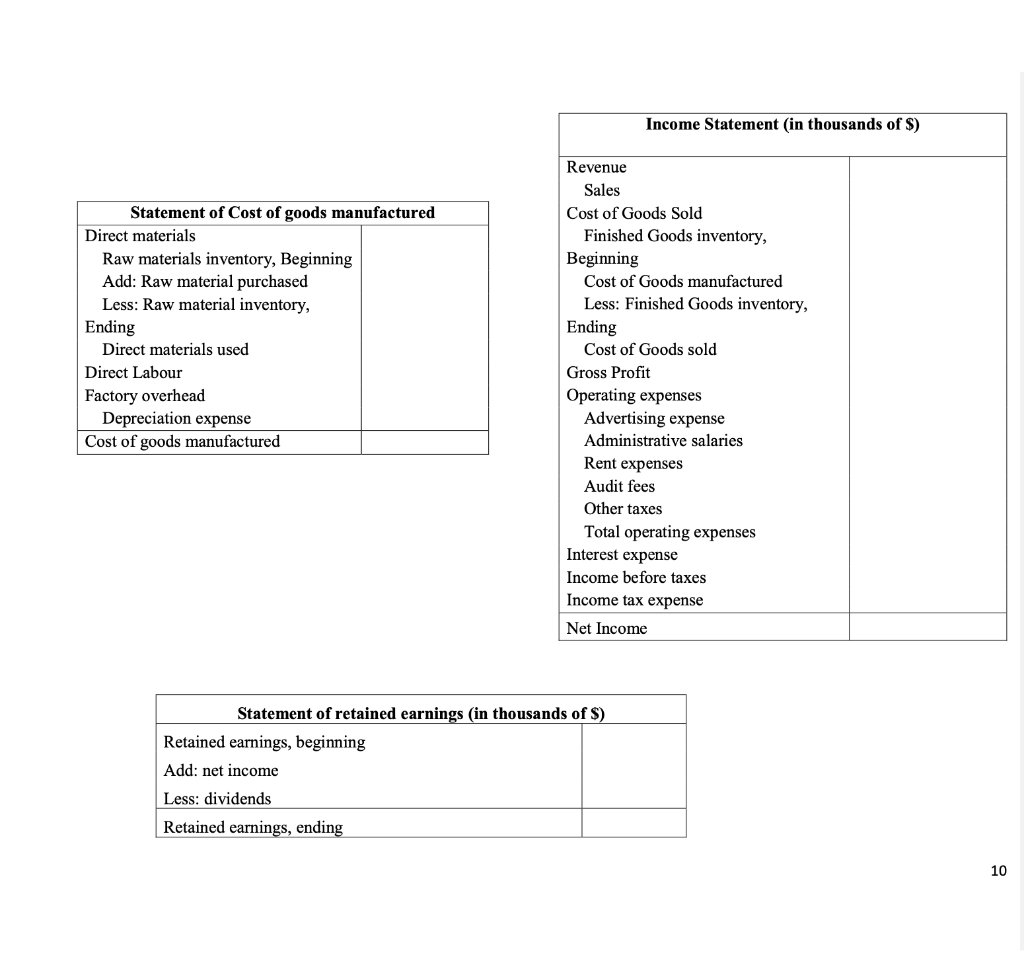
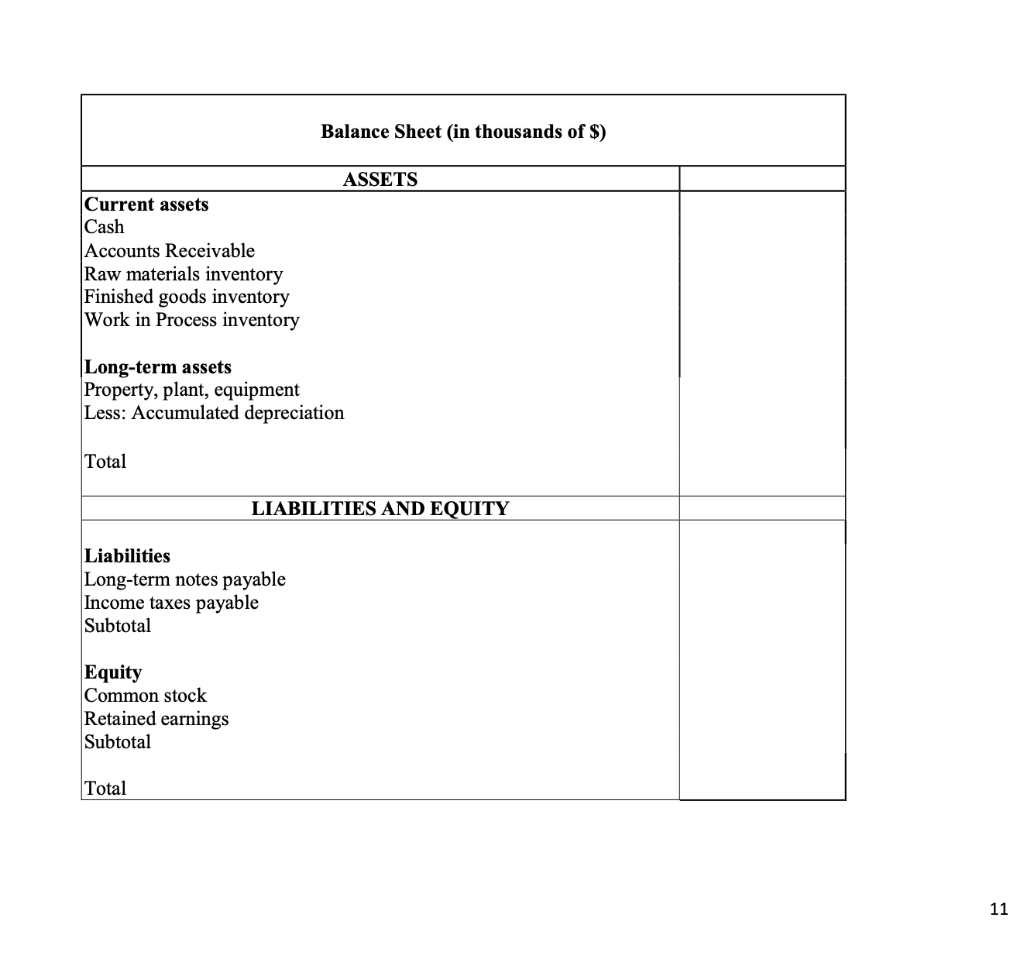
NEED HELP WITH BELOW WITH FILLING OUT THE DECISION SHEET.
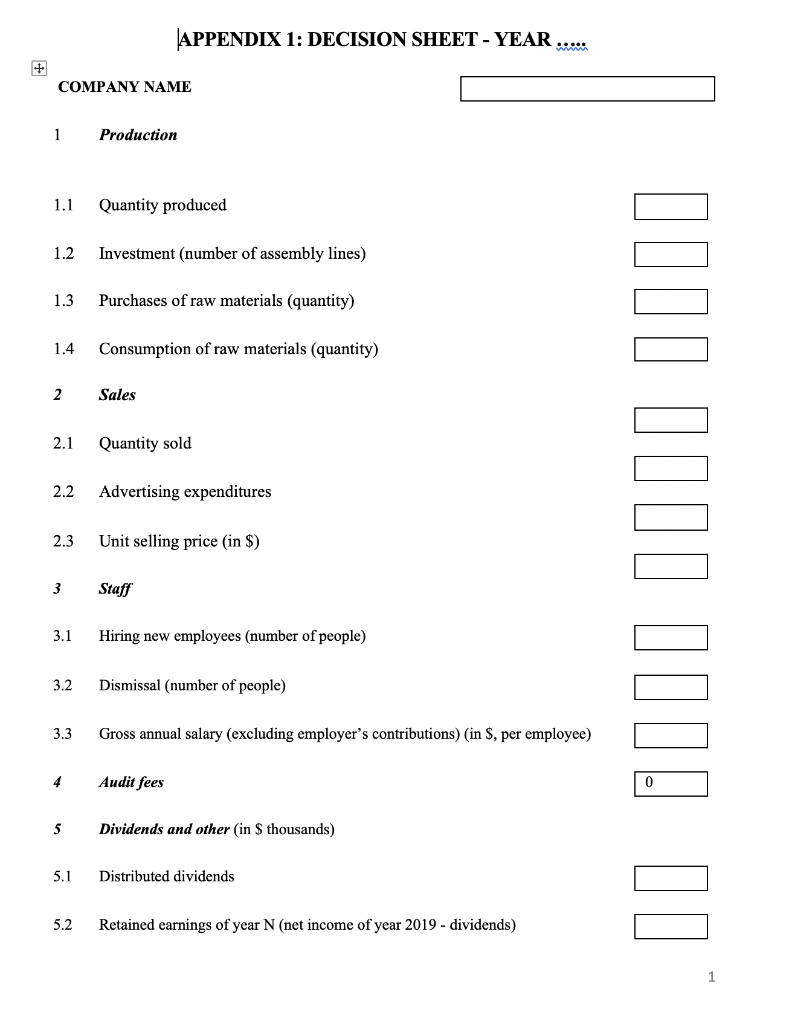
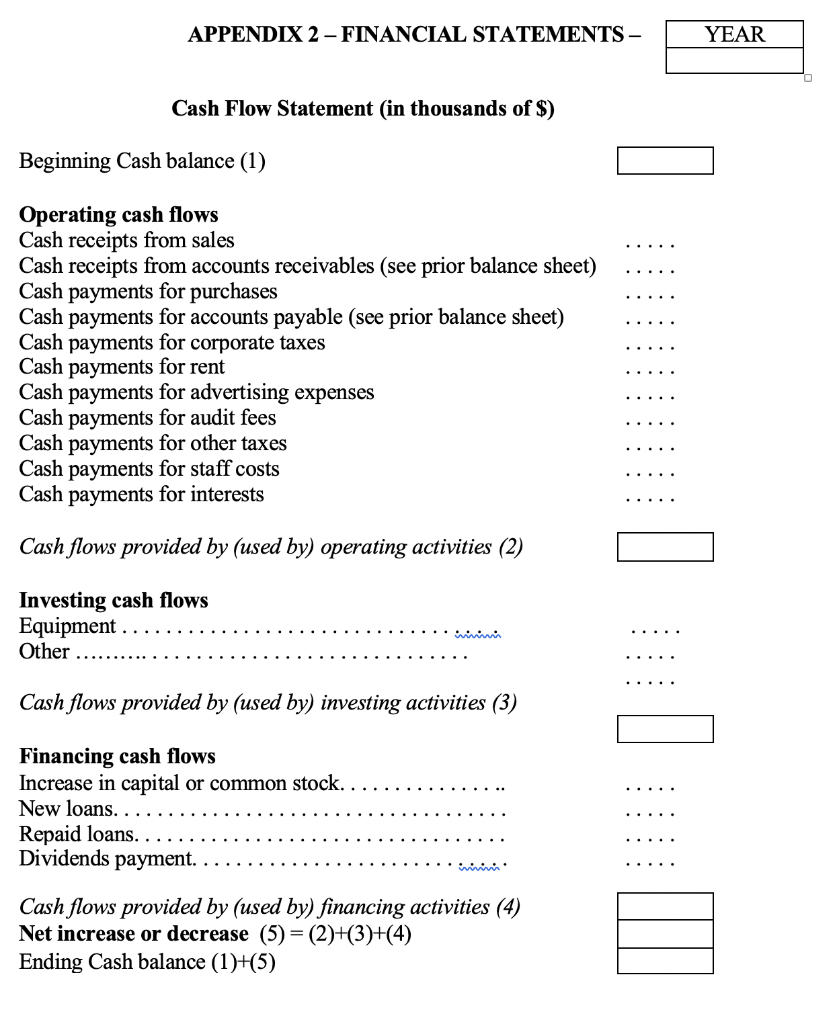
AND TO PREDICTED FINANCIAL STATEMENT YEAT 2020 BELOW.
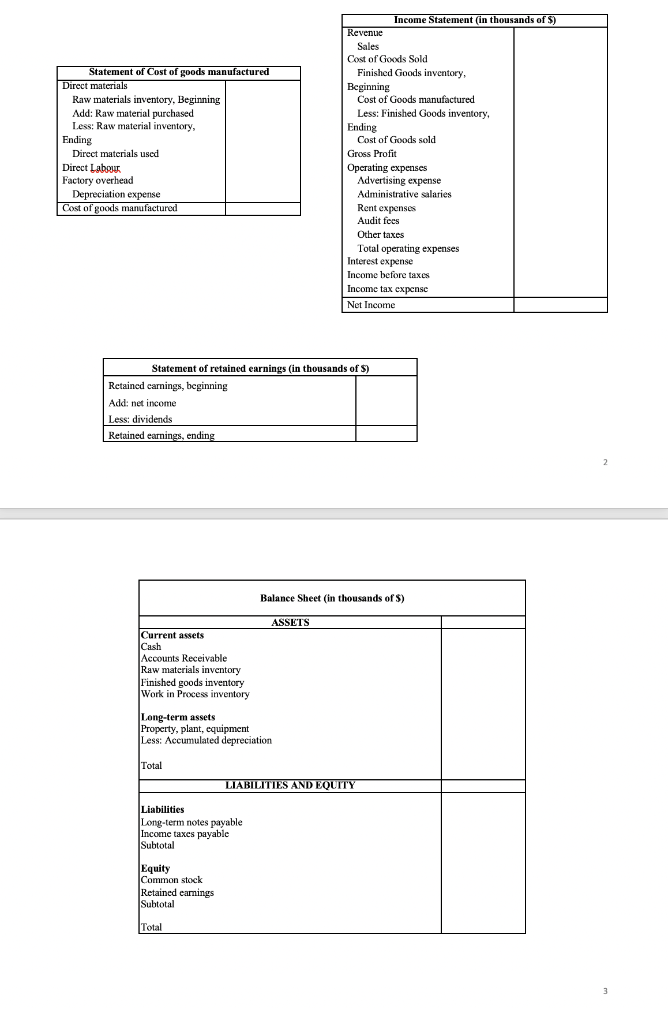
THANK YOU FOR THE HELP!
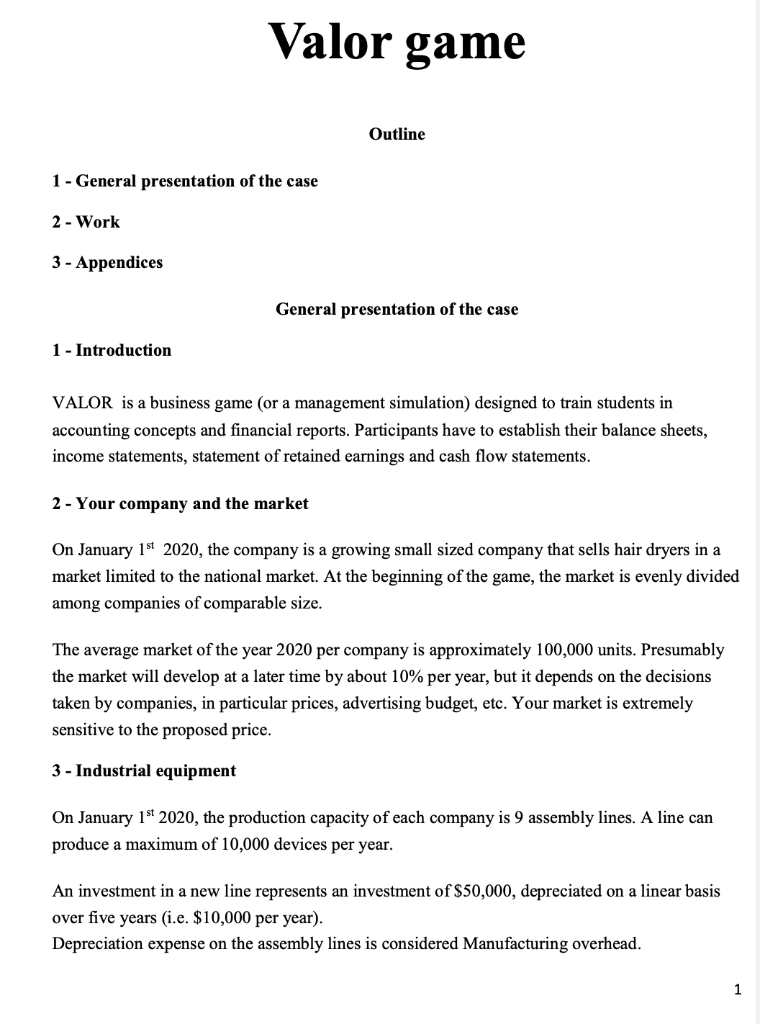
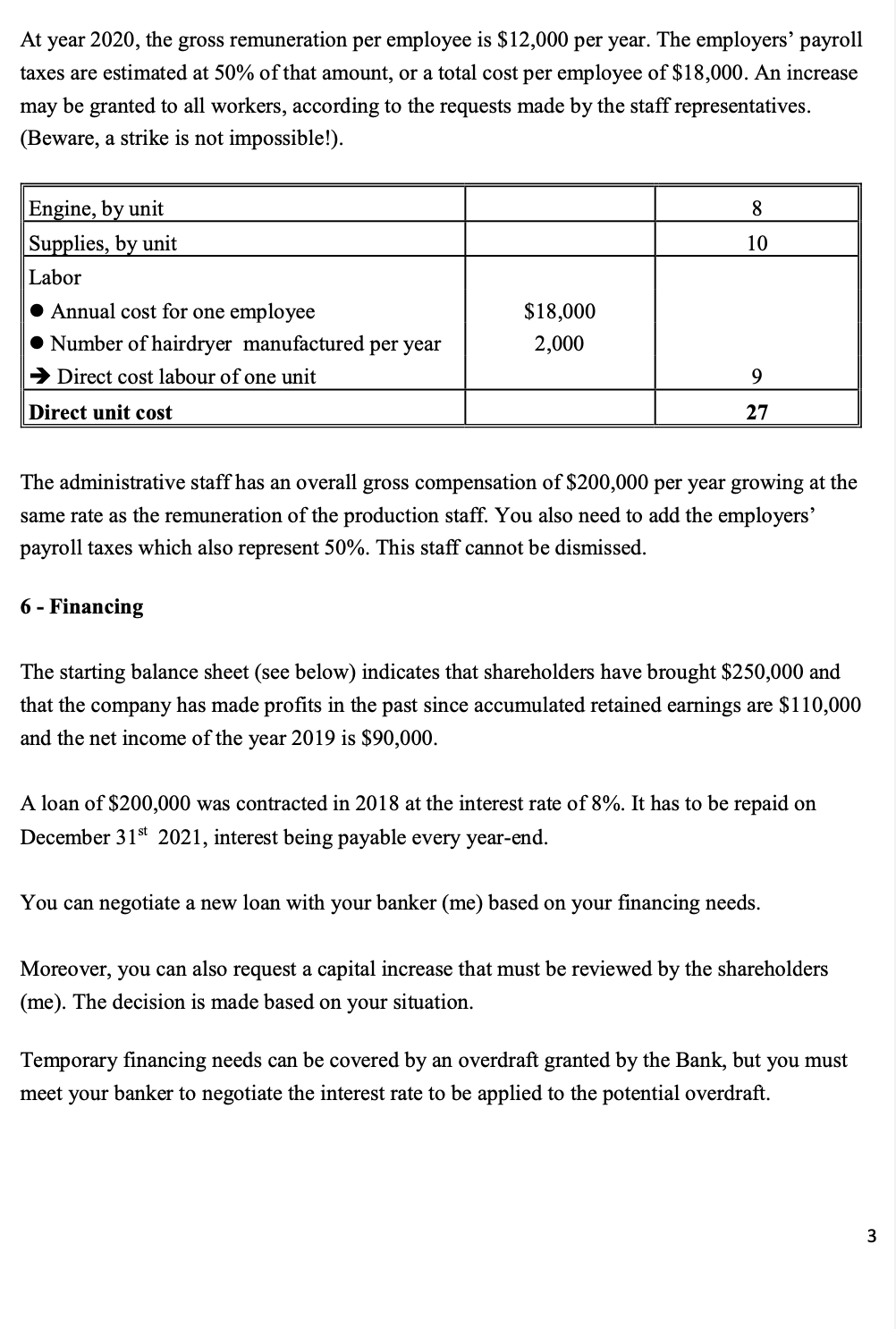
Outline 1 - General presentation of the case 2 - Work 3 - Appendices General presentation of the case 1 - Introduction VALOR is a business game (or a management simulation) designed to train students in accounting concepts and financial reports. Participants have to establish their balance sheets, income statements, statement of retained earnings and cash flow statements. 2 - Your company and the market On January 1st2020, the company is a growing small sized company that sells hair dryers in a market limited to the national market. At the beginning of the game, the market is evenly divided among companies of comparable size. The average market of the year 2020 per company is approximately 100,000 units. Presumably the market will develop at a later time by about 10% per year, but it depends on the decisions taken by companies, in particular prices, advertising budget, etc. Your market is extremely sensitive to the proposed price. 3 - Industrial equipment On January 1st2020, the production capacity of each company is 9 assembly lines. A line can produce a maximum of 10,000 devices per year. An investment in a new line represents an investment of $50,000, depreciated on a linear basis over five years (i.e. $10,000 per year). Depreciation expense on the assembly lines is considered Manufacturing overhead. 1 Specifically, the equipment on January 1st2010 consists of (see also the Balance Sheet): Each company may acquire new lines that can be used as soon as the purchase period. Once the machine is fully amortized, the machine is being scrapped (i.e., you cannot use it for your production). 4 - Inventories To mount one hairdryer, companies use raw materials: they need one set of engines and other supplies to manufacture one hairdryer. The engines cost is $8 per unit in 2020 and the cost of supplies is $10. Therefore, total cost of raw materials: $18. On January 1st, the raw materials inventory is 10,000 sets of engines and supplies. The company also has an inventory of 5,000 finished products (ready for sale) valued at their direct cost: material + productive labor: $27. See Table below. 5 - Staff On January 1st,50 people are working in the production. Each worker can mount normally 2,000 items per year. You can hire or dismiss people. In case of dismissal, the employee is entitled to severance payment equal to four-month gross salary (no payroll deductions). At year 2020, the gross remuneration per employee is $12,000 per year. The employers' payroll taxes are estimated at 50% of that amount, or a total cost per employee of $18,000. An increase may be granted to all workers, according to the requests made by the staff representatives. (Beware, a strike is not impossible!). The administrative staff has an overall gross compensation of $200,000 per year growing at the same rate as the remuneration of the production staff. You also need to add the employers' payroll taxes which also represent 50%. This staff cannot be dismissed. 6 - Financing The starting balance sheet (see below) indicates that shareholders have brought $250,000 and that the company has made profits in the past since accumulated retained earnings are $110,000 and the net income of the year 2019 is $90,000. A loan of $200,000 was contracted in 2018 at the interest rate of 8%. It has to be repaid on December 31st2021, interest being payable every year-end. You can negotiate a new loan with your banker (me) based on your financing needs. Moreover, you can also request a capital increase that must be reviewed by the shareholders (me). The decision is made based on your situation. Temporary financing needs can be covered by an overdraft granted by the Bank, but you must meet your banker to negotiate the interest rate to be applied to the potential overdraft. 1 Retained earnings in the balance sheet 2019= Retained earnings 2019, ending balance = Retained earnings 2019 , beginning balance (i.e., accumulated earnings until year 2018) + net income of 2019 - Dividends of 2019 =110,000+90,0000 Net income for the year 2019=$90,000. Dividends on this net income will be distributed in 2020 . 8 - Suppliers and customers All of the above costs (general expenses) and the wages and investments are paid on the reporting period. 90% of purchases of raw materials are paid on the period, the remaining 10% on the next period (i.e., accounts payable). The customers pay 85% of deliveries/invoices over the period. The remaining 15% are accounts receivables. 9 Tax - dividends In case of a profit (we can be optimistic), your company has to pay corporate income taxes at a rate of 40%. This tax is paid in the following year for the sake of simplification. In case of a net loss, tax is 0 . The net income can be distributed wholly or partially in the form of dividends to shareholders. The amount of dividends distributed (if it is not zero), is based on the net income of the previous year. 10 - Operating constraints Sales quantities cannot be greater than the quantity available at the beginning of period (beginning inventory), to which we add the production of the year. Second part: Work to do 1 - Decisions to be taken by the Management Committee: see appendix 1. Submit your decision sheet for 2020. 2 - Simulation for 2020 A - Preparation of predicted reports for 2020 to test your decisions. It is desirable that the documents are balanced, but it is not a requirement. Do not hesitate to call the accountant of the company (me) if you need help. B - Record of the market verdict: each team takes note of the amount of its actual sales in 2020. This amount is a maximum figure based on the decisions of the company and its competitors. C - Establishment of the realized reports. These documents must be balanced this time. Indeed, before being submitted to the annual general meeting, they will be certified by the auditor of the company (me). Third part: list of appendices Appendix 1: Decision sheet Appendix 2: Financial statements (for predicted or actual figures). I suggest you to start completing the financial statements in the following order: 1. Cash flow statement 2. Cost of Goods manufactured report 3. Income statement 4. Statement of Retained Earnings 5. Balance sheet Commented [NC1]: How many assembly lines I want to acquire? or maybe not. Commented [NC2]: Based on the quantity I want to sell, how many raw materials do I need to purchase? To produce one hairdryer I need one set of raw materials (raw materials cost is 18$ per set). Also, you have some raw materials inventory that you can use this year for your production. Commented [NC3]: How many raw materials will I consume during this year N ? Commented [NC4]: how many units I expect to sell? In the document, it is written that the average market of the year N per company is approximately 100,000 units so your quantity should be 100,000 more or less. Maybe, you expect to sell more because you will advertise your products a lot (then your advertising expenses should be high). Or maybe you expect to sell less than 100,000 units because you don't want to invest in new assembly lines. Currently, at January 1st, you have 9 assembly lines that can produce in total 90,000 hair dryers ( 10,000 units per line). In your inventory of finished goods you have 5,000 hair dryers. Therefore, if you do not invest in purchasing new assembly lines then your max quantity sol should be 90,000+5,000=95,000. Commented [NC5]: what is the price you want to sell your product at year N ? you should decide a price given that your price should cover the costs of producing the hair dryers and should also gives you a margin 5.3 Capital increase in cash - upon the agreement of the shareholders 5.4 New loans - upon the agreement of your banker 5.5 Repaid loans 5.6 Overdraft interests (on last year's overdraft) APPENDIX 2 - FINANCIAL STATEMENTS - \begin{tabular}{|l|} \hline YEAR \\ \hline \end{tabular} Cash Flow Statement (in thousands of \$) Beginning Cash balance (1) Operating cash flows Cash receipts from sales Cash receipts from accounts receivables (see prior balance sheet) Cash payments for purchases . Cash payments for accounts payable (see prior balance sheet) . Cash payments for corporate taxes Cash payments for rent Cash payments for advertising expenses Cash payments for audit fees Cash payments for other taxes Cash payments for staff costs Cash payments for interests Cash flows provided by (used by) operating activities (2) Investing cash flows Equipment . . Other Cash flows provided by (used by) investing activities (3) Financing cash flows Increase in capital or common stock. . New loans. ........................... Dividends payment. Cash flows provided by (used by) financing activities (4) Net increase or decrease (5)=(2)+(3)+(4) Ending Cash balance (1)+(5) \begin{tabular}{|l|} \hline \\ \hline \\ \hline \end{tabular} 9 \begin{tabular}{|l|l|} \hline \multicolumn{2}{|c|}{ Income Statement (in thousands of \$) } \\ \hline Revenue & \\ Sales & \\ Cost of Goods Sold \\ Finished Goods inventory, \\ Beginning & \\ Cost of Goods manufactured & \\ Less: Finished Goods inventory, \\ Ending & \\ Cost of Goods sold & \\ Gross Profit & \\ Operating expenses & \\ Advertising expense & \\ Administrative salaries & \\ Rent expenses & \\ Audit fees & \\ Other taxes \\ Total operating expenses & \\ Interest expense \\ Income before taxes \\ Income tax expense & \\ \hline Net Income & \\ \hline \end{tabular} \begin{tabular}{|l|l|} \hline \multicolumn{2}{|c|}{ Statement of retained earnings (in thousands of \$) } \\ \hline Retained earnings, beginning & \\ Add: net income & \\ Less: dividends & \\ \hline Retained earnings, ending & \\ \hline \end{tabular} 10 Balance Sheet (in thousands of \$) \begin{tabular}{|l|l|} \hline \multicolumn{1}{|c|}{ ASSETS } & \\ \hline Current assets \\ Cash \\ Accounts Receivable \\ Raw materials inventory \\ Finished goods inventory \\ Work in Process inventory \\ Long-term assets \\ Property, plant, equipment \\ Less: Accumulated depreciation \\ Total & \\ \hline LIABILITIES AND EQUITY & \\ \hline Liabilities \\ Long-term notes payable Income taxes payable Subtotal & \\ \hline Equity \\ Common stock \\ Retained earnings \\ Subtotal \end{tabular} 11 APPENDIX 1: DECISION SHEET - YEAR COMPANY NAME 1 Production 1.1 Quantity produced 1.2 Investment (number of assembly lines) 1.3 Purchases of raw materials (quantity) 1.4 Consumption of raw materials (quantity) 2 Sales 2.1 Quantity sold 2.2 Advertising expenditures 2.3 Unit selling price (in $) 3 Staff 3.1 Hiring new employees (number of people) 3.2 Dismissal (number of people) 3.3 Gross annual salary (excluding employer's contributions) (in \$, per employee) 4 Audit fees 0 5 Dividends and other (in \$ thousands) 5.1 Distributed dividends 5.2 Retained earnings of year N (net income of year 2019 - dividends) 1 5.3 Capital increase in cash - upon the agreement of the shareholders 0 5.4 New loans - upon the agreement of your banker 0 5.5 Repaid loans 0 5.6 Overdraft interests (on last year's overdraft) 0 APPENDIX 2 - FINANCIAL STATEMENTS - \begin{tabular}{|c|} \hline YEAR \\ \hline \\ \hline \end{tabular} Cash Flow Statement (in thousands of \$) Beginning Cash balance (1) Operating cash flows Cash receipts from sales Cash receipts from accounts receivables (see prior balance sheet) Cash payments for purchases Cash payments for rent CashpaymentsforadvertisingexpensesCashpaymentsforauditfees CashpaymentsforstaffcostsCashpaymentsforinterests Cash flows provided by (used by) operating activities (2) Investing cash flows Equipment Other Cash flows provided by (used by) investing activities (3) Financing cash flows Increase in capital or common stock. Dividends payment. Cash flows provided by (used by) financing activities (4) Net increase or decrease (5)=(2)+(3)+(4) Ending Cash balance (1) +(5) \begin{tabular}{|l|} \hline \\ \hline \\ \hline \end{tabular} \begin{tabular}{|l|l|} \hline \multicolumn{2}{|c|}{ Income Statement (in thousands of \$) } \\ \hline Revenue \\ Sales \\ Cost of Goods Sold \\ Finished Goods inventory, \\ Beginning \\ Cost of Goods manufactured \\ Less: Finished Goods inventory, \\ Ending \\ Cost of Goods sold \\ Gross Profit \\ Operating expenses \\ Advertising expense \\ Administrative salaries \\ Rent expenses \\ Audit fees \\ Other taxes \\ Total operating expenses \\ Interest expense \\ Income before taxes \\ Income tax expense & \\ \hline Net Income & \\ \hline \end{tabular} \begin{tabular}{|l|l|} \hline \multicolumn{2}{|c|}{ Statement of Cost of goods manufactured } \\ \hline Direct materials & \\ Raw materials inventory, Beginning & \\ Add: Raw material purchased & \\ Less: Raw material inventory, \\ Ending \\ Direct materials used \\ Direct Laboug \\ Factory overhead \\ Depreciation expense & \\ \hline Cost of goods manufactured & \\ \hline \end{tabular} \begin{tabular}{|l|l|} \hline \multicolumn{2}{|c|}{ Statement of retained earnings (in thousands of \$) } \\ \hline Retained carnings, beginning & \\ Add: net income & \\ Less: dividends & \\ \hline Retained earnings, ending & \\ \hline \end{tabular} 2 3 Outline 1 - General presentation of the case 2 - Work 3 - Appendices General presentation of the case 1 - Introduction VALOR is a business game (or a management simulation) designed to train students in accounting concepts and financial reports. Participants have to establish their balance sheets, income statements, statement of retained earnings and cash flow statements. 2 - Your company and the market On January 1st2020, the company is a growing small sized company that sells hair dryers in a market limited to the national market. At the beginning of the game, the market is evenly divided among companies of comparable size. The average market of the year 2020 per company is approximately 100,000 units. Presumably the market will develop at a later time by about 10% per year, but it depends on the decisions taken by companies, in particular prices, advertising budget, etc. Your market is extremely sensitive to the proposed price. 3 - Industrial equipment On January 1st2020, the production capacity of each company is 9 assembly lines. A line can produce a maximum of 10,000 devices per year. An investment in a new line represents an investment of $50,000, depreciated on a linear basis over five years (i.e. $10,000 per year). Depreciation expense on the assembly lines is considered Manufacturing overhead. 1 Specifically, the equipment on January 1st2010 consists of (see also the Balance Sheet): Each company may acquire new lines that can be used as soon as the purchase period. Once the machine is fully amortized, the machine is being scrapped (i.e., you cannot use it for your production). 4 - Inventories To mount one hairdryer, companies use raw materials: they need one set of engines and other supplies to manufacture one hairdryer. The engines cost is $8 per unit in 2020 and the cost of supplies is $10. Therefore, total cost of raw materials: $18. On January 1st, the raw materials inventory is 10,000 sets of engines and supplies. The company also has an inventory of 5,000 finished products (ready for sale) valued at their direct cost: material + productive labor: $27. See Table below. 5 - Staff On January 1st,50 people are working in the production. Each worker can mount normally 2,000 items per year. You can hire or dismiss people. In case of dismissal, the employee is entitled to severance payment equal to four-month gross salary (no payroll deductions). At year 2020, the gross remuneration per employee is $12,000 per year. The employers' payroll taxes are estimated at 50% of that amount, or a total cost per employee of $18,000. An increase may be granted to all workers, according to the requests made by the staff representatives. (Beware, a strike is not impossible!). The administrative staff has an overall gross compensation of $200,000 per year growing at the same rate as the remuneration of the production staff. You also need to add the employers' payroll taxes which also represent 50%. This staff cannot be dismissed. 6 - Financing The starting balance sheet (see below) indicates that shareholders have brought $250,000 and that the company has made profits in the past since accumulated retained earnings are $110,000 and the net income of the year 2019 is $90,000. A loan of $200,000 was contracted in 2018 at the interest rate of 8%. It has to be repaid on December 31st2021, interest being payable every year-end. You can negotiate a new loan with your banker (me) based on your financing needs. Moreover, you can also request a capital increase that must be reviewed by the shareholders (me). The decision is made based on your situation. Temporary financing needs can be covered by an overdraft granted by the Bank, but you must meet your banker to negotiate the interest rate to be applied to the potential overdraft. 1 Retained earnings in the balance sheet 2019= Retained earnings 2019, ending balance = Retained earnings 2019 , beginning balance (i.e., accumulated earnings until year 2018) + net income of 2019 - Dividends of 2019 =110,000+90,0000 Net income for the year 2019=$90,000. Dividends on this net income will be distributed in 2020 . 8 - Suppliers and customers All of the above costs (general expenses) and the wages and investments are paid on the reporting period. 90% of purchases of raw materials are paid on the period, the remaining 10% on the next period (i.e., accounts payable). The customers pay 85% of deliveries/invoices over the period. The remaining 15% are accounts receivables. 9 Tax - dividends In case of a profit (we can be optimistic), your company has to pay corporate income taxes at a rate of 40%. This tax is paid in the following year for the sake of simplification. In case of a net loss, tax is 0 . The net income can be distributed wholly or partially in the form of dividends to shareholders. The amount of dividends distributed (if it is not zero), is based on the net income of the previous year. 10 - Operating constraints Sales quantities cannot be greater than the quantity available at the beginning of period (beginning inventory), to which we add the production of the year. Second part: Work to do 1 - Decisions to be taken by the Management Committee: see appendix 1. Submit your decision sheet for 2020. 2 - Simulation for 2020 A - Preparation of predicted reports for 2020 to test your decisions. It is desirable that the documents are balanced, but it is not a requirement. Do not hesitate to call the accountant of the company (me) if you need help. B - Record of the market verdict: each team takes note of the amount of its actual sales in 2020. This amount is a maximum figure based on the decisions of the company and its competitors. C - Establishment of the realized reports. These documents must be balanced this time. Indeed, before being submitted to the annual general meeting, they will be certified by the auditor of the company (me). Third part: list of appendices Appendix 1: Decision sheet Appendix 2: Financial statements (for predicted or actual figures). I suggest you to start completing the financial statements in the following order: 1. Cash flow statement 2. Cost of Goods manufactured report 3. Income statement 4. Statement of Retained Earnings 5. Balance sheet Commented [NC1]: How many assembly lines I want to acquire? or maybe not. Commented [NC2]: Based on the quantity I want to sell, how many raw materials do I need to purchase? To produce one hairdryer I need one set of raw materials (raw materials cost is 18$ per set). Also, you have some raw materials inventory that you can use this year for your production. Commented [NC3]: How many raw materials will I consume during this year N ? Commented [NC4]: how many units I expect to sell? In the document, it is written that the average market of the year N per company is approximately 100,000 units so your quantity should be 100,000 more or less. Maybe, you expect to sell more because you will advertise your products a lot (then your advertising expenses should be high). Or maybe you expect to sell less than 100,000 units because you don't want to invest in new assembly lines. Currently, at January 1st, you have 9 assembly lines that can produce in total 90,000 hair dryers ( 10,000 units per line). In your inventory of finished goods you have 5,000 hair dryers. Therefore, if you do not invest in purchasing new assembly lines then your max quantity sol should be 90,000+5,000=95,000. Commented [NC5]: what is the price you want to sell your product at year N ? you should decide a price given that your price should cover the costs of producing the hair dryers and should also gives you a margin 5.3 Capital increase in cash - upon the agreement of the shareholders 5.4 New loans - upon the agreement of your banker 5.5 Repaid loans 5.6 Overdraft interests (on last year's overdraft) APPENDIX 2 - FINANCIAL STATEMENTS - \begin{tabular}{|l|} \hline YEAR \\ \hline \end{tabular} Cash Flow Statement (in thousands of \$) Beginning Cash balance (1) Operating cash flows Cash receipts from sales Cash receipts from accounts receivables (see prior balance sheet) Cash payments for purchases . Cash payments for accounts payable (see prior balance sheet) . Cash payments for corporate taxes Cash payments for rent Cash payments for advertising expenses Cash payments for audit fees Cash payments for other taxes Cash payments for staff costs Cash payments for interests Cash flows provided by (used by) operating activities (2) Investing cash flows Equipment . . Other Cash flows provided by (used by) investing activities (3) Financing cash flows Increase in capital or common stock. . New loans. ........................... Dividends payment. Cash flows provided by (used by) financing activities (4) Net increase or decrease (5)=(2)+(3)+(4) Ending Cash balance (1)+(5) \begin{tabular}{|l|} \hline \\ \hline \\ \hline \end{tabular} 9 \begin{tabular}{|l|l|} \hline \multicolumn{2}{|c|}{ Income Statement (in thousands of \$) } \\ \hline Revenue & \\ Sales & \\ Cost of Goods Sold \\ Finished Goods inventory, \\ Beginning & \\ Cost of Goods manufactured & \\ Less: Finished Goods inventory, \\ Ending & \\ Cost of Goods sold & \\ Gross Profit & \\ Operating expenses & \\ Advertising expense & \\ Administrative salaries & \\ Rent expenses & \\ Audit fees & \\ Other taxes \\ Total operating expenses & \\ Interest expense \\ Income before taxes \\ Income tax expense & \\ \hline Net Income & \\ \hline \end{tabular} \begin{tabular}{|l|l|} \hline \multicolumn{2}{|c|}{ Statement of retained earnings (in thousands of \$) } \\ \hline Retained earnings, beginning & \\ Add: net income & \\ Less: dividends & \\ \hline Retained earnings, ending & \\ \hline \end{tabular} 10 Balance Sheet (in thousands of \$) \begin{tabular}{|l|l|} \hline \multicolumn{1}{|c|}{ ASSETS } & \\ \hline Current assets \\ Cash \\ Accounts Receivable \\ Raw materials inventory \\ Finished goods inventory \\ Work in Process inventory \\ Long-term assets \\ Property, plant, equipment \\ Less: Accumulated depreciation \\ Total & \\ \hline LIABILITIES AND EQUITY & \\ \hline Liabilities \\ Long-term notes payable Income taxes payable Subtotal & \\ \hline Equity \\ Common stock \\ Retained earnings \\ Subtotal \end{tabular} 11 APPENDIX 1: DECISION SHEET - YEAR COMPANY NAME 1 Production 1.1 Quantity produced 1.2 Investment (number of assembly lines) 1.3 Purchases of raw materials (quantity) 1.4 Consumption of raw materials (quantity) 2 Sales 2.1 Quantity sold 2.2 Advertising expenditures 2.3 Unit selling price (in $) 3 Staff 3.1 Hiring new employees (number of people) 3.2 Dismissal (number of people) 3.3 Gross annual salary (excluding employer's contributions) (in \$, per employee) 4 Audit fees 0 5 Dividends and other (in \$ thousands) 5.1 Distributed dividends 5.2 Retained earnings of year N (net income of year 2019 - dividends) 1 5.3 Capital increase in cash - upon the agreement of the shareholders 0 5.4 New loans - upon the agreement of your banker 0 5.5 Repaid loans 0 5.6 Overdraft interests (on last year's overdraft) 0 APPENDIX 2 - FINANCIAL STATEMENTS - \begin{tabular}{|c|} \hline YEAR \\ \hline \\ \hline \end{tabular} Cash Flow Statement (in thousands of \$) Beginning Cash balance (1) Operating cash flows Cash receipts from sales Cash receipts from accounts receivables (see prior balance sheet) Cash payments for purchases Cash payments for rent CashpaymentsforadvertisingexpensesCashpaymentsforauditfees CashpaymentsforstaffcostsCashpaymentsforinterests Cash flows provided by (used by) operating activities (2) Investing cash flows Equipment Other Cash flows provided by (used by) investing activities (3) Financing cash flows Increase in capital or common stock. Dividends payment. Cash flows provided by (used by) financing activities (4) Net increase or decrease (5)=(2)+(3)+(4) Ending Cash balance (1) +(5) \begin{tabular}{|l|} \hline \\ \hline \\ \hline \end{tabular} \begin{tabular}{|l|l|} \hline \multicolumn{2}{|c|}{ Income Statement (in thousands of \$) } \\ \hline Revenue \\ Sales \\ Cost of Goods Sold \\ Finished Goods inventory, \\ Beginning \\ Cost of Goods manufactured \\ Less: Finished Goods inventory, \\ Ending \\ Cost of Goods sold \\ Gross Profit \\ Operating expenses \\ Advertising expense \\ Administrative salaries \\ Rent expenses \\ Audit fees \\ Other taxes \\ Total operating expenses \\ Interest expense \\ Income before taxes \\ Income tax expense & \\ \hline Net Income & \\ \hline \end{tabular} \begin{tabular}{|l|l|} \hline \multicolumn{2}{|c|}{ Statement of Cost of goods manufactured } \\ \hline Direct materials & \\ Raw materials inventory, Beginning & \\ Add: Raw material purchased & \\ Less: Raw material inventory, \\ Ending \\ Direct materials used \\ Direct Laboug \\ Factory overhead \\ Depreciation expense & \\ \hline Cost of goods manufactured & \\ \hline \end{tabular} \begin{tabular}{|l|l|} \hline \multicolumn{2}{|c|}{ Statement of retained earnings (in thousands of \$) } \\ \hline Retained carnings, beginning & \\ Add: net income & \\ Less: dividends & \\ \hline Retained earnings, ending & \\ \hline \end{tabular} 2 3
Step by Step Solution
There are 3 Steps involved in it

Get step-by-step solutions from verified subject matter experts