







Question: I need help finding the generator matrix or Q for this problem. I was also given a big hint on how the generator matrix should
I need help finding the generator matrix or Q for this problem. I was also given a big hint on how the generator matrix should function.
Here is the hint as well:
m_x(t)=E(X_t\X_0=x)=\sum_y yP_{xy}(t)
Differentiate wrt t:
m'_x(t)=\sum_y yP'_{xy}(t)
Use Kolmogorov forward equation: P'=PQ
m'_x(t)=\sum_y y(P(t)Q)_{xy}
Use product of matrices:
m'_x(t)=\sum_y y\sum_z P_{xz}(t)Q_{zy}
=\sum_zP_{xz}(t) \sum_y yQ_{zy}
Use the particular Q matrix for this problem to compute \sum_y yQ_{zy}
You should get
-2\lambda z +N\lambda
So that
m'_x(t)=\sum_zP_{xz}(t) (-2\lambda z +N\lambda)=-2\lambda \sum_zzP_{xz}(t)+N\\lambda \sum_zP_{xz}(t)
=-2\lambda m_x(t) +N\lambda
and
For instance the rate to go from 0 flea to 1 flea is N\lambda since there are N fleas on the other dog.
The rate to go from 3 fleas to 4 will be (N-3)\lambda since there N_3 fleas one the other dog
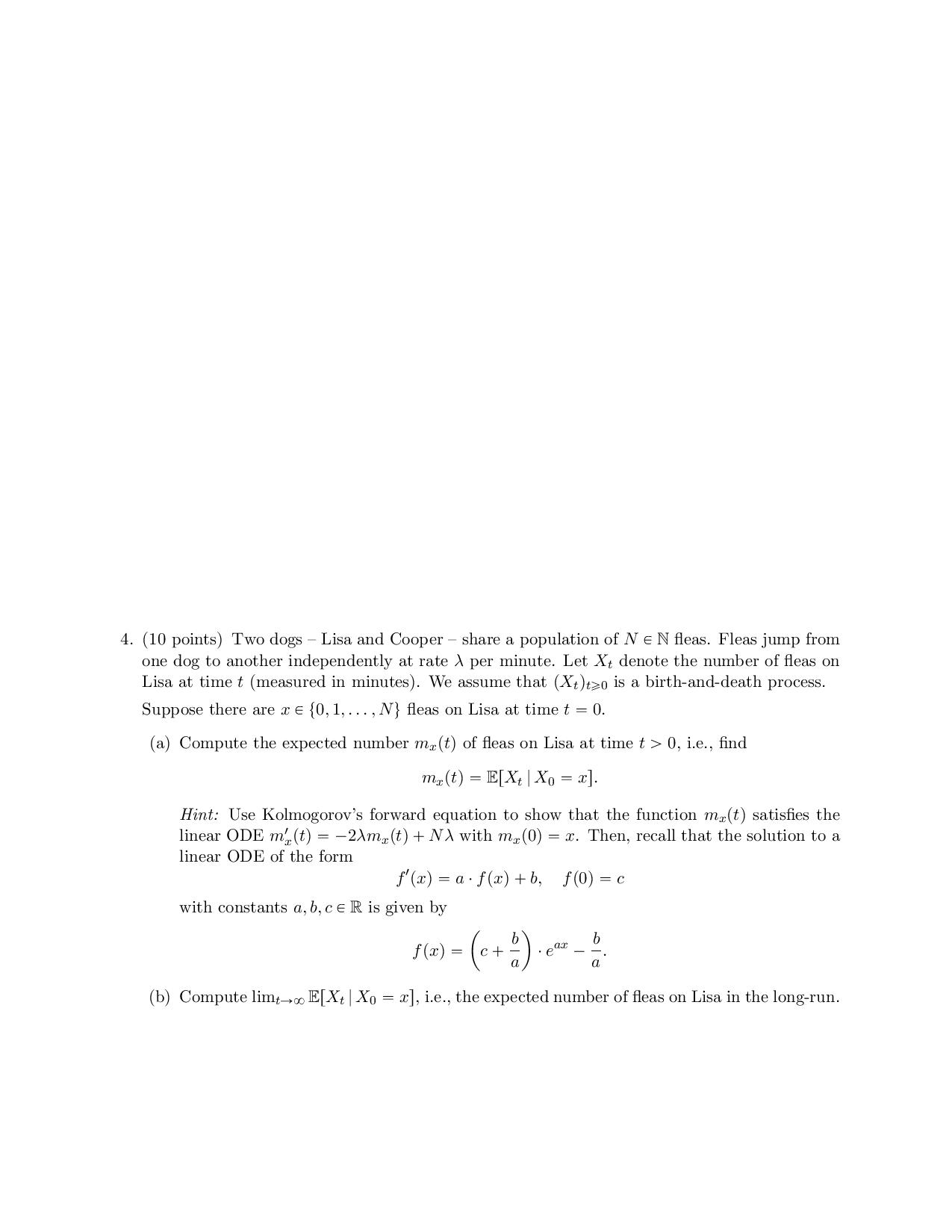
4. (10 points) Two dogs - Lisa and Cooper - share a population of N E N fleas. Fleas jump from one dog to another independently at rate A per minute. Let Xt denote the number of fleas on Lisa at time t (measured in minutes). We assume that (Xt)tzo is a birth-and-death process. Suppose there are re {0, 1,. .., N} fleas on Lisa at time t = 0. (a) Compute the expected number me(t) of fleas on Lisa at time t > 0, i.e., find mr(t) = E[Xt | Xo = x]. Hint: Use Kolmogorov's forward equation to show that the function mr(t) satisfies the linear ODE m'?(t) = -2\\m,(t) + NX with my(0) = x. Then, recall that the solution to a linear ODE of the form f'(x) = a . f(x) +b, f(0) = c with constants a, b, ce R is given by f ( x ) = ( c + 6 ) . ear - b . (b) Compute limt . E[Xt | Xo = x], i.e., the expected number of fleas on Lisa in the long-run
Step by Step Solution
There are 3 Steps involved in it

Get step-by-step solutions from verified subject matter experts
 Study Help