





Question: Please help answer DSM/N2 Case Study Background Your company hires a very expensive and reputable management consulting firm called Decision Support to shed light on

Please help answer
Please help answer DSM/N2 Case Study Background

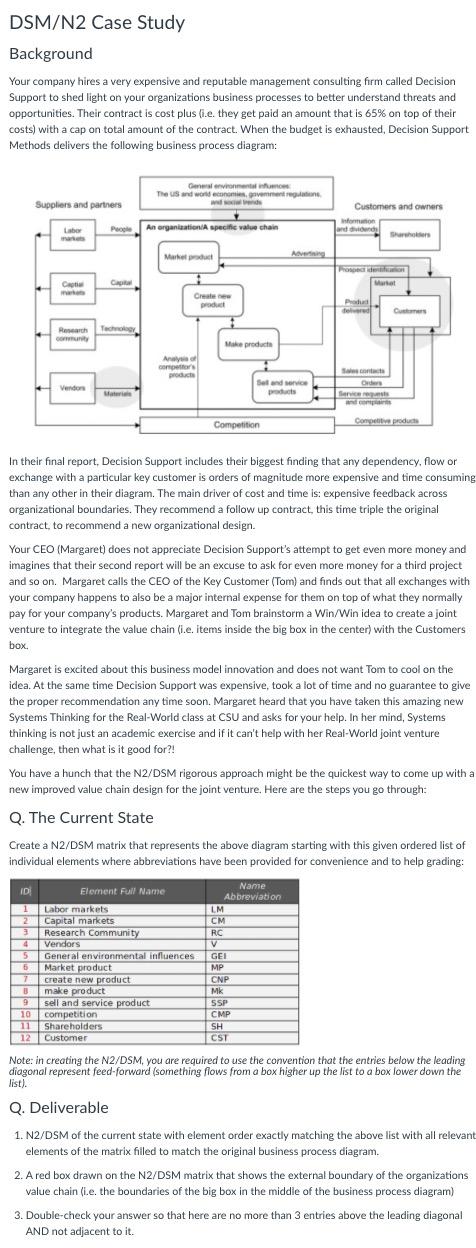
DSM/N2 Case Study Background Your company hires a very expensive and reputable management consulting firm called Decision Support to shed light on your organizations business processes to better understand threats and opportunities. Their contract is cost plus (i.e. they get paid an amount that is 65% on top of their costs) with a cap on total amount of the contract. When the budget is exhausted, Decision Support Methods delivers the following business process diagram: The US and worden gemens Suppliers and partners Customers and owners Information and unda Share Labor Pool An organisation specific value chain Market A CA Maret Crew product C Research Technology GO Mke product An como products Selv Order Vendon We Competition Competitive products a In their final report, Decision Support includes their biggest finding that any dependency, flow or exchange with a particular key customer is orders of magnitude more expensive and time consuming than any other in their diagram. The main driver of cost and time is: expensive feedback across organizational boundaries. They recommend a follow up contract, this time triple the original contract, to recommend a new organizational design. Your CEO (Margaret) does not appreciate Decision Support's attempt to get even more money and imagines that their second report will be an excuse to ask for even more money for a third project and so on. Margaret calls the CEO of the Key Customer (Tom) and finds out that all exchanges with your company happens to also be a major internal expense for them on top of what they normally pay for your company's products. Margaret and Tom brainstorm a Win/ Win idea to create a joint venture to integrate the value chain (i.e. items inside the big box in the center) with the Customers box. Margaret is excited about this business model innovation and does not want Tom to cool on the idea. At the same time Decision Support was expensive, took a lot of time and no guarantee to give the proper recommendation any time soon. Margaret heard that you have taken this amazing new Systems Thinking for the Real-World class at CSU and asks for your help. In her mind, Systems thinking is not just an academic exercise and if it can't help with her Real-World joint venture challenge, then what is it good for?! You have a hunch that the N2/DSM rigorous approach might be the quickest way to come up with a new improved value chain design for the joint venture. Here are the steps you go through: Q. The Current State Create a N2/DSM matrix that represents the above diagram starting with this given ordered list of individual elements where abbreviations have been provided for convenience and to help grading: ID Element Full Name 1 Labor markets 2 Capital markets 3 Research Community 4 Vendors 5 General environmental influences 5 Market product 7 create new product B make product 9 sell and service product 10 competition 11 Shareholders 12 Customer Name Abbreviation LM RC V GEI MP CNP MK SSP CMP SH CST Note: in creating the N2/DSM, you are required to use the convention that the entries below the leading diagonal represent feed-forward (something flows from a box higher up the list to a box lower down the list). Q. Deliverable 1. N2/DSM of the current state with element order exactly matching the above list with all relevant elements of the matrix filled to match the original business process diagram. 2. A red box drawn on the N2/DSM matrix that shows the external boundary of the organizations value chain (i.e. the boundaries of the big box in the middle of the business process diagram) 3. Double-check your answer so that here are no more than 3 entries above the leading diagonal AND not adjacent to it. DSM/N2 Case Study Background Your company hires a very expensive and reputable management consulting firm called Decision Support to shed light on your organizations business processes to better understand threats and opportunities. Their contract is cost plus (i.e. they get paid an amount that is 65% on top of their costs) with a cap on total amount of the contract. When the budget is exhausted, Decision Support Methods delivers the following business process diagram: The US and worden gemens Suppliers and partners Customers and owners Information and unda Share Labor Pool An organisation specific value chain Market A CA Maret Crew product C Research Technology GO Mke product An como products Selv Order Vendon We Competition Competitive products a In their final report, Decision Support includes their biggest finding that any dependency, flow or exchange with a particular key customer is orders of magnitude more expensive and time consuming than any other in their diagram. The main driver of cost and time is: expensive feedback across organizational boundaries. They recommend a follow up contract, this time triple the original contract, to recommend a new organizational design. Your CEO (Margaret) does not appreciate Decision Support's attempt to get even more money and imagines that their second report will be an excuse to ask for even more money for a third project and so on. Margaret calls the CEO of the Key Customer (Tom) and finds out that all exchanges with your company happens to also be a major internal expense for them on top of what they normally pay for your company's products. Margaret and Tom brainstorm a Win/ Win idea to create a joint venture to integrate the value chain (i.e. items inside the big box in the center) with the Customers box. Margaret is excited about this business model innovation and does not want Tom to cool on the idea. At the same time Decision Support was expensive, took a lot of time and no guarantee to give the proper recommendation any time soon. Margaret heard that you have taken this amazing new Systems Thinking for the Real-World class at CSU and asks for your help. In her mind, Systems thinking is not just an academic exercise and if it can't help with her Real-World joint venture challenge, then what is it good for?! You have a hunch that the N2/DSM rigorous approach might be the quickest way to come up with a new improved value chain design for the joint venture. Here are the steps you go through: Q. The Current State Create a N2/DSM matrix that represents the above diagram starting with this given ordered list of individual elements where abbreviations have been provided for convenience and to help grading: ID Element Full Name 1 Labor markets 2 Capital markets 3 Research Community 4 Vendors 5 General environmental influences 5 Market product 7 create new product B make product 9 sell and service product 10 competition 11 Shareholders 12 Customer Name Abbreviation LM RC V GEI MP CNP MK SSP CMP SH CST Note: in creating the N2/DSM, you are required to use the convention that the entries below the leading diagonal represent feed-forward (something flows from a box higher up the list to a box lower down the list). Q. Deliverable 1. N2/DSM of the current state with element order exactly matching the above list with all relevant elements of the matrix filled to match the original business process diagram. 2. A red box drawn on the N2/DSM matrix that shows the external boundary of the organizations value chain (i.e. the boundaries of the big box in the middle of the business process diagram) 3. Double-check your answer so that here are no more than 3 entries above the leading diagonal AND not adjacent to it

Step by Step Solution

There are 3 Steps involved in it

1 Expert Approved Answer
Step: 1 Unlock blur-text-image

Question Has Been Solved by an Expert!

Get step-by-step solutions from verified subject matter experts

Step: 2 Unlock
Step: 3 Unlock

Students Have Also Explored These Related General Management Questions!