







Question: I need help! How do I prove this mathmatically? 2 Extra Credit: Collatz Conjecture (10 points) The Collatz sequence starting at n is a sequence
I need help! How do I prove this mathmatically?
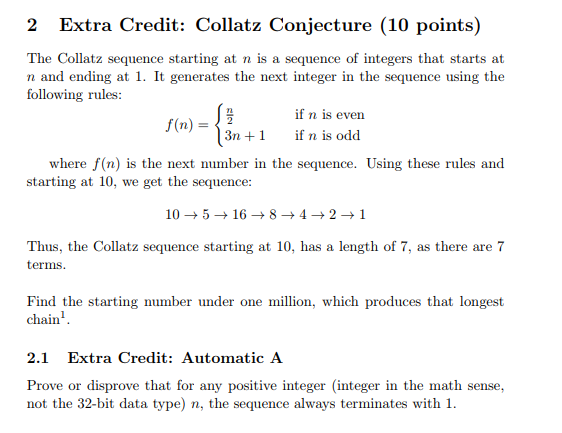
2 Extra Credit: Collatz Conjecture (10 points) The Collatz sequence starting at n is a sequence of integers that starts at n and ending at 1. It generates the next integer in the sequence using the following rules if n is even f n is odd f(n) 3n + 1 where f(n) is the next number in the sequence. Using these rules and starting at 10, we get the sequence: 10516-8-42-1 Thus, the Collatz sequence starting at 10, has a length of 7, as there are 7 Find the starting number under one million, which produces that longest chain 2.1 Extra Credit: Automatic A Prove or disprove that for any positive integer (integer in the math sense, not the 32-bit data type) n, the sequence always terminates with 1. 2 Extra Credit: Collatz Conjecture (10 points) The Collatz sequence starting at n is a sequence of integers that starts at n and ending at 1. It generates the next integer in the sequence using the following rules if n is even f n is odd f(n) 3n + 1 where f(n) is the next number in the sequence. Using these rules and starting at 10, we get the sequence: 10516-8-42-1 Thus, the Collatz sequence starting at 10, has a length of 7, as there are 7 Find the starting number under one million, which produces that longest chain 2.1 Extra Credit: Automatic A Prove or disprove that for any positive integer (integer in the math sense, not the 32-bit data type) n, the sequence always terminates with 1
Step by Step Solution
There are 3 Steps involved in it

Get step-by-step solutions from verified subject matter experts
 Study Help