







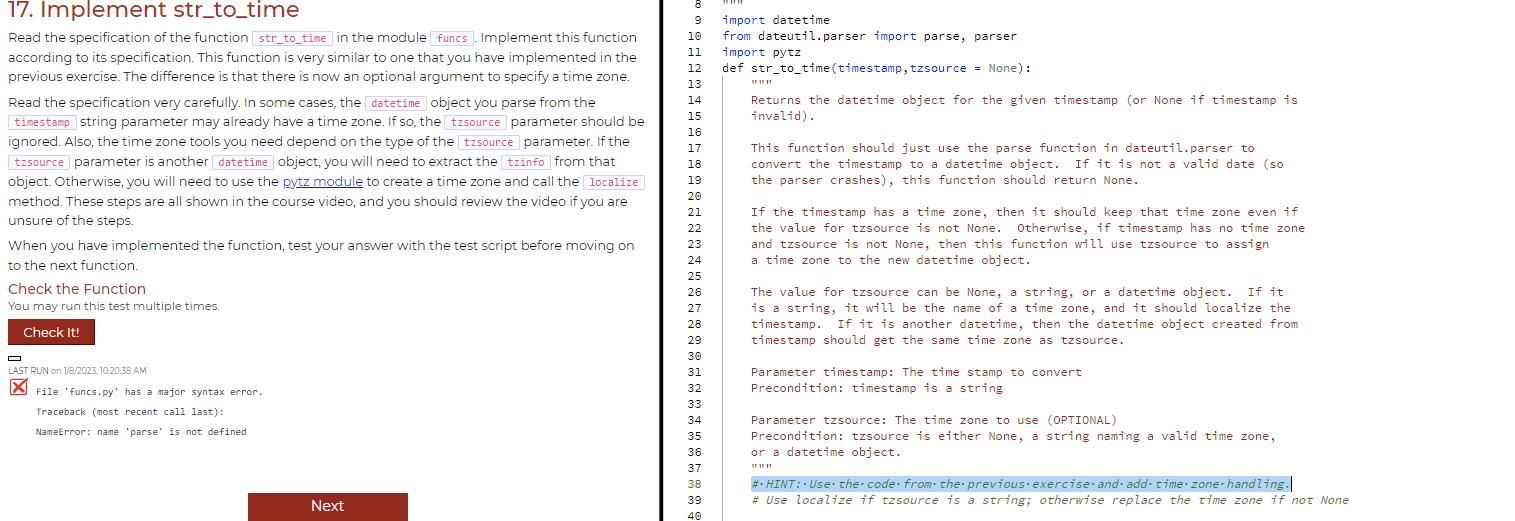
Question: I need help implementing def str_to_time(timestamp, tzsource = none) Returns the datetime object for the given timestamp (or None if timestamp is invalid). This function
I need help implementing def str_to_time(timestamp, tzsource = none)
Returns the datetime object for the given timestamp (or None if timestamp is
invalid).
This function should just use the parse function in dateutil.parser to
convert the timestamp to a datetime object. If it is not a valid date (so
the parser crashes), this function should return None.
If the timestamp has a time zone, then it should keep that time zone even if
the value for tzsource is not None. Otherwise, if timestamp has no time zone
and tzsource is not None, then this function will use tzsource to assign
a time zone to the new datetime object.
The value for tzsource can be None, a string, or a datetime object. If it
is a string, it will be the name of a time zone, and it should localize the
timestamp. If it is another datetime, then the datetime object created from
timestamp should get the same time zone as tzsource.
Parameter timestamp: The time stamp to convert
Precondition: timestamp is a string
Parameter tzsource: The time zone to use (OPTIONAL)
Precondition: tzsource is either None, a string naming a valid time zone,
or a datetime object.
# HINT: Use the code from the previous exercise and add time zone handling.
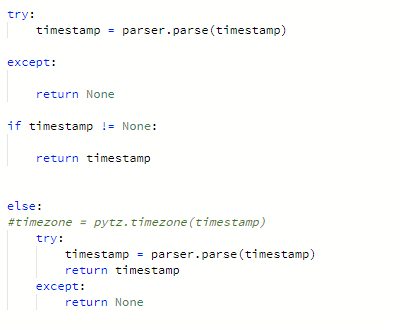
THIS IS MY CODE FROM THE PREVIOUS EXAMPLE
 So basically, I need my other code to do this problem and I am having issues implementing it.
try: timestamp = parser.parse(timestamp) except: return None if timestamp : = None: return timestamp else: \#timezone = pytz.timezone (timestamp) try: timestamp = parser.parse(timestamp) return timestamp except: return None
Step by Step Solution
There are 3 Steps involved in it

Get step-by-step solutions from verified subject matter experts
 Study Help